
Building Companies Between Markets and Cultures
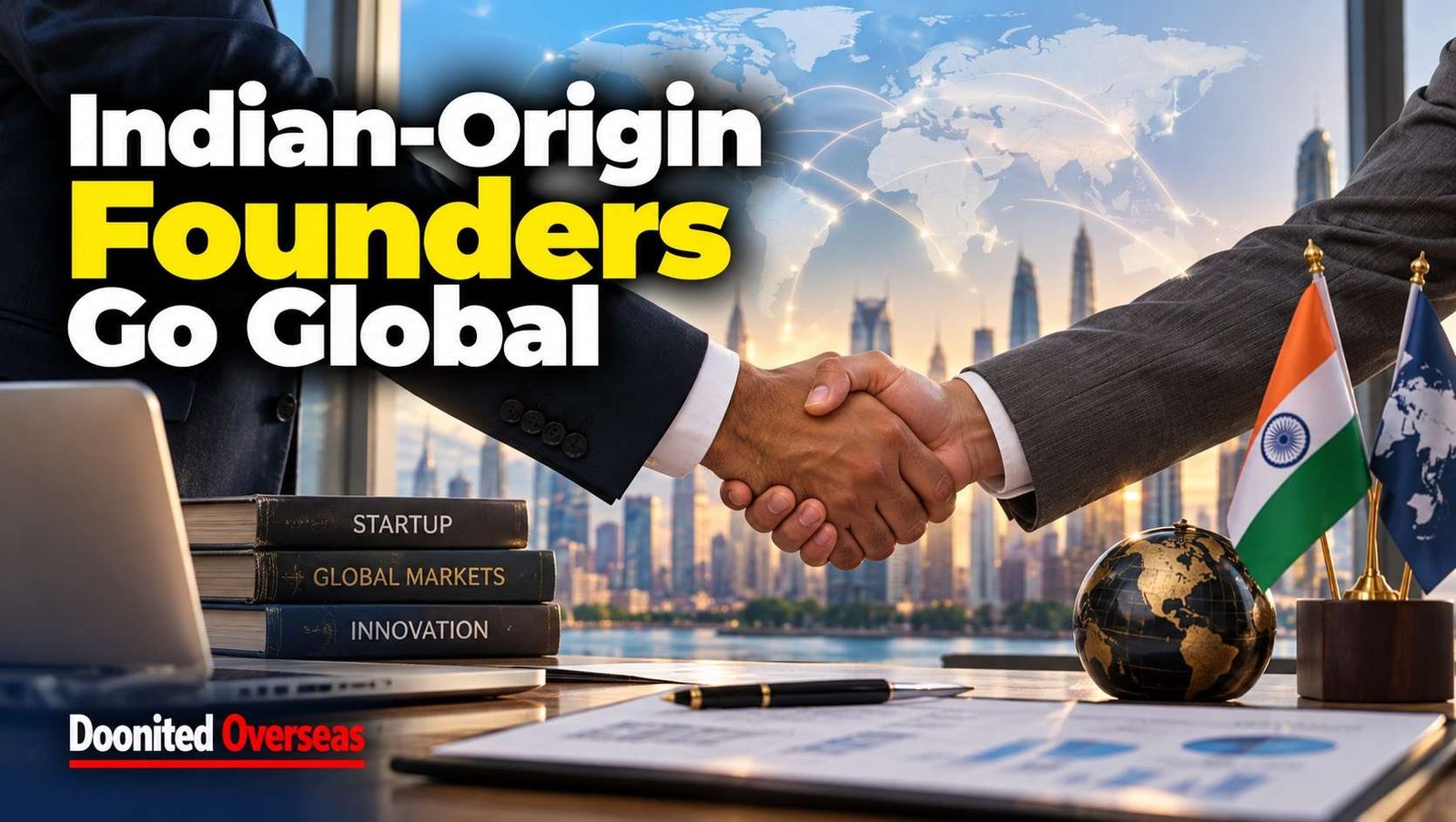
Indian-origin entrepreneurs are building companies that connect talent, capital and customers across borders. New research puts their contribution to global startup value in sharp focus, while academic studies reveal a more complicated story behind the success: access to diaspora networks can help a young business grow, but immigration rules, hiring practices, cultural differences and the demands of operating across jurisdictions can shape its future.
For Indian-origin founders abroad, the business opportunity often begins with a connection between markets. It might be technical talent with roots in India, customers in North America, suppliers in Asia or investors who understand more than one business environment. These connections can help a company cross borders—but they do not remove the friction of building a business in a country where its founder may still be learning the rules.
A new Indian Diaspora Index from technology investor Prosus and startup data platform Dealroom offers a striking measure of the scale. Its analysis identifies 205 current and former overseas unicorns with at least one founder who grew up in India, attributing approximately US$560 billion in company value to those founders using a founder-share calculation. The index says 187 of these companies—about 91%—are based in the United States. The figure is not the founders’ personal wealth, nor does it mean they own that proportion of the companies today.
The numbers capture one part of a much broader diaspora business story. Beyond high-profile technology companies, immigrant entrepreneurship includes small firms, professional services, manufacturers, retailers and businesses that serve customers in more than one country. Their paths to growth can be very different.
For DOONITED OVERSEAS readers, the central question is not simply how many successful founders have Indian roots. It is how they build businesses between markets—and what helps or hinders that process.
The diaspora network: a bridge, not a business model
A founder’s connection to a diaspora community can provide an early advantage. Trusted contacts may help identify employees, introduce customers, explain local business customs or point a newcomer towards professional advisers. For a young company without an established reputation, such relationships can lower the cost of finding people and opportunities.
But networks are not a substitute for a business model. A company still needs customers willing to pay, a product that solves a real problem, sound financial management and the ability to deliver consistently.
Research by Mallika Banerjee, published in Entrepreneurship Theory and Practice, examines how immigrant founders’ choices about hiring can shape the design and evolution of their businesses. The study followed 11 foreign-born entrepreneurs and eight information-technology ventures in a US community, drawing on fieldwork and records over several years.
Its findings complicate the familiar idea that ethnic networks are simply an advantage. Some founders relied on talent recruited through home-country or community connections, while others focused more on attracting clients and hiring through the wider market. These different approaches were associated with distinct business models and different relationships between owners and employees.
The study is valuable because it looks closely at how companies actually operate. But its small, specific sample—IT firms in one US community, with founders who migrated in the 1990s or early 2000s—cannot represent every Indian-origin entrepreneur or today’s entire startup ecosystem. Its insights are best treated as a lens through which to examine business choices, not as a universal formula.
When community hiring creates both opportunity and risk
Recruiting through trusted networks can help a founder find people with relevant skills, shared language or familiarity with the company’s market. It may also create opportunities for workers whose qualifications or experience are not immediately recognised by employers in the host country.
Yet the same relationships can create imbalances. If an employer controls a worker’s immigration sponsorship, employment and access to future opportunities, the worker may have limited bargaining power. Banerjee’s research describes cases in which heavy reliance on co-ethnic employees and employer control shaped business models in ways that could harm workers’ well-being and attract scrutiny.
This is a crucial distinction: a business can benefit from a community network while still needing strong safeguards for the people within it. Shared background does not automatically mean equal power, fair pay or secure employment.
For founders, the practical lesson is to build transparent employment practices from the beginning. Written contracts, clear pay arrangements, lawful immigration and employment procedures, and a genuine ability for workers to raise concerns are not merely compliance tasks. They help establish the trust and reputation a growing company needs.
For employees considering an offer from a diaspora-owned business, the same principle applies in reverse: assess the role, contract, compensation, visa implications and reporting arrangements—not only the comfort of a shared cultural background.
The border is also a regulatory boundary
A company operating across countries must navigate more than time zones. Incorporation, taxation, employment law, data protection, intellectual property, financial reporting and immigration rules may differ between jurisdictions. The details depend on where the business is established, where it hires, where customers are located and what activities it conducts.
Immigration status is particularly important for founders who initially move abroad as students or employees. The right to work for an employer does not necessarily include the right to operate a business or become self-employed. The OECD’s review of migrant entrepreneurship notes that many countries restrict business activity under certain work permits, while others provide specific entrepreneur routes or allow broader activity under particular statuses.
There is no single “Indian founder visa” that applies worldwide. Entrepreneurs should obtain advice relevant to their actual status and destination before taking on paid work, hiring staff or restructuring a company. A business plan that is commercially sound can still fail if its operating arrangements conflict with local rules.
The challenge grows when a company expands. A founder may need local legal and accounting support, reliable systems for managing teams in different time zones, and clear decisions about which activities belong in which country. Cross-border operations can open markets, but they also multiply the places where a company can make costly mistakes.
India’s manufacturing ambitions create another connection
The diaspora story is not limited to software and venture-backed startups. India’s industrial ambitions also create potential links between overseas founders, investors, buyers, technology providers and domestic manufacturers.
In its August 2026 report, Key Sectors to Position India as a Global Manufacturing Hub, NITI Aayog, working with CRISIL Intelligence, examined sectors including chemicals, textiles, solar photovoltaic manufacturing, and telecom and networking products. The report identifies opportunities for stronger participation in global value chains, while also discussing constraints such as critical-input dependence, infrastructure and logistics gaps, technology limitations and skills shortages.
That report is about India’s manufacturing ecosystem; it does not establish that diaspora founders are already solving these challenges. But it points to areas where cross-border business relationships may be relevant. Overseas entrepreneurs can potentially connect Indian suppliers with foreign customers, bring market knowledge to partnerships, or help companies understand the expectations of buyers in different countries.
The opportunity must be assessed sector by sector. A relationship or introduction is not the same as a confirmed investment, export contract or technology transfer. Sustainable partnerships require commercial due diligence, credible counterparties and a clear understanding of regulatory requirements in both markets.
What aspiring founders should take from the evidence
The recent index demonstrates the scale of value associated with India-raised founders abroad. The academic research shows why the path to building a company is more complex than a headline valuation suggests. Together, they point to several practical considerations:
Use networks to open doors, not to avoid the market. Validate demand with customers beyond a familiar community.
Build a balanced team. Combine trusted relationships with skills, experience and perspectives sourced from the wider market.
Treat immigration and employment compliance as core operations. Confirm what the founder and each employee are legally permitted to do.
Make cross-border costs visible. Account for professional advice, taxes, currency exposure, logistics and the management burden of multiple jurisdictions.
Protect the people who help build the company. Fair employment practices support both worker welfare and long-term credibility.
The most important distinction is between having access to a network and knowing how to use it responsibly. Networks can help a company get started; they cannot guarantee product-market fit, regulatory compliance or lasting growth.
A global business identity, built one decision at a time
Indian-origin founders abroad are part of a wider story of migration, skill, ambition and economic connection. Their companies can create jobs in host countries, build relationships with India and connect markets that might otherwise remain distant. The value attributed to overseas unicorns is one visible measure of that contribution, though it captures only a narrow segment of diaspora enterprise.
The next generation of cross-border businesses will need more than international reach. They will need credible governance, adaptable teams, fair employment and a realistic understanding of the rules in every market they enter.
For founders, the diaspora can be a powerful starting point. For a business to endure, however, community connections must evolve into a professional organisation capable of earning trust across cultures—and across borders.


World Beyond the News
Birds Can Navigate Using Earth’s Magnetic Field
Several bird species can sense Earth’s magnetic field, helping them navigate during long-distance migration.
Fermentation Is a Global Food Tradition
People across continents have used fermentation for centuries to preserve food and create distinctive flavours.
Modern Batteries Store Energy Chemically
Rechargeable batteries repeatedly move ions between electrodes, allowing electrical energy to be stored and released.
Why Songs Become Global Hits
Streaming platforms, short-form video, playlists and international collaborations can rapidly carry music across borders.