
Hong Kong Sixes: How India Is Helping Cricket Build a New Global Audience
As India returns to the Hong Kong Sixes in October, the six-a-side tournament is expanding to 12 teams, a larger fan park and a stronger India-facing commercial strategy—offering a glimpse of how cricket is trying to grow beyond its traditional markets.
Cricket’s global expansion is often discussed in terms of World Cups, billion-dollar leagues and Olympic ambitions. But sometimes the more revealing experiment takes place on a much smaller field.
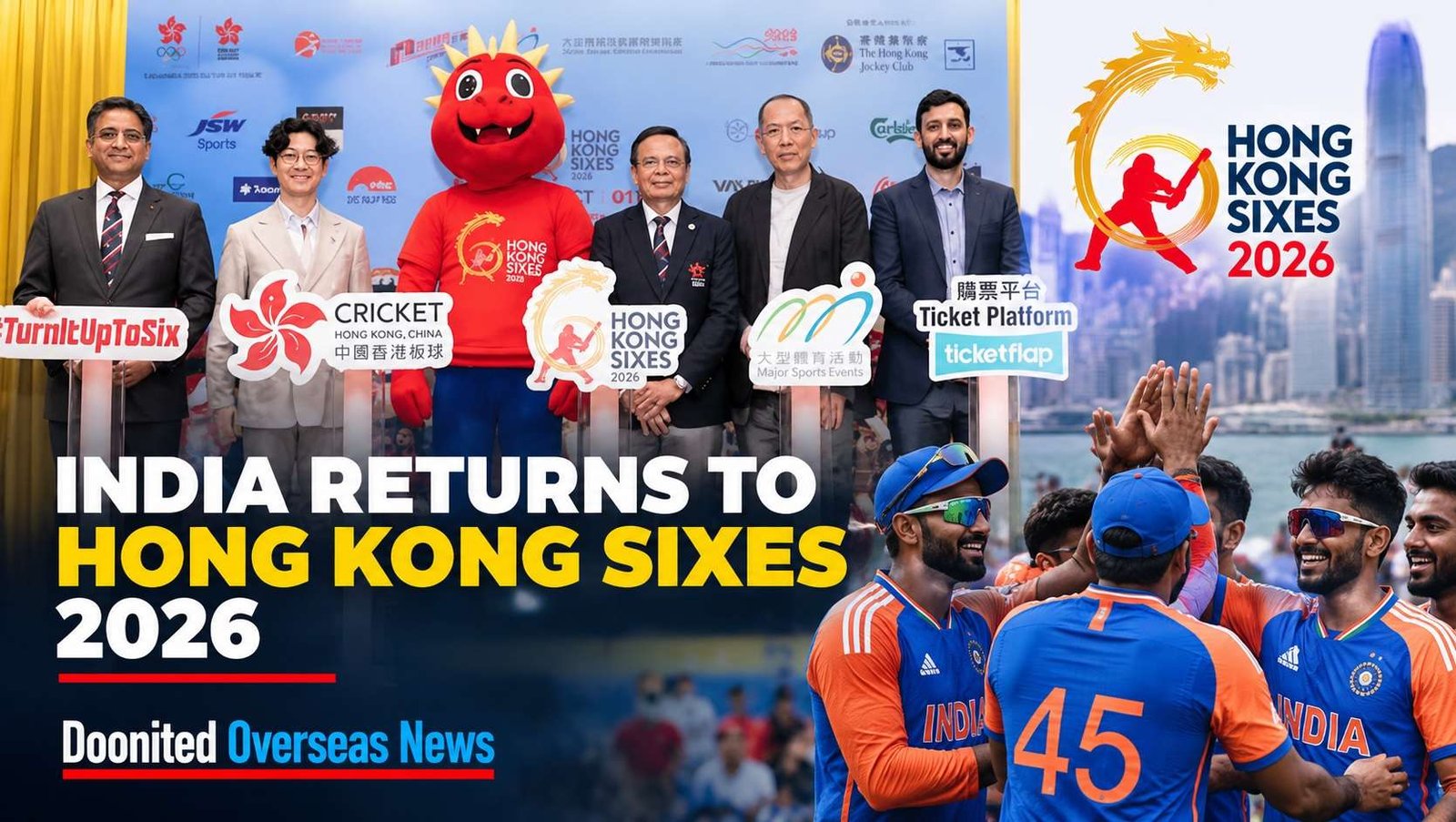
The Hong Kong Sixes, returning from 30 October to 1 November 2026, is one such experiment.
The tournament will bring together 12 international teams, including India, Pakistan, Australia, England, Sri Lanka, Bangladesh, South Africa, Afghanistan, Oman, UAE, Hong Kong China and Scotland. Matches will be played at Tin Kwong Road Recreation Ground in Hong Kong under the deliberately compressed six-a-side format. ETSports.com
India’s participation is particularly significant.
Led by veteran fast bowler Bhuvneshwar Kumar, India’s squad includes experienced players such as Krunal Pandya, Shashank Singh, Rahul Tewatia, Nitish Rana, Rahul Tripathi and T. Natarajan. Their presence gives the tournament a connection to the Indian Premier League ecosystem—and, potentially, to one of cricket’s largest audiences.
But the interesting story is not simply whether India wins.
It is why a Hong Kong tournament is increasingly looking to India to help build its international audience.
A small format with a big commercial question
Six-a-side cricket is almost the opposite of Test cricket.
There are fewer players, fewer overs and little room for slow accumulation. Matches are designed around rapid scoring, aggressive batting and constant action.
That makes the format easier to package for spectators who may not have grown up watching five-day cricket.
The Hong Kong Sixes has a long history, dating back to 1992, and has previously featured some of the sport’s biggest names. According to the International Cricket Council, former participants have included Brian Lara, Sachin Tendulkar, the Waugh brothers, Viv Richards, Andrew Flintoff, Adam Gilchrist and Wasim Akram. The tournament has also channelled profits back into cricket development in Hong Kong. icc
The 2026 edition is attempting to build on that heritage.
The expansion to 12 teams, a larger fan park and a stronger community programme represents an effort to turn the tournament into more than a compact exhibition competition.
It is becoming a sports-entertainment property.
And India is central to that strategy.
Why India matters so much
India’s importance to world cricket is obvious at the elite level.
The country has the world’s largest cricket audience, an enormous domestic commercial ecosystem and the Indian Premier League, which has become one of the sport’s most influential professional competitions.
But India’s influence is not restricted to matches played inside India.
Indian viewers, sponsors, broadcasters and diaspora communities have helped create audiences for cricket far beyond the traditional Test-playing countries.
The Hong Kong Sixes is therefore trying to connect a local Asian sporting event with a much larger international cricket audience.
The reported involvement of Sony Sports as an Indian broadcast partner and JSW Sports as commercial partner underlines that strategy. ETSports.com
That is commercially important for Hong Kong.
A tournament can be played in Hong Kong, but its economic potential is not limited to the people physically sitting in the stadium.
Broadcast audiences, digital engagement, sponsorship, hospitality and tourism can extend the value of the event across borders.
India gives the tournament access to precisely that kind of scale.
Why Bhuvneshwar Kumar is an interesting choice
India’s captain for the tournament, Bhuvneshwar Kumar, represents an important bridge between established international cricket and the newer entertainment-driven format.
He has played extensively at international level and in the IPL, where his expertise in swing bowling and variations made him one of India’s most recognisable white-ball bowlers.
In a six-a-side tournament, experience can be particularly valuable.
There is little time to recover from a poor over.
A bowler cannot simply settle into a long spell.
A batter cannot spend several overs assessing conditions.
Every delivery has greater immediate importance.
That makes experienced short-format players commercially attractive to a tournament trying to deliver fast-paced cricket to a broad audience.
India’s squad also contains players familiar to IPL viewers.
For Hong Kong organisers, that matters because recognition can help convert a cricket-curious audience into an engaged audience.
Hong Kong is more than a venue
The tournament’s significance also needs to be considered from Hong Kong’s perspective.
Hong Kong has a long cricket history but operates in a sporting environment dominated by football, basketball and other international sports.
Cricket’s challenge is therefore not merely to produce good players.
It is to create local relevance.
The expanded fan park and community programme are important in that context.
A successful international sports event should ideally leave something behind: young people introduced to the sport, local participation, coaching opportunities, community activity and commercial interest.
The Hong Kong Sixes has historically directed profits toward cricket development in Hong Kong, giving the tournament a connection between elite entertainment and grassroots development. icc
That is a model worth watching.
If the 2026 expansion succeeds, Hong Kong could demonstrate how a relatively small cricket market can use an international event to build participation and visibility.
India’s diaspora adds another layer
There is also a direct Overseas Indian dimension.
Hong Kong has a long-established Indian-origin community, including families with roots in Gujarat, Sindh, Punjab and other parts of South Asia.
For many members of the diaspora, cricket is more than entertainment.
It is a cultural connection.
That creates an interesting ecosystem around an event such as the Hong Kong Sixes.
An Indian family living in Hong Kong can potentially experience the tournament simultaneously as:
- an international sporting event,
- a connection with Indian cricket,
- a community gathering,
- and a local Hong Kong event.
This is precisely the kind of intersection that makes overseas Indian stories relevant to Doonitednews.in.
The story isn’t simply that Indian cricketers are playing abroad.
It is that Indian sporting culture can become part of the social and commercial fabric of another country.
Cricket’s globalisation is no longer just about the World Cup
There is a larger trend behind the Hong Kong experiment.
The ICC Men’s T20 World Cup has expanded from 12 teams in its inaugural 2007 edition to 20 teams, while the 2024 tournament brought an ICC event to the United States for the first time. The 2026 tournament also includes Italy as a debutant. icc
Cricket is therefore experimenting with different ways to reach new audiences.
There are global tournaments.
There are franchise leagues.
There are shorter formats.
There are fan parks.
And cricket is also returning to the Olympic programme, with men’s and women’s T20 events scheduled for Los Angeles 2028. The ICC says six men’s and six women’s teams will participate, with 28 matches in total. icc
The Hong Kong Sixes fits into this broader transformation.
It offers a version of cricket that is:
shorter, faster, easier to schedule and easier to package as entertainment.
That doesn’t mean sixes cricket will replace T20 or traditional cricket.
It doesn’t need to.
Its potential value is as an entry point.
The real test: can the audience become local?
This is where the Hong Kong experiment faces its biggest challenge.
Indian viewers are already passionate about cricket.
Bringing Indian players to Hong Kong can generate attention.
But sustainable international growth requires something more difficult:
local people becoming cricket fans and participants.
A tournament can attract spectators because India is playing.
That does not necessarily mean those spectators will follow Hong Kong cricket after the event.
For the sport to grow, the commercial excitement around the tournament must translate into youth programmes, local clubs, coaching, schools and pathways for Hong Kong players.
That is why the community programme may ultimately matter more than the fan park.
The spectacle attracts people.
Grassroots development gives them a reason to stay.
India can be both participant and growth engine
There is an interesting reversal taking place in international cricket.
Historically, cricket travelled from Britain to different parts of the world.
Today, India’s cricket economy is becoming one of the forces helping cricket travel further.
The Indian Premier League has created a generation of players who are comfortable with short formats, international teammates and highly commercial sporting environments.
Indian broadcasters bring enormous audiences.
Indian sponsors bring commercial capital.
Indian diaspora communities provide cultural connections.
And Indian players provide recognisable sporting personalities.
The Hong Kong Sixes is using all four.
That makes India’s participation much more consequential than the number of matches it will play.
The bigger opportunity for Hong Kong
The 2026 Hong Kong Sixes will ultimately be judged by more than its final scorecard.
If the tournament can combine Indian cricket’s enormous audience appeal with Hong Kong’s local sporting infrastructure, it could create a sustainable model for cricket development in a non-traditional market.
That would be a meaningful achievement.
India, meanwhile, gets another opportunity to participate in the internationalisation of its favourite sport—not merely by winning trophies, but by helping create audiences and commercial ecosystems in places where cricket is still competing for attention.
And that may be the most interesting development of all.
The future of cricket’s global expansion may not always begin with another World Cup. Sometimes it may begin with six players, a short match, a local community—and a large Indian audience watching from thousands of kilometres away.


World Beyond the News
Octopuses Can Change Their Appearance
Octopuses can rapidly alter their skin colour and texture to communicate, camouflage themselves and respond to danger.
Some Cities Exist Across Two Continents
A small number of cities are geographically associated with two continents, creating unusual cultural and geographic identities.
Earth’s Climate Is Measured in Many Ways
Scientists track temperature, atmospheric gases, sea level, ice cover and other indicators rather than relying on a single climate number.
Streaming Changed How Audiences Discover Shows
Recommendation systems and global streaming releases allow audiences to discover programmes far beyond their original markets.