
Geeta K. Swamy: The Indian-American Physician-Scientist Taking Women’s Health Leadership to Boston University
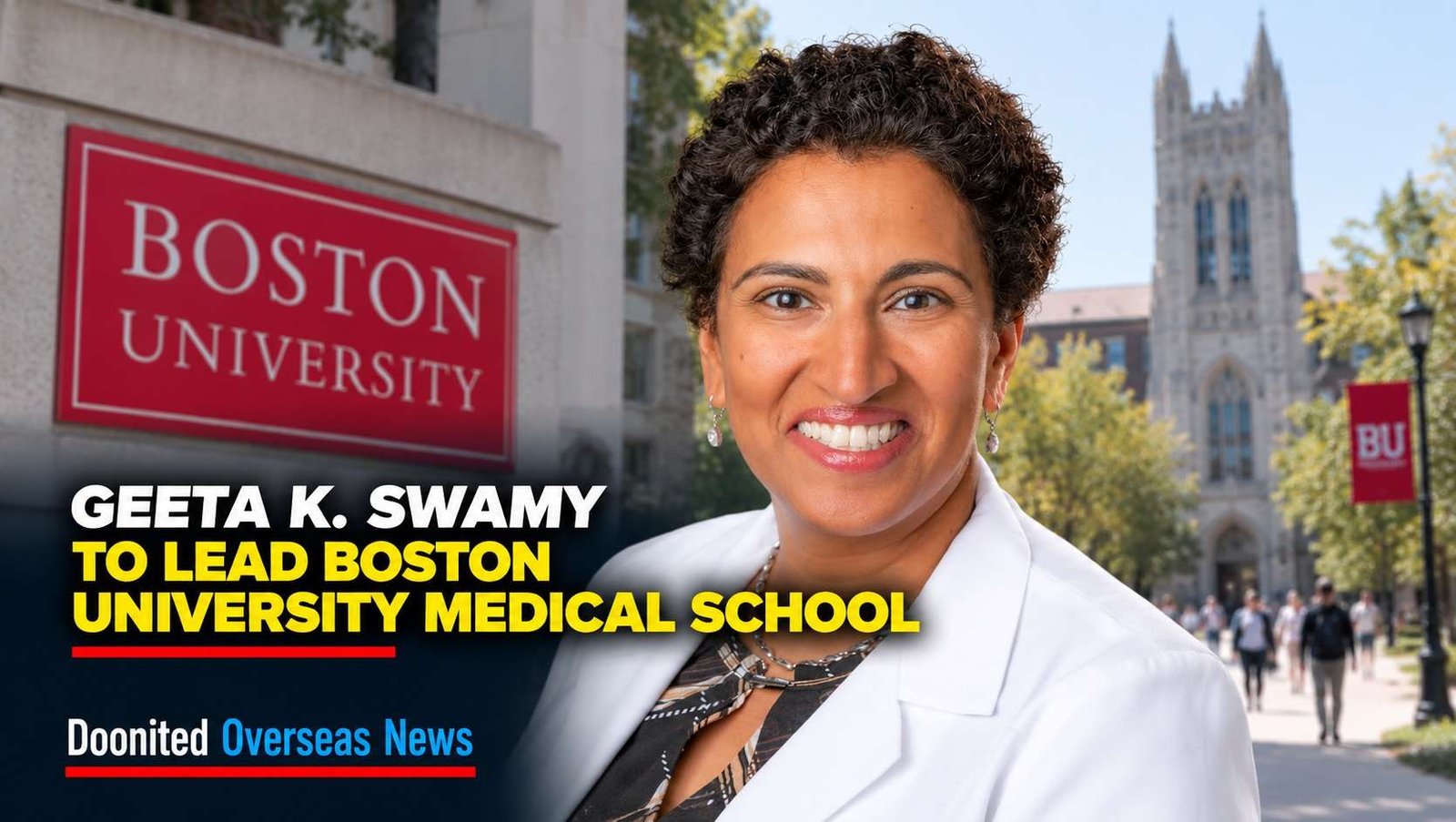
After more than two decades at Duke University, physician-scientist Geeta K. Swamy will become the 19th dean of Boston University’s Chobanian & Avedisian School of Medicine in January 2027, bringing a career spanning maternal-fetal medicine, vaccine research, scientific integrity and academic leadership.
The next chapter of Geeta K. Swamy’s career will take her from one of America’s leading research universities to another—but the significance of the move extends well beyond an academic appointment.
On January 1, 2027, Swamy will become dean of Boston University’s Chobanian & Avedisian School of Medicine, succeeding interim dean Hee-Young Park and becoming the medical school’s 19th leader. She joins Boston University after more than two decades at Duke University, where she has built a career combining clinical medicine, women’s-health research, vaccine science and increasingly senior leadership of a major academic research enterprise. Boston University
For the Indian-American community, her appointment is another example of diaspora professionals reaching senior positions not only in corporate America and technology, but in the institutions that shape medical education, research and public health.
Swamy’s story is particularly notable because her influence has been built at the intersection of patient care, scientific research and institutional leadership.
From medical training to maternal-fetal medicine
Swamy earned a bachelor’s degree in public health and biostatistics and her medical degree from the University of North Carolina at Chapel Hill. She completed her obstetrics and gynecology residency at the University of Pittsburgh before undertaking a fellowship in maternal-fetal medicine at Duke.
Her decision to specialise in obstetrics and gynecology was reinforced during medical training.
A 2019 Duke profile recalled that, during an early clinical rotation, Swamy drove through a major snowstorm to reach her assignment at WakeMed Hospital. The experience gave her an unexpected opportunity to participate in nine deliveries and helped confirm her decision to pursue obstetrics and gynecology. Duke University School of Medicine
At Duke, her scientific work developed around some of the most complicated questions in pregnancy and maternal health.
Her research has focused particularly on perinatal infections, maternal immunization, preterm birth and complications of pregnancy. Duke identifies her as a clinician-scientist in maternal-fetal medicine and a member of the Duke Human Vaccine Institute. Scholars@Duke
That combination of clinical experience and research would eventually become the foundation for a much broader leadership role.
Research that connects mothers, babies and vaccines
Swamy’s scientific career has included work on infectious diseases during pregnancy and the development and evaluation of vaccines.
Duke says she has been involved in research involving influenza, pertussis and respiratory syncytial virus, and has served as a consultant to the World Health Organization on evaluating vaccine immunogenicity, safety and efficacy in pregnant women.
Her research also became especially relevant during the COVID-19 pandemic.
Swamy was a co-investigator on Duke’s COVID-19 vaccine trial and studied vaccine safety and efficacy in pregnant women—an important area because pregnant people were initially underrepresented in many clinical studies, while pregnancy itself creates distinctive medical considerations.
Her broader research has also examined how environmental, social and political factors can affect health outcomes for women and children.
This is where her career becomes particularly relevant to contemporary global health.
Women’s health is not simply a question of developing new medicines. It also involves ensuring that clinical research includes women appropriately, that evidence is reliable, that pregnancy is considered in vaccine and treatment research, and that discoveries move successfully from laboratories into clinical practice.
From scientist to institutional leader
Over more than 20 years at Duke, Swamy gradually expanded beyond her own research programme.
She joined Duke as an assistant professor in 2004 and subsequently became a professor, director of the Duke Perinatal Research Center, vice dean for scientific integrity, associate vice provost and eventually Executive Vice Dean for Clinical Sciences and Research Administration and Associate Vice President for Research. Scholars@Duke
These roles placed her in charge of far more than individual scientific projects.
Duke says her responsibilities have included research administration, sponsored grants and contracts, human research, research quality, compliance, scientific integrity, conflicts of interest and institutional research operations.
That experience is likely to be central to her new job.
A modern medical-school dean is not simply an academic figurehead. The position involves balancing education, clinical relationships, research funding, faculty recruitment, institutional governance and partnerships with health systems.
Swamy has already spent years working across those boundaries.
Why Boston University chose her
Boston University’s announcement makes clear that Swamy’s appointment comes at an important institutional moment.
The university and Boston Medical Center Health System have been working to strengthen their partnership, with an emphasis on research, medical education and patient care. BU says Swamy’s experience connecting a medical school, university and health system was an important qualification for the role.
That is particularly significant because Boston Medical Center serves a large and diverse urban population, including many patients from underserved communities.
Swamy has said that one of the attractions of the position was the opportunity to connect the medical school more deeply with Boston University, Boston Medical Center and the wider Boston community while strengthening interdisciplinary discovery.
Her mandate will therefore extend beyond laboratory research.
She will lead the medical school’s education and research missions, work with faculty and students, and collaborate with Boston Medical Center leadership on the institutions’ shared priorities.
A particularly important moment for women’s health
Swamy is arriving at a time when women’s health is receiving increasing attention in biomedical research.
Historically, many areas of women’s health have received less research investment and visibility than their societal importance would suggest. Boston University itself recently received a Massachusetts Life Sciences Center grant for research into historically underexamined women’s-health conditions, according to BU.
That makes Swamy’s background unusually well matched to the school’s current direction.
Her research has concentrated on maternal and reproductive health, while her administrative career has involved building systems that allow research to be conducted responsibly and efficiently.
The combination could allow her to approach women’s health not simply as a clinical specialty, but as a broader research and institutional priority.
Scientific integrity is part of the story
Another less visible aspect of Swamy’s career may prove equally important.
She has held senior responsibilities for scientific integrity and research compliance at Duke.
That work concerns issues that rarely make headlines when research is going well: whether studies are conducted according to appropriate standards, whether evidence can be trusted, whether research participants are protected and whether institutions maintain confidence in the scientific process.
In an era of misinformation, declining public trust in some institutions and rapidly expanding biomedical technologies, those questions have become central to medicine.
A medical school needs talented researchers.
But it also needs systems capable of ensuring that the research it produces is credible.
Swamy’s career has included both.
The Indian-American dimension
Indian-American physicians have long played an important role in the U.S. healthcare system, but Swamy’s appointment represents a different level of institutional influence.
She is moving into the leadership of a major American medical school after building a substantial career within another elite research institution.
Her Indian-American identity has been highlighted by Indian-American and diaspora media following the Boston University announcement. India Weekly
At the same time, the strongest evidence for her professional significance comes from the institutions where she has worked: Duke describes her as an internationally recognised clinician-researcher, while Boston University emphasises her record in medicine, research administration and academic leadership.
That distinction matters.
Her story should not be reduced to an identity milestone. The diaspora significance lies precisely in the substance of the career behind the appointment.
She has moved from clinical training to scientific investigation, from research leadership to institutional governance—and now to the top leadership position at another major medical school.
What her appointment means beyond Boston
Swamy’s move also illustrates a broader trend in the global Indian professional community.
The first generation of Indian-origin professionals who established themselves in Western institutions often became visible through individual professions—medicine, engineering, academia or business.
The next stage is institutional leadership.
These professionals are increasingly helping determine which research gets prioritised, how universities train future professionals, how health systems collaborate and how scientific institutions engage with society.
Swamy’s appointment belongs to that second category.
Her challenge at Boston University will be substantial. Medical schools face rising research costs, competition for scientific talent, pressure to translate discoveries into clinical impact, complex relationships with health systems and the continuing need to improve access and equity.
But her career has prepared her for precisely that kind of complexity.
From caring for individual patients to leading an institution
There is an appealing symmetry in Swamy’s career.
Early in her medical training, she discovered her calling by helping deliver babies during a difficult clinical rotation.
Years later, she became a researcher studying the infections, vaccines and pregnancy complications that affect mothers and children.
Then she moved into leadership roles concerned with the integrity and infrastructure of medical research.
Now she is preparing to lead an entire medical school.
The scale has changed dramatically, but the underlying mission has remained remarkably consistent: improving health by connecting clinical care, evidence and the institutions that make better medicine possible.
For the Indian-American diaspora, Geeta K. Swamy’s appointment is therefore more than a senior academic promotion.
It is a reminder that diaspora influence increasingly operates at the highest levels of the institutions that shape the future of medicine.
On January 1, 2027, her new chapter begins in Boston.
The larger question will be what she builds there.

World Beyond the News
Birds Can Navigate Using Earth’s Magnetic Field
Several bird species can sense Earth’s magnetic field, helping them navigate during long-distance migration.
Fermentation Is a Global Food Tradition
People across continents have used fermentation for centuries to preserve food and create distinctive flavours.
Modern Batteries Store Energy Chemically
Rechargeable batteries repeatedly move ions between electrodes, allowing electrical energy to be stored and released.
Why Songs Become Global Hits
Streaming platforms, short-form video, playlists and international collaborations can rapidly carry music across borders.