
Mahindra’s Global Journey: How an Indian Automaker Built — and Refined — Its International Portfolio
From Italian automotive design and Turkish tractors to South Korean SUVs and Finnish harvesters, Mahindra’s overseas expansion has been an ambitious attempt to build a global mobility and farm-equipment business. But its more recent exits show an equally important lesson: becoming multinational is not just about buying foreign companies; it is about knowing which international assets can create long-term value.
Mahindra’s international story is often told through a list of acquisitions.
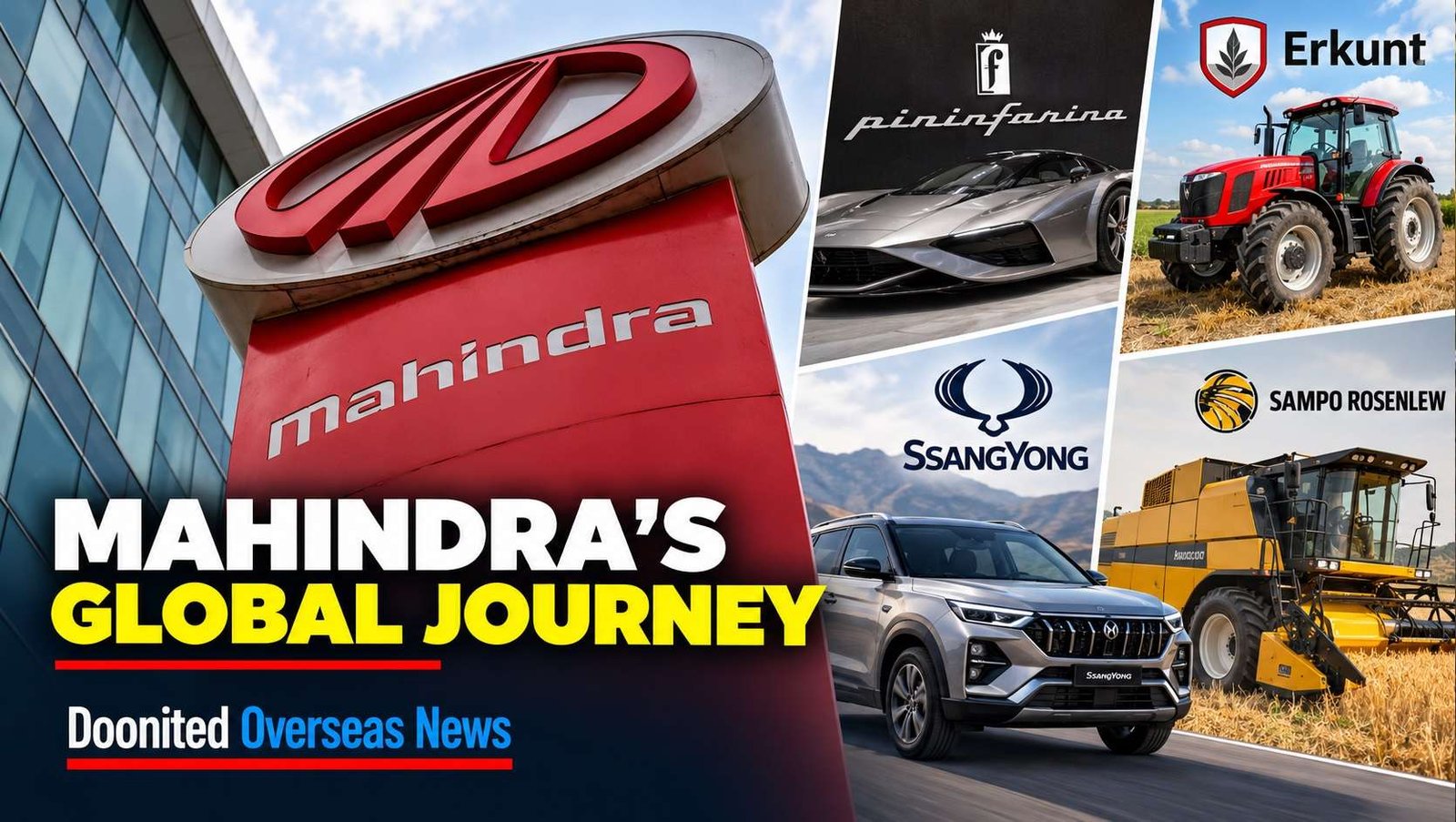
South Korea’s SsangYong. Italy’s Pininfarina. France’s Peugeot Motocycles. Turkey’s Erkunt Traktör. Finland’s Sampo Rosenlew. Japan’s Mitsubishi Mahindra Agricultural Machinery.
Taken together, they appear to tell the story of an Indian company steadily buying its way into global markets.
But that description is now incomplete.
Some of these businesses remain important parts of Mahindra’s international strategy. Others have been sold, restructured or wound down. That makes the company’s overseas journey more interesting—not less.
Mahindra is demonstrating that globalisation is a process of experimentation, investment, learning and, sometimes, retreat.
For the Indian diaspora, that matters because Indian multinationals are increasingly operating in the same countries where millions of Indians live and work. The relationship between India and its overseas community is no longer only about migration and remittances. It is also about Indian companies becoming employers, investors, technology partners and industrial participants in foreign economies.
Pininfarina: Indian ownership, Italian design
Perhaps the most visually striking example is Italy’s Pininfarina.
In December 2015, Mahindra & Mahindra and Tech Mahindra agreed to acquire a controlling stake in Pininfarina S.p.A., the legendary Italian automotive design and engineering company. The transaction involved a joint venture in which Tech Mahindra held 60% and Mahindra & Mahindra 40%.
Pininfarina had designed some of the world’s most famous automobiles and had worked with global manufacturers including Ferrari.
Mahindra’s strategy was not to erase that Italian heritage.
Instead, the group used Pininfarina’s design capabilities as part of a broader technology and mobility strategy.
That eventually produced one of the most extraordinary products associated with an Indian-owned automotive group: the all-electric Automobili Pininfarina Battista.
Automobili Pininfarina is a separate company from the historic Pininfarina design house. Mahindra describes it as a wholly owned investment, while Pininfarina S.p.A. contributes design and production expertise.
The Battista is hand-built in Italy, uses a 120-kWh battery and four electric motors, and produces 1,900 hp. Mahindra says production is limited to 150 examples.
This is more than an acquisition story.
It is an example of Indian capital helping create a new Italian luxury-technology proposition while retaining Italian design and manufacturing identity.
That distinction is important in understanding how modern Indian multinationals operate.
Erkunt: using Turkey as an agricultural gateway
Mahindra’s international ambitions are not confined to luxury cars.
In 2017, the company acquired 100% of Erkunt Traktör and 98.7% of Erkunt Sanayi in Turkey. Mahindra described Erkunt as the country’s fourth-largest tractor company at the time and saw Turkey as a gateway to markets in the Middle East, Europe and the CIS region.
The strategy made industrial sense.
Turkey has a major agricultural sector and a geographic position connecting Europe, the Middle East and surrounding markets. Erkunt brought Mahindra an established product portfolio, manufacturing capability and distribution relationships.
Mahindra subsequently restructured parts of its Turkish operations, while retaining the core agricultural machinery business. Its current reporting says the tractor business in Turkey remains part of the Mahindra Group, even as other international subsidiaries have been exited.
This is an important distinction from simply saying Mahindra “owns Turkish brands.”
Its international portfolio is continually changing.
Sampo Rosenlew: a lesson in technology transfer
Finland’s Sampo Rosenlew illustrates that point particularly well.
Mahindra initially acquired a 35% stake in the Finnish combine-harvester company in 2016. The stated objective was to jointly expand the combine-harvester business globally and build a broader farm-equipment portfolio beyond tractors.
Mahindra later increased its ownership to 100% in 2022.
But the story did not end with permanent ownership.
In September 2025, Mahindra agreed to sell its entire stake in Sampo Rosenlew to Turkish investment company TERA for €5 million. Mahindra said the business had nevertheless contributed meaningfully to the group and that technologies developed by Sampo had helped build Mahindra’s own farm-machinery capabilities.
That is perhaps one of the clearest lessons in Mahindra’s global strategy.
An overseas acquisition does not have to remain permanently inside the group to be strategically successful.
If an acquired company transfers technology, engineering knowledge, product expertise or market understanding to the parent, its value may continue after ownership ends.
Mitsubishi Mahindra: when partnership stops making sense
Japan provides another example.
Mahindra and Mitsubishi Heavy Industries established Mitsubishi Mahindra Agricultural Machinery Co., in which Mahindra held roughly one-third. Mahindra’s FY2024–25 reporting still recorded a 33.33% interest in the Japanese associate.
But in 2026, the company announced a major change.
Mitsubishi Mahindra Agricultural Machinery decided to withdraw from the agricultural machinery business and plans to cease production and sales during the first half of fiscal 2027. It will continue spare-parts and warranty services for existing products.
Mahindra’s FY2025–26 annual report describes the withdrawal as part of a broader portfolio-optimisation strategy.
This is a reminder that even a strategic partnership involving established industrial groups can become difficult when market demand, production economics and long-term profitability change.
For an Indian multinational, global presence has to justify itself commercially.
SsangYong: the difficult side of overseas expansion
The most dramatic example of that reality was South Korea’s SsangYong Motor.
Mahindra acquired control of SsangYong in 2011, but the Korean SUV manufacturer later experienced severe financial difficulties.
By 2022, a consortium led by South Korea’s KG Group acquired an 80.5% stake in the debt-ridden company. Mahindra’s ownership was reduced to approximately 5.2% after the transaction.
SsangYong subsequently became KG Mobility.
Mahindra itself had already identified the company as an exit under its “Reigniting Value Creation” strategy, alongside other overseas businesses. The company was seeking greater capital discipline and a sharper focus on businesses with stronger long-term prospects.
The episode is significant because it counters a simplistic narrative of Indian companies successfully buying foreign brands and automatically transforming them.
International acquisitions carry substantial risks:
- different labour and regulatory systems;
- currency exposure;
- high restructuring costs;
- weak demand cycles;
- technological disruption;
- legacy debt;
- and the difficulty of integrating businesses across cultures.
A multinational company must be prepared not only to invest but also to exit when the economics no longer work.
Peugeot Motocycles: another strategic retreat
France’s Peugeot Motocycles offers a similar example.
Mahindra acquired a majority stake in Peugeot Scooters in 2015 and subsequently increased its ownership.
But in November 2022, Mahindra announced an agreement under which German investment company Mutares would acquire an 80% controlling stake. Mahindra remained a co-shareholder to support product launches and the company’s growth.
The transaction effectively shifted Mahindra away from direct control while allowing it to retain a minority interest.
Again, the lesson is not that the original acquisition was necessarily a failure.
Mahindra’s strategy evolved.
The company could retain a connection to a historic French brand while transferring majority control to a partner with a different restructuring and investment model.
What has Mahindra learned?
Mahindra’s FY2026 results show why the group can afford to be selective.
Mahindra & Mahindra reported consolidated FY2026 revenue of ₹1,98,639 crore, up 25%, and consolidated profit after tax of ₹17,099 crore. Its automotive and farm businesses remained central to the group, while management emphasised capital allocation and portfolio discipline.
Its current farm-equipment strategy is increasingly focused on selected markets rather than maintaining every international experiment.
The company identifies the United States, Brazil and Turkey as key markets for its farm-equipment operations, while highlighting its lightweight OJA tractor range and higher-value machinery categories.
This is a very different philosophy from simply accumulating international subsidiaries.
The objective is becoming quality of global presence rather than quantity of global assets.
Why this matters to Indians abroad
There is a wider diaspora story here.
Mahindra’s international businesses operate in countries with substantial Indian-origin communities: Britain, the United States, Europe, Japan, Turkey and elsewhere.
For overseas Indians, an Indian multinational can represent a different form of economic connection to India.
It may employ local professionals, work with regional suppliers, develop technology with foreign partners or introduce Indian engineering capabilities into established international industries.
That can create a two-way flow.
Indian professionals abroad gain opportunities inside global businesses with Indian ownership, while Mahindra gains access to international engineering, design, manufacturing and customer markets.
The Pininfarina story demonstrates this particularly well.
An Italian design institution can remain Italian in character while benefiting from Indian capital and strategic direction. The resulting electric vehicle can then be sold as a global luxury product rather than an “Indian car” or an “Italian car” in a narrow sense.
That is increasingly what multinational business looks like.
The bigger lesson: globalisation includes knowing when to leave
Mahindra’s overseas journey is ultimately more valuable as a case study because it contains both acquisitions and exits.
Pininfarina demonstrates how Indian ownership can support a premium global technology proposition.
Erkunt shows how an acquisition can provide a geographic gateway.
Sampo demonstrates technology transfer even after divestment.
Mitsubishi Mahindra shows that industrial partnerships can eventually become uneconomic.
SsangYong demonstrates the risks of rescuing a distressed foreign manufacturer.
Peugeot Motocycles illustrates the use of a strategic minority position after transferring control.
Together, these stories suggest that India’s corporate globalisation has entered a more mature phase.
The question is no longer:
“How many foreign companies can an Indian group acquire?”
It is:
“Which international businesses genuinely strengthen the capabilities, technology, markets and returns of the Indian parent?”
For Mahindra, the answer is becoming increasingly selective.
And for the Indian diaspora, that evolution is worth watching. Indian companies abroad are no longer simply symbols of national ambition. They are becoming participants in the economic systems, employment markets and technological ecosystems of the countries where Indians have built their lives.
That is a much deeper form of global Indian influence.
The most useful angle for Doonited Overseas is not the conventional “Indian company owns foreign brands” narrative.
Mahindra’s story is more sophisticated: India’s multinationalisation is entering a portfolio-management phase.
The company has demonstrated that overseas acquisitions can deliver design capabilities, agricultural technology, manufacturing expertise and market access. But it has also demonstrated that international ownership is not an achievement in itself. SsangYong, Peugeot Motocycles, Sampo Rosenlew and Mitsubishi Mahindra show why capital discipline matters.
For the diaspora, this is an important shift. The strongest Indian multinational may not be the one with the largest collection of foreign names, but the one capable of combining Indian capital with the best international capabilities—and walking away when an overseas business no longer fits.

World Beyond the News
Why Elephants Stay Close to Their Herd
Elephants live in highly social family groups and use calls, touch and body movements to maintain strong bonds.
Most of the Deep Ocean Remains Difficult to Explore
Extreme pressure, darkness and distance make deep-ocean exploration one of Earth’s greatest scientific challenges.
Spacecraft Can Travel Without Traditional Roads
Spacecraft use carefully calculated trajectories and gravity assists to travel enormous distances through space.
Why Movie Trailers Are Released in Stages
Major films often use teaser trailers, full trailers and final promotional spots to build awareness over time.