
Apollo Tyres and Vredestein: How an Indian Tyre Maker Built a European Manufacturing and Technology Footprint
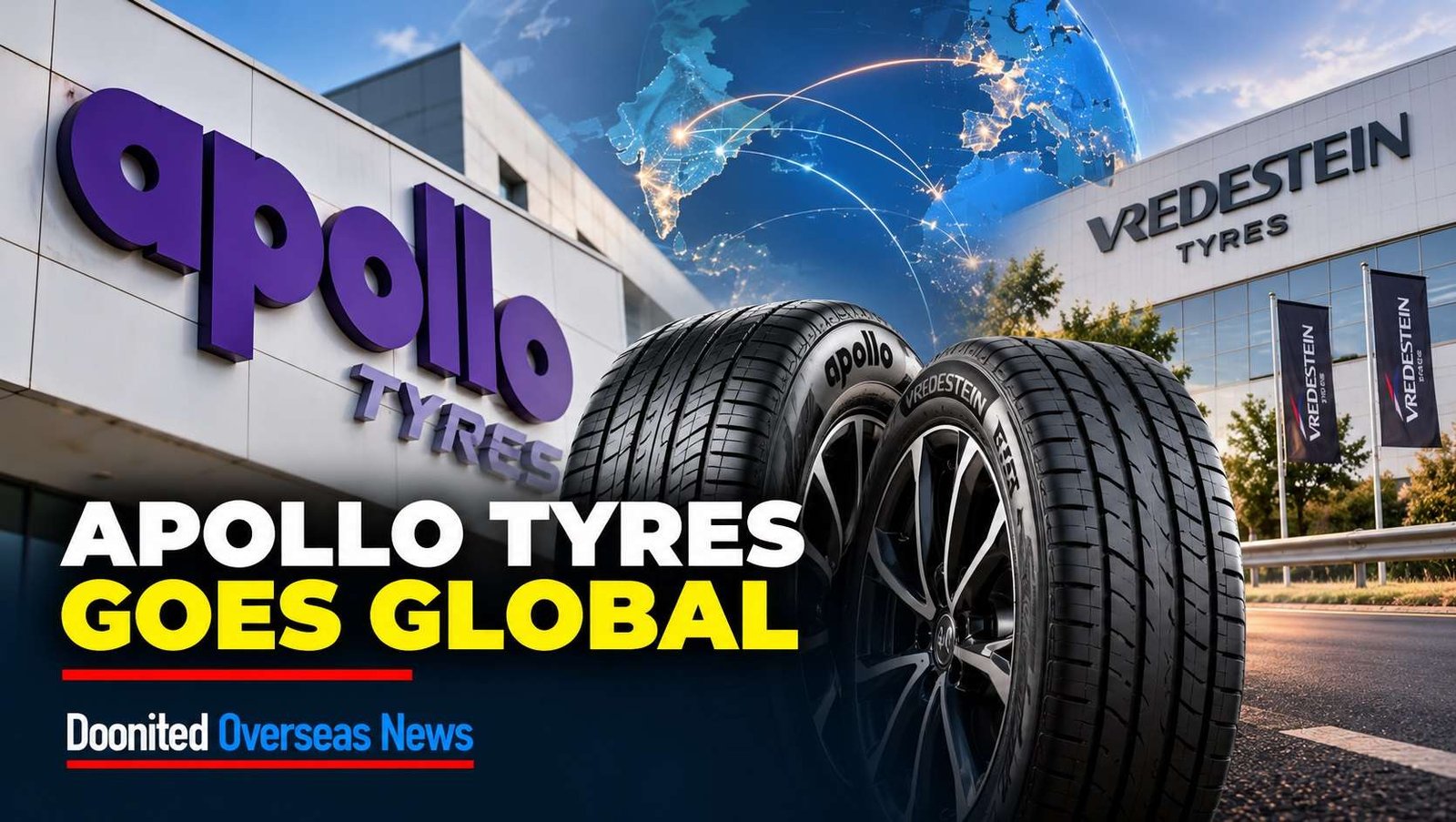
Apollo Tyres’ 2009 acquisition of Dutch tyre maker Vredestein was more than an Indian company buying a European brand. It gave Apollo access to premium tyre technology, European distribution and a 110-year-old brand—and helped turn an Indian manufacturer into a multinational with production and R&D capabilities across continents.
When an Indian company buys a foreign brand, the headline usually focuses on the acquisition.
The more interesting story is what happens afterward.
For Apollo Tyres, the acquisition of Dutch tyre manufacturer Vredestein Banden B.V. in 2009 became a turning point in the company’s transformation from a predominantly Indian tyre manufacturer into an international business.
Today, Apollo says its products are available in more than 100 countries, with seven manufacturing facilities—five in India and one each in the Netherlands and Hungary. It markets two principal global brands, Apollo and Vredestein, while maintaining a portfolio spanning passenger vehicles, commercial vehicles, two-wheelers, agriculture, industrial and specialty applications. Apollo Corporate
For Doonited Overseas, the significance goes beyond tyres.
Apollo’s journey provides a useful example of how an Indian company can acquire a European brand without eliminating its European identity, while using that acquisition to develop technology, manufacturing and market access that strengthen the parent company’s global position.
Vredestein was already a European institution
Vredestein was not an unknown company waiting for an Indian buyer.
Founded in the Netherlands in 1909, the brand had more than a century of history when Apollo acquired it. Apollo describes Vredestein as a premium tyre brand with a particularly strong reputation in high-performance passenger-car and specialist tyres.
The acquisition therefore gave Apollo something that would have taken decades to build organically:
European brand heritage.
It also brought an established distribution network across Europe and specialist manufacturing and R&D capabilities.
Apollo’s corporate history records May 2009 as the year it acquired Vredestein Banden B.V., which was subsequently renamed Apollo Vredestein B.
The timing was significant.
The global financial crisis had created opportunities to acquire businesses at distressed valuations, but buying a company during a difficult economic period also required confidence that the underlying technology, brand and markets remained valuable.
Apollo appears to have viewed Vredestein as precisely that kind of strategic asset.
The deal was part of a bigger internationalisation strategy
Vredestein was not Apollo’s first international step.
In 2006, Apollo acquired Dunlop Tyres International’s operations in South Africa and Zimbabwe. Its own corporate history identifies the transaction as an early stage in its transformation into a multi-geography business.
The sequence is revealing.
Apollo first established an international manufacturing and market presence in Africa.
Three years later it acquired a European premium tyre manufacturer.
It then built additional European manufacturing capacity rather than relying exclusively on the acquired Dutch operation.
That strategy eventually led to Hungary.
Hungary changed the equation
In 2015, Apollo began construction of a new greenfield tyre factory in Hungary.
The company invested approximately €475 million in the facility, with Phase I designed for annual production of 5.5 million passenger-car and light-truck tyres and 675,000 commercial-vehicle tyres.
The Hungarian facility was inaugurated in 2017.
Its significance was strategic: Apollo could combine its Indian manufacturing base with European production located closer to major automotive markets and customers.
The company said the plant would produce both Apollo and Vredestein tyres for the European market and was intended to help move beyond the replacement market into supplies to leading original-equipment manufacturers.
That is a crucial difference between simply exporting from India and becoming an international manufacturer.
A company with production inside the target market can respond differently to logistics, customer requirements, supply chains, technical standards and OEM relationships.
Vredestein’s Italian design connection
Vredestein also brought something less obvious: design differentiation.
The Dutch brand has maintained a long-standing relationship with Italian automotive designer Giorgetto Giugiaro and his design studio. Apollo says the relationship began in 1997 and became an important part of Vredestein’s identity as a design-led premium tyre brand.
This matters because a tyre is not normally viewed as a fashion product.
Yet premium automotive manufacturers and consumers increasingly care about the visual appearance of wheels and tyres, especially in the luxury and performance segments.
Vredestein therefore occupies a different position from a purely volume-oriented tyre manufacturer.
Apollo has retained that positioning.
Rather than replacing the Vredestein name with Apollo, the group continues to market the Dutch brand as a distinct premium proposition.
That is one of the clearest examples of Indian ownership combined with local European brand identity.
Technology moved in both directions
The acquisition also created a technology exchange.
Apollo had scale and manufacturing experience in India. Vredestein brought European premium-tyre development and market knowledge.
Apollo subsequently established its European R&D centre in Enschede, Netherlands, while maintaining additional research and advanced-engineering capabilities in India. Its historical milestones record the Enschede R&D centre in 2013 and advanced engineering R&D in Bengaluru in 2014. Apollo Corporate
This distributed R&D model is increasingly normal for global manufacturers.
The important point is that technology no longer necessarily flows from headquarters to subsidiary.
Knowledge can move in both directions.
Indian engineering teams can contribute to global product development, while European engineers contribute expertise in premium tyres and advanced vehicle applications.
For an Indian multinational, that can be considerably more valuable than simply owning a foreign trademark.
Reifen.com added another piece of the puzzle
Apollo’s international strategy expanded again in 2015 when it acquired Reifencom GmbH, a German tyre distributor with both online and offline operations.
Apollo describes Reifencom as one of Germany’s largest tyre distributors at the time of acquisition.
The strategic logic was different from Vredestein.
Vredestein brought a premium manufacturing brand.
Reifen.com brought distribution and customer access.
Together, manufacturing, brand, R&D and distribution created a much more complete European business model.
That is an important lesson for Indian companies expanding abroad.
A foreign acquisition does not have to deliver only revenue. It can provide one missing piece of an international value chain.
Apollo did not abandon India
Perhaps the most important feature of Apollo’s internationalisation is that its global expansion did not mean shifting the centre of gravity away from India.
The company continues to be headquartered in Gurugram, while maintaining five manufacturing facilities in India alongside the two European facilities.
Apollo’s international business therefore operates as a network rather than a replacement of its Indian base.
Its global footprint includes manufacturing, sales, R&D, procurement and distribution across multiple regions.
The result is a company that can draw on different capabilities from different markets.
That is increasingly the model for successful Indian multinationals.
The sustainability question
The European operation also illustrates another challenge for Indian companies operating in developed markets: environmental expectations are becoming part of competitiveness.
Apollo has introduced a responsible-sourcing requirement for natural rubber used at its European production facilities in the Netherlands and Hungary.
The company says suppliers must commit to the principles of the Global Platform for Sustainable Natural Rubber (GPSNR), covering environmental, human-rights and social considerations. Apollo says the policy means all Apollo and Vredestein tyres produced in Europe use natural rubber sourced from companies committed to those sustainability guidelines.
This is more than a corporate-social-responsibility issue.
For global tyre manufacturers, the supply chain itself is increasingly subject to scrutiny over deforestation, biodiversity, labour practices and traceability.
Indian companies competing internationally therefore have to meet standards shaped not only in India but also by European regulators, customers and civil society.
Why this matters to Overseas Indians
Apollo’s story has a strong diaspora relevance even though it is not a conventional Indian-diaspora story.
Millions of Indians live across Europe, the Middle East, Africa and North America—the same markets where Indian multinational companies increasingly operate.
For overseas Indian professionals, companies such as Apollo create opportunities that are different from traditional expatriate employment.
An Indian engineer can work on a European vehicle programme.
A European designer can contribute to a product ultimately developed by an Indian-headquartered company.
A procurement specialist in Singapore can work with Indian and European manufacturing facilities.
A software or data professional in Germany can support an Indian multinational’s global supply chain.
The old model was India exports products to the world.
The newer model is India operates within global production networks.
Apollo’s European footprint is an example of that transition.
The bigger lesson from Vredestein
The Vredestein acquisition is now more than 17 years old.
Its most important legacy is therefore not the original transaction.
It is what Apollo built around it.
A Dutch premium brand remained Dutch in character.
European R&D remained important.
A Hungarian factory expanded manufacturing capacity close to European customers.
German distribution strengthened market access.
Indian factories and engineering centres remained central to the group.
The result is a genuinely multinational operating structure rather than an Indian company with a foreign logo attached to it.
That distinction matters.
The real measure of an overseas acquisition is not whether the acquired company still exists under the same name.
It is whether the combination creates capabilities that neither company could have developed as efficiently alone.
In Apollo’s case, Vredestein helped provide a bridge between Indian manufacturing scale and European premium mobility.
For India’s global corporate story, that is significant.
And for the Indian diaspora, it represents a broader change: Indian companies are no longer simply exporting goods to the countries where Indians have settled.
They are becoming local economic participants in those countries—employing people, developing technology, manufacturing products and competing for customers on global terms.
Apollo’s journey from a tyre factory in Kerala to a multinational with production in Europe is therefore not just a story about tyres.
It is a story about how Indian industry learned to operate across borders.
The strongest Doonited Overseas angle is “Indian ownership, European identity, global technology.”
Apollo did not make Vredestein valuable by erasing its Dutch heritage. It used that heritage, European R&D and market access alongside Indian manufacturing and engineering capabilities.
The company also provides a useful counterpoint to the assumption that global expansion means endlessly buying foreign companies. Apollo’s international strategy has combined acquisitions, greenfield investment, R&D centres and distribution.
The deeper lesson is that Indian multinationalisation is becoming less about ownership and more about integration of capabilities across countries.
That is exactly the kind of global Indian business story that matters to Overseas Indians.

World Beyond the News
Dolphins Use Individual Signature Whistles
Bottlenose dolphins develop distinctive whistles that function somewhat like individual acoustic identifiers.
The Pacific Is Earth’s Largest Ocean
The Pacific Ocean covers more area than any other ocean basin and stretches between Asia, Australia and the Americas.
Artificial Intelligence Learns Statistical Patterns
Modern machine-learning systems identify patterns in large datasets and use those patterns to generate predictions or outputs.
Why Some Stories Spread So Quickly
Emotion, novelty, visual appeal and easy sharing can make a story travel rapidly across social platforms.