
India’s defence-export story is entering a more interesting phase.
The latest signal is not another overseas order for an Indian-made weapon. It is a decision to manufacture Indian-designed autonomous drone technology on European soil.
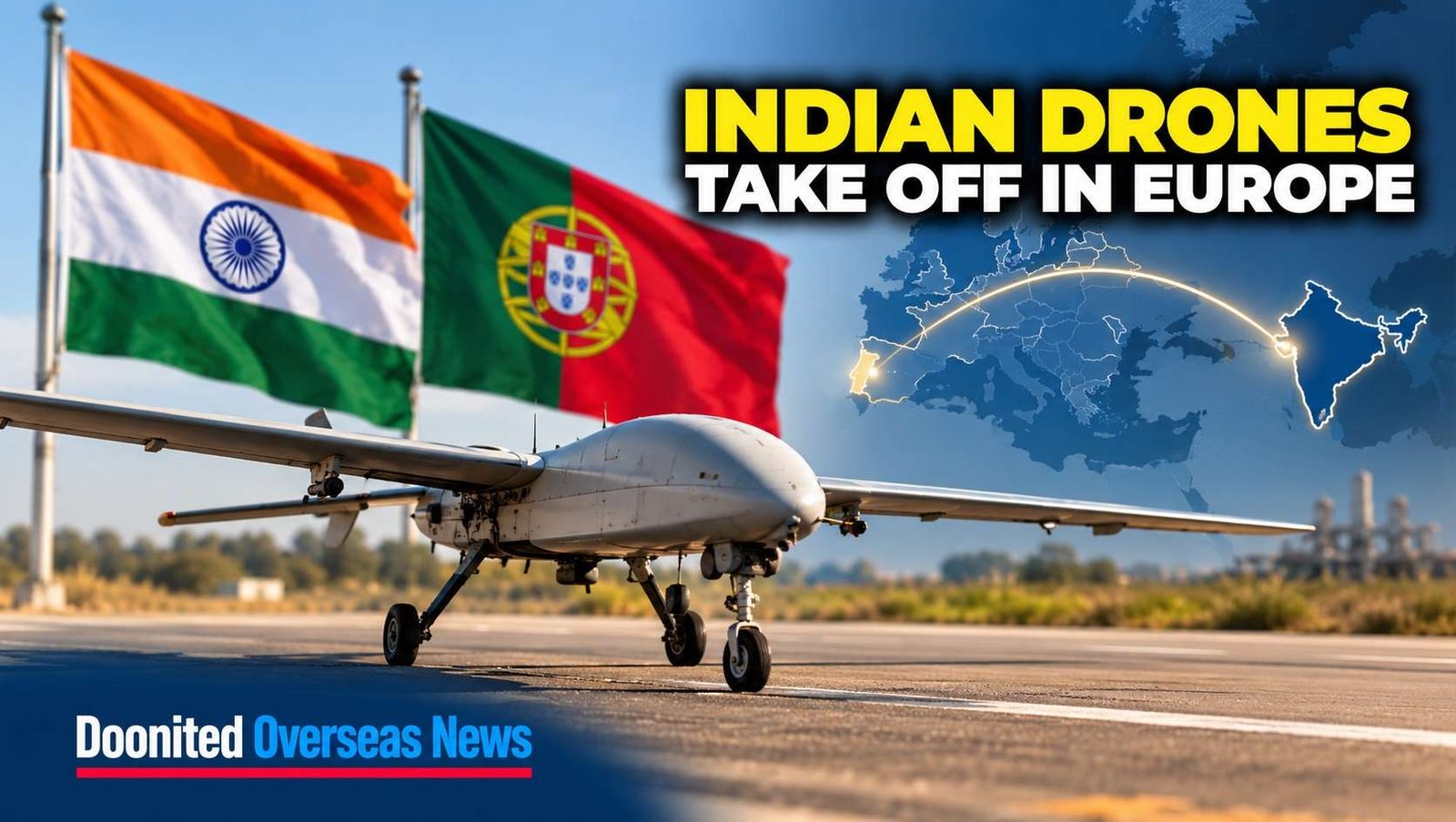
Bengaluru-based Flying Wedge Defence & Aerospace (FWDA) has signed an industrial partnership with Portugal’s Keydef, the defence and aerospace division of Portuguese technology company SketchPixel LDA, under which Keydef will invest an initial €6 million in FWDA’s technologies and the companies will establish production capabilities in Portugal for international markets.
The agreement covers FWDA’s Kaal Bhairava autonomous UAV and YAMA interceptor drone, with the proposed Portuguese operation eventually intended to extend across the company’s wider portfolio of surveillance, air-defence and civilian systems.
For India, that makes this more than a manufacturing announcement.
It is an experiment in whether an Indian defence startup can move from exporting products to becoming part of an international defence-technology supply chain.
From Bengaluru engineering to European manufacturing
FWDA describes itself as a Bengaluru-based developer of autonomous aerial and AI-enabled defence systems. Its product portfolio includes the Kaalbhairav series and YAMA, alongside other UAV and civilian applications.
The company’s own product information describes the Kaalbhairav Lite as an indigenous long-endurance UAV with a 50-kg maximum take-off weight, a 10-kg payload and a stated endurance of five to 15 hours, depending on configuration. YAMA is positioned as a much smaller interceptor drone intended to counter hostile UAVs.
These are very different missions.
The Kaalbhairav concept is associated with long-endurance intelligence, surveillance and reconnaissance and other mission configurations. YAMA is designed around the increasingly important counter-drone problem: what happens when relatively inexpensive unmanned aircraft become numerous enough to threaten military forces, infrastructure or other drones?
That distinction matters because the international market for unmanned systems is no longer simply about buying a drone.
Customers increasingly want an ecosystem—sensors, communications, autonomy, electronic systems, software, interoperability, training, maintenance and secure supply chains.
That is where Portugal enters the story.
Why Portugal?
The proposed manufacturing base gives FWDA something it cannot obtain simply by shipping a finished aircraft from India: a physical presence inside a European industrial environment.
Portugal is a NATO founding member, having joined the Alliance in 1949.
That does not mean a drone manufactured in Portugal automatically becomes a “NATO-certified drone”. It does not.
FWDA and Keydef have stated that they intend to pursue NATO certification for systems manufactured through the partnership. That certification is therefore a future objective, rather than a status the systems currently possess.
The distinction is important.
NATO itself emphasises standardisation and interoperability as fundamental to allowing equipment and forces from different countries to work together. Its standards include technical requirements and Standardization Agreements, or STANAGs, covering different aspects of military equipment and operations.
NATO has also been trying to accelerate the adoption of emerging defence technologies and make it easier for non-traditional suppliers to participate in innovation and procurement. Its Rapid Adoption Action Plan specifically addresses faster testing, validation, integration and procurement of new technologies.
For a young defence company, that ecosystem can be valuable.
But certification is only one part of the commercial journey. Winning military customers still requires testing, regulatory approvals, procurement qualification, security requirements, financing, logistics and—perhaps most importantly—evidence that the technology performs reliably outside demonstrations.
The €6 million is important, but the factory matters more
The initial €6 million investment is significant for a young defence-technology company. But the more consequential part of the announcement may be what happens after the investment.
The final Portuguese factory location has not yet been announced. Keydef is reportedly evaluating municipalities based on infrastructure, land availability, incentives and access to skilled workers.
That means the project remains under development.
The companies nevertheless envisage a broader industrial footprint. Portuguese engineering and technology capabilities are expected to contribute to electronic components and artificial-intelligence development, while FWDA brings its Indian-developed autonomous systems and airframe technologies.
In other words, the proposed model is not simply:
India designs → Portugal assembles → Europe buys.
It could become:
India develops core technology → Portugal adds European engineering and industrial capability → joint systems target international markets.
That is a considerably more ambitious proposition.
A 100-hour drone project points to the next race
The partnership also extends beyond today’s two products.
FWDA and Keydef/SketchPixel are working with the University of Minho on a long-duration uncrewed aircraft project targeting up to 100 hours of autonomous flight.
The project comes as FWDA says its Kaalbhairav platform has crossed 100 cumulative hours of airborne testing.
Those two numbers should not be confused.
“100 hours of flight testing” is a test milestone accumulated across flights. A “100-hour autonomy” aircraft is a much more demanding engineering objective involving persistent flight, reliability, propulsion efficiency, materials, communications, autonomy and systems management over an exceptionally long period.
If achieved, the latter would represent a meaningful technological step.
The partners have also announced plans for a joint laboratory at Fábrica do Arquinho from 2028, suggesting that the Portuguese initiative is being conceived as a longer-term research and industrial relationship rather than merely an assembly contract.
What this means for Indians working in Europe
For the Indian diaspora, the most interesting part of this story is not that an Indian drone will carry a European manufacturing label.
It is the emergence of a different kind of Indian global enterprise.
For decades, India’s international technology image was dominated by IT services, pharmaceuticals, automotive components and engineering services. Defence manufacturing was comparatively associated with government-owned institutions and domestic procurement.
That picture is changing.
Private Indian companies are increasingly attempting to sell aerospace systems, missiles, electronics, drones and other defence technologies internationally.
FWDA’s Portugal move adds another layer: Indian-origin engineering potentially creating manufacturing, research and specialist employment opportunities in Europe.
That could eventually involve Indian engineers, software specialists, aerospace professionals and entrepreneurs working across the India-Portugal technology corridor.
But it would be premature to claim that this deal will immediately create a large number of jobs or a major diaspora ecosystem. The factory location has not been finalised, and the scale of production has not been publicly established.
The opportunity is real. The outcome is still being built.
Europe is also looking for more drones
The timing is significant.
European militaries have been forced to reconsider the role of drones after observing their extensive use in modern conflicts. Small UAVs can provide surveillance at comparatively low cost, while counter-UAS systems are becoming essential because the same affordability that makes drones useful also makes drone swarms dangerous.
NATO is explicitly pushing for faster adoption of emerging technologies and stronger defence-industrial production and interoperability.
This creates an opening for smaller technology companies.
The opportunity, however, is not exclusively Indian.
European companies, American defence contractors, Israeli firms, Turkish manufacturers and startups across the continent are competing in the same broad markets.
FWDA therefore enters a crowded field.
Its European manufacturing base could improve proximity to customers and partners, but proximity alone does not create competitive advantage. Reliability, price, autonomy, sensor performance, cybersecurity, supply-chain security and after-sales support will determine whether the technology becomes commercially significant.
The bigger test is execution
The Portugal agreement deserves attention because it represents a change in ambition.
An Indian defence startup is attempting to establish a manufacturing foothold outside India, combine Indian-developed technology with European engineering capabilities, pursue NATO-related standards and build a research relationship with a European university.
That is a more difficult proposition than simply announcing an export order.
It also creates more ways to fail.
The factory must be established. Production quality must be consistent. European regulatory and export-control requirements must be navigated. The technology must perform reliably. The NATO-related certification objective must move from intention to measurable qualification. And customers must actually place orders.
Those are the tests that will determine whether the Portugal partnership becomes a landmark or merely an interesting corporate announcement.
The larger Indian lesson
The most important phrase in this story may therefore be neither “€6 million” nor “NATO”.
It is European manufacturing.
India’s defence industry has spent years trying to establish that Indian companies can design and manufacture sophisticated military technologies. The next question is whether those companies can build international production networks around those technologies.
If FWDA succeeds in Portugal, the model could become significant: develop core intellectual property in India, combine it with specialised international capabilities, manufacture closer to major customers and build credibility through globally recognised standards.
That would be a different version of “Make in India”.
Not simply made in India for export, but Indian technology becoming part of the world’s defence-industrial architecture.
For India’s engineers, startups and overseas professional community, that is the more consequential story.
The drone itself may be flying from Portugal.
The real test is whether the business model can fly with it.

World Beyond the News
Bees Communicate Where Food Is
Honeybees use movement patterns known as waggle dances to communicate information about food locations.
Street Food Reflects Local History
Many famous street foods developed from migration, trade, local ingredients and the everyday needs of working communities.
A Day on Venus Is Extremely Long
Venus rotates so slowly that one rotation relative to distant stars takes longer than its trip around the Sun.
Human Achievement Continues to Push Limits
Athletes, engineers, scientists and explorers regularly establish new benchmarks in speed, endurance, scale and precision.