

India Inc Goes Global 2.0: Why Indian Companies Are Building Inside Foreign Markets
India’s second major wave of corporate globalisation looks different from the acquisition spree of the 2000s. Today’s overseas bets increasingly combine local manufacturing, technology acquisition, supply-chain security, nearshoring and energy transition—turning Indian companies from exporters into participants inside foreign economies.
For much of the 2000s, the phrase “India Inc goes global” usually meant one thing: an Indian conglomerate buying a foreign company.
Tata Steel bought Corus. Tata Motors acquired Jaguar Land Rover. Indian groups accumulated European steel, automotive, energy and pharmaceutical assets. The ambition was unmistakable—acquire scale, technology, brands and global customers.
But the next phase looks different.
Indian companies are still buying foreign businesses. Some of the deals are enormous. Sun Pharmaceutical Industries agreed to acquire US-based Organon for an enterprise value of $11.75 billion. Tata Motors launched a €3.82 billion all-cash tender offer for Italian commercial-vehicle maker Iveco. Persistent Systems is pursuing the takeover of Germany-headquartered Nagarro, while Coforge has completed its $2.35 billion acquisition of AI engineering company Encora.
But something else is happening alongside the acquisitions.
Indian companies are increasingly building inside the markets they want to serve.
That is the more important story.
Globalisation is becoming more local
The old model of globalisation was built around arbitrage.
Manufacture where costs were lower. Develop services in India. Export products. Serve Western customers from offshore centres.
The new environment is less forgiving.
Tariffs, geopolitical tensions, immigration restrictions, industrial-policy incentives, supply-chain disruptions and national-security concerns are forcing companies to ask a different question:
Where must we actually be located to remain competitive?
For an Indian manufacturer selling into the United States, producing entirely in India can create tariff exposure.
For an Indian technology company serving European clients, an Indian delivery centre may not provide the same advantages as having engineers in European time zones.
For an energy company, owning or operating infrastructure inside the target market can provide something an export contract cannot: a long-term position in that country’s industrial ecosystem.
This is why “Globalisation 2.0” is a useful way to describe the emerging pattern—not as an established academic term, but as an editorial shorthand for a visibly different corporate strategy.
Tata: from acquisition to industrial integration
Tata Motors’ proposed Iveco acquisition is a particularly revealing example.
The €3.82 billion transaction is being pursued through a recommended all-cash tender offer. The acceptance period runs from September 7 to October 26, 2026, with the transaction still subject to its completion process.
Iveco is not simply a foreign brand that Tata can add to its portfolio.
It brings manufacturing operations, European engineering capabilities, established customers and an existing industrial footprint.
That matters because commercial vehicles are deeply local businesses. Trucks and buses have to meet regional regulations, customer requirements, service expectations and infrastructure conditions.
Owning a European commercial-vehicle platform therefore provides Tata with a more direct position inside the European market.
The company’s earlier battery investment points in the same direction.
Tata Sons committed more than £4 billion to establish a 40GW battery-cell gigafactory in the UK, designed to supply electric mobility and renewable-energy storage markets in Britain and Europe.
The two strategies are complementary.
One acquires an established industrial platform.
The other builds new infrastructure.
Together, they illustrate a move from selling into Europe to manufacturing for Europe.
Sun Pharma: global scale, but don’t oversimplify the tariff story
Sun Pharma’s Organon transaction is another major example, but it requires a little more caution.
The companies announced an all-cash acquisition valuing Organon at $11.75 billion. Organon’s portfolio spans women’s health and general medicines, with products commercialised across 140 countries and manufacturing facilities across the European Union and emerging markets.
The strategic logic is clear: Sun is buying a large international healthcare platform with established products, regulatory infrastructure and distribution.
But it would be too strong to state as a verified fact that Sun bought Organon specifically to avoid proposed US tariffs on foreign-made generic medicines.
That is an analytical interpretation, not the publicly established primary rationale for the acquisition.
There is nevertheless a broader strategic lesson.
When a company owns manufacturing, brands, regulatory capabilities and distribution inside multiple markets, it becomes less dependent on any single cross-border route.
That is valuable in an era when trade policy can change faster than a factory can be relocated.
Essar’s American bet is different again
Essar-backed Mesabi Metallics offers perhaps the clearest example of the new localisation logic.
In September, Mesabi announced an $18 billion investment to create a fully integrated American steel company, combining an iron-ore operation in Minnesota with a new steel complex in Iowa.
The company says $3 billion will be invested in completing the Minnesota iron-ore mine and $15 billion in the Iowa steel facility. The resulting supply chain is intended to be entirely American—from mining to steelmaking.
That is not traditional offshore expansion.
It is almost the reverse.
An Indian-backed group is investing heavily to produce inside the country where the customers, infrastructure spending and industrial-policy incentives are located.
The timing is hardly accidental.
US industrial policy has placed extraordinary emphasis on domestic manufacturing and supply security. A plant that mines American ore and produces American steel is structurally better positioned for that environment than an overseas plant attempting to export into it.
But this strategy also carries enormous execution risk.
An $18 billion project is not merely a bet on steel demand. It is a bet on construction, energy costs, labour, financing, permitting, future steel prices and the durability of American industrial policy.
Globalisation may have changed.
Capital risk has not.
Essar’s UK strategy shows the energy version of Global 2.0
The same company is pursuing a different form of localisation in Britain.
Essar Energy Transition has outlined a £4.3 billion investment pipeline through 2035 to transform its Stanlow complex into an energy-transition hub. More than £1 billion of projects are approaching Final Investment Decision, while the programme includes low-carbon hydrogen, carbon capture, sustainable aviation fuel and other decarbonisation projects.
Again, the logic is not simply “Indian capital goes abroad”.
It is Indian capital becoming part of the host country’s strategic infrastructure.
That distinction is important.
The company is not merely exporting energy-transition equipment from India. It is attempting to build the infrastructure in Britain that Britain itself needs.
Technology companies are localising differently
The same pattern is visible in India’s technology sector, although the physical assets are smaller.
Persistent Systems’ proposed combination with Germany’s Nagarro is designed to create a larger digital-engineering company with a stronger European presence.
As of September 22, Persistent had secured 83.25% of Nagarro’s outstanding share capital through the takeover offer, with an additional acceptance period running to October 6 and completion expected in the first quarter of calendar 2027.
The strategic rationale is broader geographic reach, technology capability and access to customers.
Persistent has also been expanding its European nearshore footprint. In Estonia, it announced plans to establish delivery centres in Tallinn and Tartu through an agreement involving more than 90 professionals from software engineering and IT-consulting company Concise.
That is a different form of localisation.
A steel company needs furnaces.
An IT company needs engineers.
But the principle is similar: put capability closer to the customer.
For European clients, having teams working in or near their time zone can make software modernisation, AI implementation and enterprise transformation easier to deliver.
It also reduces dependence on a single offshore operating model.
Coforge is buying capability, not just revenue
Coforge’s $2.35 billion acquisition of Encora provides another illustration.
The transaction was designed to add AI-led engineering, data and cloud capabilities, as well as a broader international delivery footprint. Coforge completed the acquisition in April 2026 and funded it partly through a $550 million three-year loan rather than proceeding with a planned QIP.
This is important because the value of many modern acquisitions lies less in physical assets and more in talent, intellectual property, customer relationships and specialised capabilities.
That makes the new globalisation wave much more knowledge-intensive than the conglomerate acquisition boom of two decades ago.
And then there is JSW
JSW Steel provides another variation.
JSW has proposed up to $500 million of investment in its US operations, including the expansion of its Baytown, Texas, steel-manufacturing infrastructure. The company’s plans include backward integration and a contiguous plate-and-pipe manufacturing facility, subject to regulatory approvals.
Its US operations are also being upgraded to reduce dependence on offshore semifinished materials.
That is exactly the kind of supply-chain localisation that has become more valuable in an era of tariffs and geopolitical uncertainty.
The strategic calculation is simple:
If the customer is American, and the policy increasingly rewards American production, then becoming more American in the production chain may be commercially rational.
What changed from the 2000s?
The contrast with the first major wave of Indian global expansion is real, but it should not be exaggerated.
The mid-2000s were not simply a period of “vanity acquisitions”. Many transactions created substantial strategic value and some remain important parts of Indian companies’ global operations.
Nor is today’s expansion entirely funded from internal cash.
Persistent is using committed financing for the Nagarro transaction. Sun Pharma used a large bridge loan for Organon and is now looking to raise about $1 billion domestically to refinance part of that financing.
So the difference is not debt versus no debt.
It is increasingly about what the capital is buying.
The emerging targets include:
- local manufacturing capacity;
- access to strategic technology;
- established distribution;
- specialised engineering talent;
- regional customer relationships;
- energy-transition infrastructure;
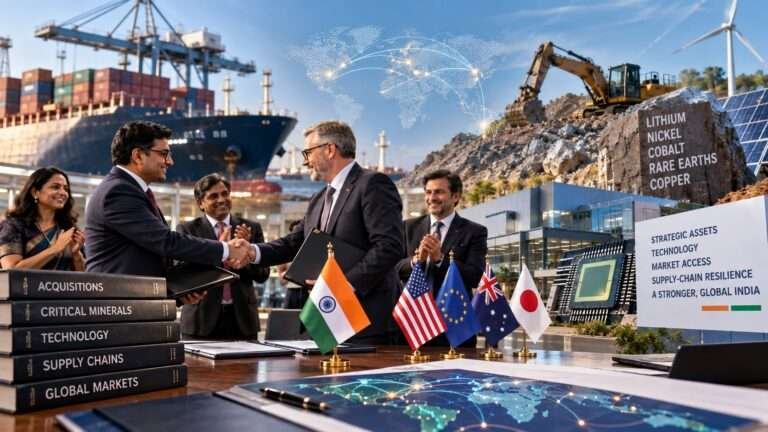
- supply-chain resilience; and
- proximity to end markets.
That is a more defensive and operational form of globalisation.
What it means for Indians abroad
For the Indian diaspora, this shift could eventually matter more than the headline acquisition values suggest.
When Indian companies establish factories, engineering centres, technology hubs and energy projects abroad, they create potential demand for people who understand both India and the host market.
That includes engineers, managers, finance professionals, lawyers, compliance specialists, cybersecurity experts, supply-chain professionals, researchers and technology entrepreneurs.
It can also create opportunities for Indian-origin businesses already established abroad.
A local Indian-owned supplier in Britain, Germany, Portugal or the United States may find new opportunities when an Indian conglomerate builds a major operation nearby.
But there is a second side to the story.
Localisation can also mean local hiring and local procurement, which is exactly what host governments increasingly demand. Indian companies cannot assume that overseas expansion will automatically translate into large-scale expatriate employment.
The future global Indian workforce may therefore be less about sending people abroad from India and more about building multinational teams in which Indian professionals and local employees work together.
The real Globalisation 2.0 test
There is a temptation to interpret every large overseas investment as evidence that India Inc has “arrived” globally.
That would be premature.
A billion-dollar acquisition can destroy value.
A greenfield factory can run over budget.
A tariff can disappear after an election.
A new technology can become obsolete.
A foreign subsidiary can struggle with cultural integration.
The real measure of Globalisation 2.0 will therefore not be the amount of money Indian companies spend abroad.
It will be whether those investments make the companies more resilient, more innovative and more deeply integrated into the economies where they operate.
That is why the current wave is different enough to deserve a new label.
India Inc is not simply buying foreign assets anymore.
It is increasingly trying to become locally relevant abroad.
And that may be the most important evolution in the global Indian business story since the first great overseas acquisition wave began.


World Beyond the News
Birds Can Navigate Using Earth’s Magnetic Field
Several bird species can sense Earth’s magnetic field, helping them navigate during long-distance migration.
Fermentation Is a Global Food Tradition
People across continents have used fermentation for centuries to preserve food and create distinctive flavours.
Modern Batteries Store Energy Chemically
Rechargeable batteries repeatedly move ions between electrodes, allowing electrical energy to be stored and released.
Why Songs Become Global Hits
Streaming platforms, short-form video, playlists and international collaborations can rapidly carry music across borders.