

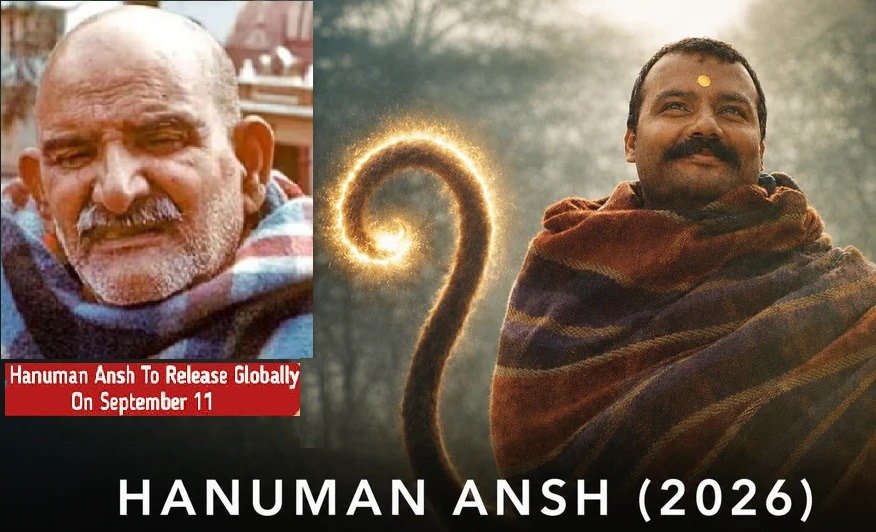
How Hanuman Ansh Turned Neem Karoli Baba’s Story Into an Unexpected Global Cinema Journey
A film that reportedly opened in India to barely around ₹10 lakh is now preparing to travel overseas.
That sentence alone sounds like the beginning of a Bollywood fairy tale.
Except this one has no superstar, no ₹500-crore production budget and no army of promotional billboards.
It has a spiritual story, a relatively small production, a filmmaker who spent years pursuing the subject—and an audience that apparently decided to do the marketing itself.
Hanuman Ansh, the Hindi devotional drama inspired by the life and spiritual journey of Neem Karoli Baba, popularly known as Maharaj-ji, is scheduled to release in international theatres on September 11, 2026. Hombale Films has announced that its overseas division will handle the international distribution.
The film’s overseas release is interesting for another reason.
It is not merely taking a Bollywood product abroad.
It is taking an Indian spiritual story—rooted in the culture and landscape of Uttarakhand—to audiences who may already know something about Neem Karoli Baba, but perhaps have never encountered his story through Indian cinema.
And that distinction could be important.
The story behind the film’s story
Neem Karoli Baba was an Indian spiritual teacher whose followers associated him closely with devotion to Lord Hanuman, love, compassion and service.
His ashram at Kainchi Dham in Uttarakhand became an important centre of his spiritual legacy.
His influence also reached beyond India. Western spiritual seekers travelled to India during the 1960s and 1970s, and public accounts have long associated figures such as Steve Jobs with the saint’s influence. Mark Zuckerberg later visited Kainchi Dham after Jobs reportedly advised him to do so. Julia Roberts has also spoken publicly about Neem Karoli Baba’s influence on her spiritual journey.
That international dimension makes the story naturally suited to a global audience.
But there is an important journalistic caution here.
The fact that famous people were influenced by Neem Karoli Baba does not automatically mean that everyone who watches the film will become interested in him.
Cinema has to do the hard work.
It has to tell the story.
A film that almost didn’t happen
Perhaps the most remarkable part of Hanuman Ansh is what happened behind the camera.
The film faced serious production difficulties, including the sudden illness of the actor originally chosen to play Neem Karoli Baba.
The replacement was not another established star.
It was Shobhinaw Satyaa, who had been working on the film as a second assistant director.
Director Vishal Chaturvedi eventually tested him for the lead role in an extended audition, and Satyaa was cast as Maharaj-ji.
In other words, the man helping make the film found himself becoming the face of the film.
That is not the usual career ladder.
Most assistant directors spend years hoping someone will give them a major acting opportunity.
Satyaa apparently skipped several chapters.
He went from handling production responsibilities to portraying the central spiritual figure.
And the story became even more unusual because members of the original team reportedly left during the difficult production period, leaving Satyaa among those who continued with the project.
From ₹10 lakh opening to a box-office phenomenon
The film’s theatrical journey has been almost as unusual as its production.
Reports indicate that Hanuman Ansh opened to approximately ₹10 lakh in India.
For a film without major conventional star power, that could easily have been the end of the story.
Instead, its fortunes changed.
Word of mouth began bringing more audiences into theatres. By its fourth week, reports were already describing the film as one of the year’s most surprising sleeper hits.
By September 6, NDTV reported that the film had crossed the ₹100-crore mark in India, after opening on only around 25 screens and being made on a reported budget of less than ₹2 crore.
The figures are extraordinary—but the more interesting statistic is not the multiplier.
It is the trajectory.
A film that initially appeared almost invisible gradually became a major theatrical story.
That tells us something important about audiences.
They do not always behave according to the marketing department’s spreadsheet.
Sometimes they simply tell a friend:
“Go watch this.”
And then the friend tells another friend.
Suddenly, the spreadsheet has a nervous breakdown.
Why did audiences respond?
There is no single proven explanation.
But the film appears to have benefited from several factors.
First is the subject itself.
Neem Karoli Baba has an established following in India and an international spiritual legacy.
Second is timing.
India has seen renewed interest in stories involving spirituality, personal transformation and Indian cultural traditions.
Third is word of mouth.
Reports on the film’s performance repeatedly point to positive audience response and sustained word-of-mouth momentum as important factors behind its unusual theatrical run.
And fourth is curiosity.
People who might not normally buy a ticket for a devotional film may have heard that a tiny-budget movie was outperforming much larger productions.
Cinema audiences are curious creatures.
Tell them something is failing and they may ignore it.
Tell them the tiny film is beating the giant film—and suddenly everybody wants to know what is going on.
The overseas test begins on September 11
Now comes the more difficult challenge.
The film is going international.
Hanuman Ansh is scheduled to reach overseas theatres on September 11, 2026, with Hombale Films handling its international distribution.
That is an important opportunity, particularly because the subject has a natural connection with Indians and people of Indian origin living abroad.
But the international audience is potentially wider than the Indian diaspora.
Neem Karoli Baba’s story already has a history of interest among Western spiritual seekers. The film therefore has an opportunity to introduce the subject to audiences who may have encountered his name through books, personal accounts, yoga communities or spiritual circles, but have never seen a Hindi feature built around his life.
That is where the film’s global journey becomes culturally interesting.
Indian spirituality is already an international conversation
India’s spiritual traditions have travelled internationally for generations.
Yoga is perhaps the most obvious example.
Meditation, Ayurveda, Vedanta and various Hindu philosophical traditions have also acquired international audiences.
But there is a difference between exporting a practice and exporting a story.
A story gives the audience a person, a place and an emotional journey.
Kainchi Dham is not simply an abstract spiritual concept.
It is a real place in the mountains of Uttarakhand.
Neem Karoli Baba was not merely a quotation on a motivational poster.
He was a historical spiritual figure whose followers built a living tradition around his teachings.
That makes cinema a potentially powerful bridge between place, personality and philosophy.
The fascinating connection between India and Silicon Valley
There is another reason the film’s subject has unusual international relevance.
Neem Karoli Baba’s name has repeatedly appeared in discussions about some of the most influential figures of the technology era.
Steve Jobs travelled to India in the 1970s in search of spiritual guidance and is widely reported to have visited Kainchi Dham. Mark Zuckerberg later visited the ashram after Jobs advised him to do so during a difficult period.
This creates an intriguing cultural intersection.
On one side is Silicon Valley—algorithms, venture capital, artificial intelligence and billion-dollar technology companies.
On the other is a small spiritual centre in the hills of Uttarakhand.
It would be tempting to turn this into an exaggerated “Indian guru created Silicon Valley” story.
That would be poor journalism.
There is no evidence to support such a sweeping claim.
The more interesting and defensible point is simpler:
Some people who helped shape modern technology were themselves searching for answers that technology could not provide.
That is a much more human story.
The Shobhinaw Satyaa story may be as interesting as the film
The film’s lead actor has another unusual distinction.
Satyaa was not originally the star.
He was part of the crew.
When circumstances forced the production to reconsider its lead actor, the director auditioned him.
The test reportedly lasted several hours. Satyaa eventually won the role.
His experience illustrates something that is often forgotten in discussions about cinema.
A film industry is not made only of actors who appear on posters.
Behind every film are assistant directors, costume designers, technicians, production workers, writers, editors and countless people who spend years working behind the camera.
Sometimes the person carrying the production forward is also the person who unexpectedly walks in front of it.
That is a good story in itself.
Faith on screen—and the need for balance
A devotional film is allowed to be devotional.
It does not have to approach faith as a laboratory experiment.
At the same time, journalism should not confuse religious belief with independently established fact.
Followers may regard Neem Karoli Baba as an incarnation of Lord Hanuman. That is a matter of faith and religious belief, and Hanuman Ansh is explicitly rooted in that spiritual tradition.
The film’s success should therefore be discussed in terms of audience response, cultural resonance and cinema—not as evidence that supernatural claims have been scientifically proven.
That distinction does not diminish the spiritual importance of the story for believers.
It simply keeps journalism honest.
What does the global release really mean?
The September 11 release should not automatically be interpreted as proof that Indian devotional cinema has conquered the world.
One overseas release cannot establish such a conclusion.
But it can demonstrate something important:
There is an audience beyond India’s borders for Indian stories that are deeply rooted in Indian culture.
And that audience may not be limited to Indians.
This is potentially valuable for Indian filmmakers.
For years, “international appeal” has sometimes been treated as shorthand for making a film more Western.
Perhaps the opposite can also work.
Tell a genuinely Indian story well.
Make it emotionally accessible.
Make the filmmaking competent.
Then allow international audiences to decide whether they connect with it.
DOONITED Editorial Perspective: The real success may be the risk
The biggest lesson from Hanuman Ansh is not necessarily its reported box-office number.
It is the willingness to make a film that the conventional commercial system might initially consider difficult to sell.
A reported budget of less than ₹2 crore.
No conventional superstar driving the opening.
A spiritual subject.
A relatively unknown lead actor.
And a story centred on a figure whose influence is deeply connected to faith and service.
On paper, that sounds like a difficult commercial proposition.
Yet the audience response has been extraordinary.
That does not mean every low-budget devotional film will become a blockbuster.
Nor does it mean star-driven cinema is finished.
It means something more useful:
audiences are capable of surprising the industry.
The lesson for filmmakers should not be “spend less.”
It should be:
Do not assume that only expensive films deserve ambitious stories.
From Kainchi Dham to international theatres
On September 11, Hanuman Ansh will take its next step.
Whether it becomes a major overseas success remains to be seen.
The international market is different. Distribution, theatre availability, language, publicity and audience demographics will all matter.
But the film has already achieved something unusual.
A story rooted in the spiritual landscape of Uttarakhand began with limited conventional commercial expectations and found a remarkably large Indian audience.
Now it is being given the opportunity to travel.
And perhaps that is the most interesting part of the journey.
The world does not always need another story designed to look global.
Sometimes it is curious about a story that is unmistakably Indian.
From Kainchi Dham to cinemas abroad, Hanuman Ansh is now asking a simple question: can a deeply Indian spiritual story cross borders without losing the identity that made it meaningful in the first place?
The audience outside India will provide the next answer.

World Beyond the News
Why Elephants Stay Close to Their Herd
Elephants live in highly social family groups and use calls, touch and body movements to maintain strong bonds.
Most of the Deep Ocean Remains Difficult to Explore
Extreme pressure, darkness and distance make deep-ocean exploration one of Earth’s greatest scientific challenges.
Spacecraft Can Travel Without Traditional Roads
Spacecraft use carefully calculated trajectories and gravity assists to travel enormous distances through space.
Why Movie Trailers Are Released in Stages
Major films often use teaser trailers, full trailers and final promotional spots to build awareness over time.