
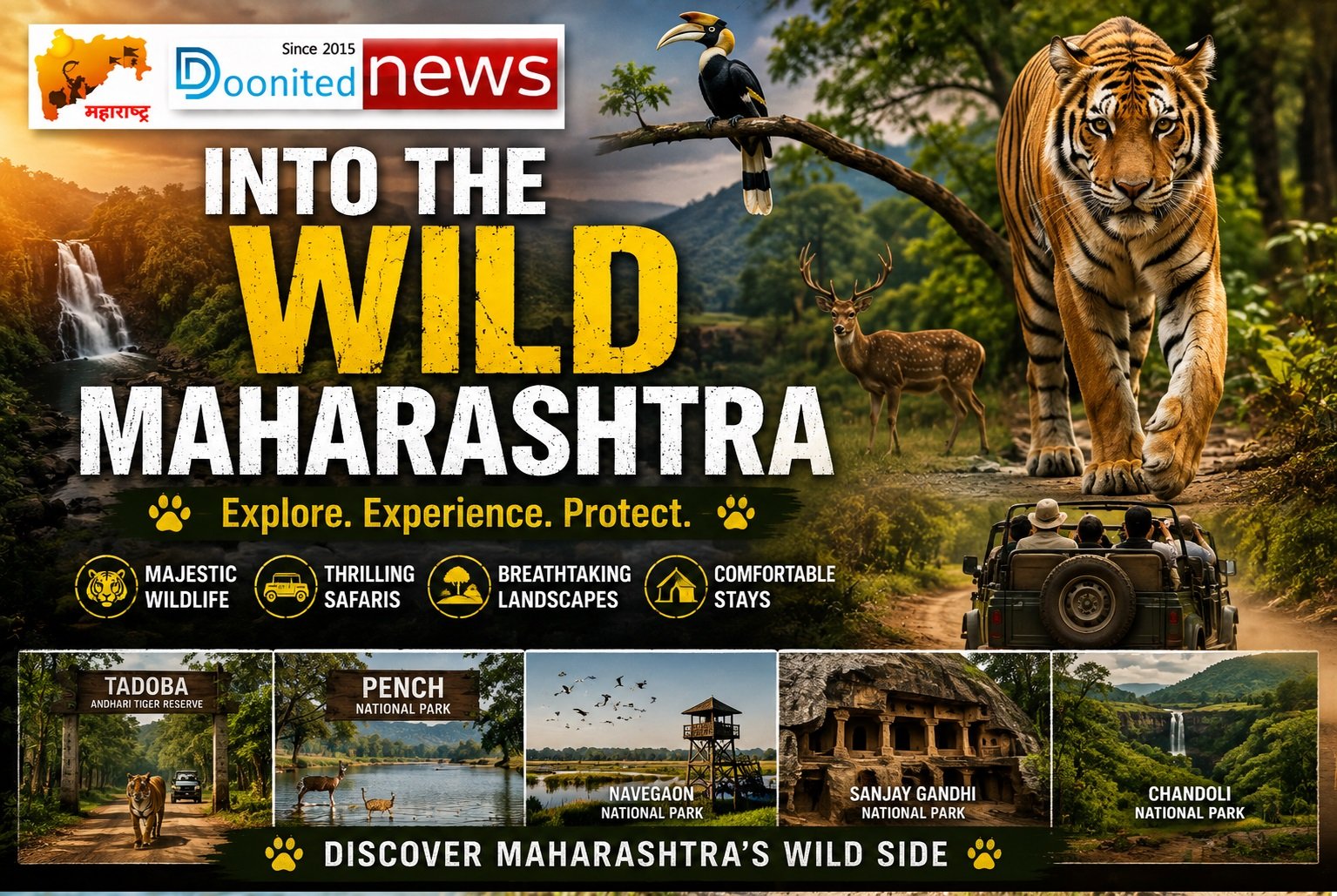
Into the Wild Maharashtra: The History, Safari, Best Time & Stay Guide to the State’s Major National Parks
By Pradeep Banerjee, Editor | Doonited News
The first sound I heard at dawn in Tadoba Andhari Tiger Reserve was not a tiger’s roar. It was the alarm call of a spotted deer, sharp and urgent, echoing through the teak forest. The safari jeep stopped. The forest held its breath. Somewhere in the bamboo, an unseen predator moved.
That moment reminded me that Maharashtra is not only the land of forts, saints, and cities; it is also one of India’s great wildlife states. From the tiger forests of Vidarbha to the evergreen valleys of the Western Ghats, Maharashtra’s national parks tell a story of survival—of forests protected, species revived, and landscapes that continue to inspire wonder.
This is a journey through the major national parks and tiger reserves of Maharashtra—their history, wildlife, safari experience, best time to visit, and where to stay.

1. Tadoba Andhari Tiger Reserve: Maharashtra’s Tiger Capital
Tadoba Andhari Tiger Reserve is the most famous wildlife destination in Maharashtra.
History
The reserve began as Tadoba National Park in 1955. In 1986 it was merged with the Andhari Wildlife Sanctuary to form the present tiger reserve. Named after the local tribal deity Taru (Tadoba) and the Andhari River, it became one of the early beneficiaries of India’s Project Tiger.
What makes it special?
-
High tiger density
-
Excellent chances of tiger sightings
-
Leopards, sloth bears, wild dogs, gaur, and crocodiles
-
Beautiful teak and bamboo forests
Best time to visit
|
Season |
Experience |
|---|---|
|
Oct–Feb |
Cool weather, lush forest, ideal for families |
|
Mar–Jun |
Best tiger sightings near waterholes |
|
Jul–Sep |
Park mostly closed due to monsoon |
Safari
-
Morning and evening jeep safaris
-
Popular gates: Moharli, Kolara, Navegaon, Pangdi
-
Advance online booking recommended
Where to stay
-
Svasara Jungle Lodge
-
Tadoba Tiger King Resort
-
Tadoba Jungle Camp
-
Maharashtra Tourism (MTDC) accommodations near Moharli
Fun fact
Tadoba is often called “The Land of Tigers” because many visitors spot multiple tigers during a single trip.
2. Pench National Park: The Jungle Book Forest
Straddling Maharashtra and Madhya Pradesh, Pench National Park inspired Rudyard Kipling’s *The Jungle Book*.

History
Pench was declared a sanctuary in 1975 and later a national park. It became a tiger reserve under Project Tiger in 1992.
Wildlife highlights
-
Tigers
-
Leopards
-
Wild dogs (dhole)
-
Jackals
-
Sambar and chital deer
-
Rich birdlife
Best time
November to April offers pleasant weather and good wildlife visibility.
Safari experience
The Turia and Sillari gates are popular among tourists. Pench safaris are known for excellent birdwatching and open forest landscapes.
Stay options
-
Pench Tree Lodge
-
Tuli Tiger Resort
-
Pench Jungle Camp
-
Forest rest houses (limited availability)
Fun fact
The character Mowgli is closely associated with the Pench landscape, and several tourism zones celebrate this connection.
3. Navegaon National Park: Vidarbha’s Bird Paradise
Navegaon National Park is less famous for tigers and more famous for birds and wetlands.

History
The area around Navegaon Lake was developed during the 18th century, and the national park was officially established in 1975.
Why visit?
-
Huge freshwater lake
-
Migratory birds in winter
-
Watchtowers and boating
-
Ideal for families and photographers
Best time
November to February is excellent for migratory birds.
Safari
Short forest drives and lake exploration are the main attractions rather than tiger-focused safaris.
Stay
-
MTDC Navegaon
-
Forest guest houses
-
Budget lodges in nearby Gondia district
Fun fact
More than 200 bird species have been recorded in the park.
4. Sanjay Gandhi National Park: A Forest Inside Mumbai
Few world cities can claim a national park within their limits. Sanjay Gandhi National Park is one of the largest protected urban forests in the world.

History
Originally protected as Krishnagiri National Park in 1969, it was later renamed after Sanjay Gandhi.
Unique attractions
-
Leopards living near a megacity
-
Kanheri Buddhist Caves
-
Nature trails and cycling
-
Butterfly diversity
-
Tulsi and Vihar lakes
Best time
October to February is the most comfortable period.
Safari
A short lion and tiger safari is available, though the park is primarily a nature and heritage destination.
Stay
Most visitors stay in Mumbai city; the park is easily accessible from suburban Mumbai.
Fun fact
The park receives millions of visitors annually, making it one of the most visited national parks in Asia.
5. Chandoli National Park: The Western Ghats Wilderness
Chandoli National Park forms part of the Sahyadri Tiger Reserve and the UNESCO-recognized Western Ghats biodiversity hotspot.

History
Declared a national park in 2004, Chandoli protects evergreen forests, rivers, and wildlife corridors of the Sahyadri ranges.
Wildlife
-
Gaur
-
Leopard
-
Sloth bear
-
Sambar
-
Malabar giant squirrel
-
Rich endemic flora
Best time
October to March offers pleasant weather and green landscapes.
Activities
-
Forest safaris
-
Nature walks
-
Waterfall visits
-
Trekking in designated areas
Stay
-
MTDC Chandoli
-
Eco-resorts near Chandoli Dam
-
Forest accommodations (advance permission required)
Fun fact
Chandoli’s forests receive heavy monsoon rainfall, creating spectacular seasonal waterfalls.
Quick Comparison Guide
|
Park |
Famous For |
Best Season |
|---|---|---|
|
Tadoba |
Tiger sightings |
Mar–Jun |
|
Pench |
Jungle Book forests |
Nov–Apr |
|
Navegaon |
Birds and lake |
Nov–Feb |
|
Sanjay Gandhi |
Urban wildlife |
Oct–Feb |
|
Chandoli |
Western Ghats wilderness |
Oct–Mar |
Suggested Wildlife Circuits
3-Day Vidarbha Tiger Circuit
-
Day 1–2: Tadoba
-
Day 3: Navegaon
4-Day Nagpur Wildlife Circuit
-
Day 1–2: Pench
-
Day 3–4: Tadoba
3-Day Western Maharashtra Nature Circuit
-
Chandoli National Park
-
Sahyadri forest trails
-
Nearby hill stations
Practical Safari Tips
Wear earthy colors such as olive, brown, or khaki.
Carry binoculars and a camera with extra batteries.
Maintain silence during safaris; wildlife is often heard before it is seen.
Summer safaris can be very hot; carry water, a cap, and sunscreen.
Book safari permits well in advance, especially for weekends and holidays.
Respect forest rules; never feed animals or litter inside protected areas.
The Human Story Behind the Forests
What moved me most during these journeys was not only the wildlife but the people who protect it—forest guards walking long patrols, local guides identifying birds by sound, women running eco-tourism homestays, and villagers who now see living forests as a shared heritage rather than a distant government boundary.
Maharashtra’s parks are living classrooms where conservation, tourism, and community livelihoods meet.
Final Reflection: Why Every Maharashtrian Should Visit These Parks
Standing beside a forest waterhole at sunrise, watching mist lift from the trees while deer step cautiously into the light, one understands something profound: cities teach us speed; forests teach us attention.
Tadoba teaches awe. Pench teaches imagination. Navegaon teaches patience. Sanjay Gandhi teaches coexistence. Chandoli teaches humility before nature.
Together, these parks form the wild heart of Maharashtra. They remind us that beyond highways, factories, and skylines, there still exists a landscape where the tiger walks, the hornbill calls, and the monsoon writes green poetry across the Sahyadri hills.
And perhaps that is the greatest safari of all—not the search for a tiger, but the rediscovery of our connection with the natural world.