
OTT Releases This Week: The fourth week of September is bringing something increasingly familiar to Indian viewers: there is no shortage of things to watch, only a shortage of time to watch them.
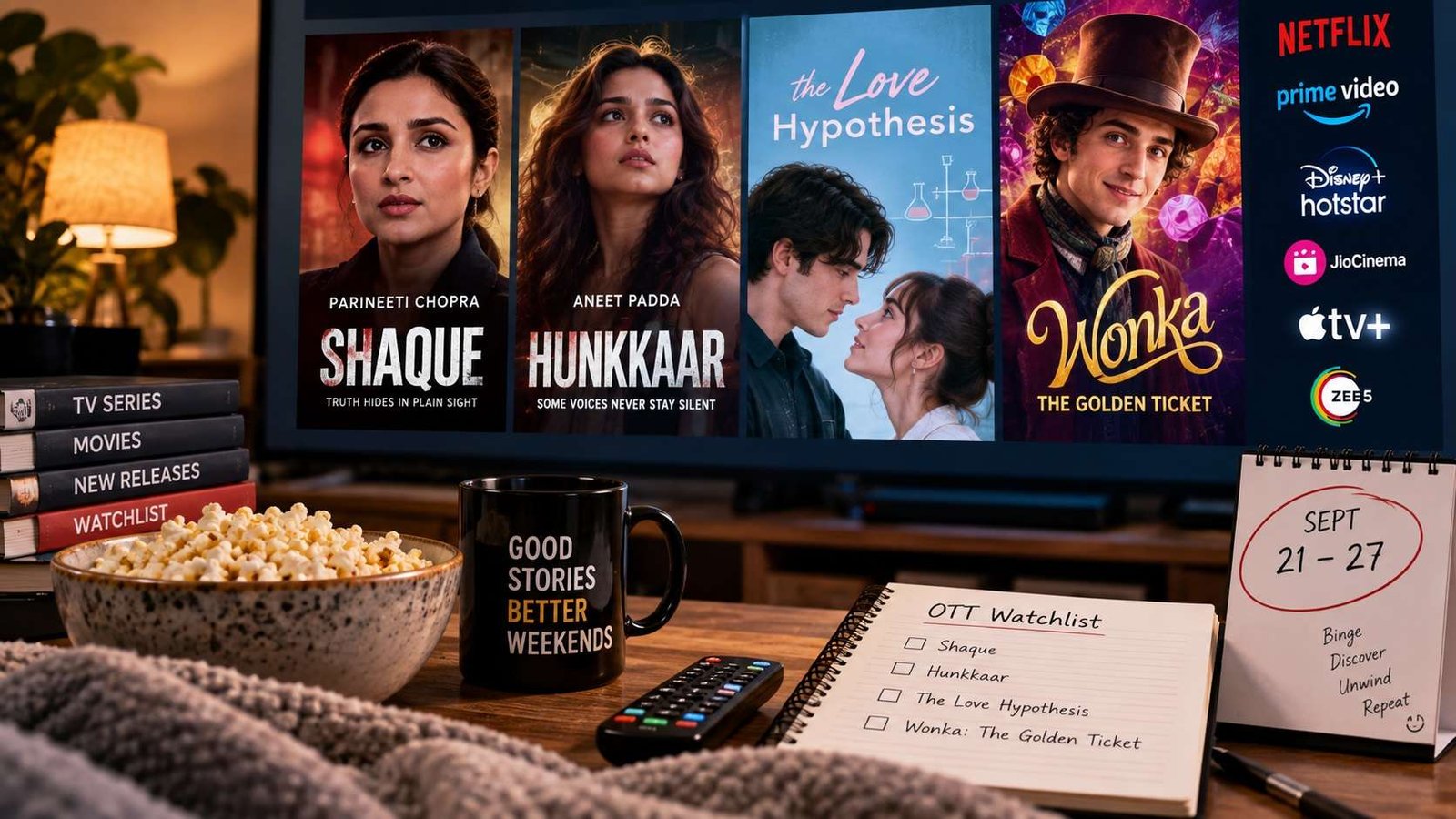
From a missing-child mystery featuring Parineeti Chopra to a courtroom thriller led by Aneet Padda, a new romantic comedy, an international crime drama and a Willy Wonka-inspired reality competition, streaming platforms are filling the week of September 21–27, 2026 with a remarkably varied slate.
The week’s releases span Netflix, Prime Video, Apple TV and JioHotstar, with Indian and international productions competing for the same increasingly valuable commodity—your evening.
And there is an interesting change beneath the entertainment headlines: Indian viewers are no longer consuming “international content” as a separate category. Global and Indian releases now sit side by side on the same home screen.
Shaque: Trust No One — Netflix
Streaming: September 24
One of the week’s biggest Indian OTT arrivals is Shaque: Trust No One, which marks Parineeti Chopra’s OTT series debut.
The mystery thriller follows a mother whose newborn daughter is abducted from a hospital. Nine years later, photographs apparently showing the missing child force her to revisit the disappearance and question the people closest to her.
The series also stars Jennifer Winget, Tahir Raj Bhasin, Soni Razdan, Sumeet Vyas, Anup Soni and Harleen Sethi.
The premise is deliberately built around uncertainty: when years have passed, is new evidence a breakthrough—or another trap?
That makes the title particularly suited to the streaming environment, where mystery series benefit from viewers discussing theories episode by episode.
Parineeti Chopra’s move into a series format is another sign of how the distinction between Bollywood cinema and streaming careers continues to blur.
Hunkkaar: The Roar — JioHotstar
Streaming: September 25
Aneet Padda returns to the screen with Hunkkaar: The Roar, a socio-courtroom thriller centred on 17-year-old Meenu Rawat.
The story begins with Meenu’s accusation against Sunil Chakosi, a powerful spiritual leader known to followers as “Baapji”. As the matter enters the legal system, the narrative expands into questions surrounding faith, influence, fear and institutional power.
The cast includes Fatima Sana Shaikh, Mohammed Zeeshan Ayyub, Arjun Mathur, Raghubir Yadav and Ram Kapoor.
The timing is notable for Padda, whose recent visibility has increased substantially following Saiyaara. Current reporting identifies Hunkkaar as her first project following that breakthrough.
Rather than being a conventional courtroom procedural, the series appears designed to combine social questions with legal drama.
That gives Indian OTT audiences something more substantial than another detective asking everyone in the room where they were at 9 p.m.
Don’t Be Shy — Prime Video
Streaming: September 25
For viewers looking for something lighter, Prime Video is bringing Don’t Be Shy, a coming-of-age romantic comedy.
Aarushi Bajaj plays Shyamili “Shy” Das, whose carefully organised life becomes complicated by friendship, first love and a shifting relationship between childhood connections and new relationships.
The film is produced by Alia Bhatt and Shaheen Bhatt under Eternal Sunshine Productions and also features Kunaal Roy Kapur, Anurag Basu, Neha Dhupia and Anju Alva Naik.
Its appeal lies in a familiar youth-story formula, but its presence on a global streaming service also reflects how Indian stories aimed at younger audiences increasingly travel beyond traditional theatrical distribution.
For the international Indian audience, that matters.
A viewer in Dubai, London, Toronto or Melbourne can encounter the same Indian release at essentially the same time as someone watching from Mumbai or Delhi.
The diaspora viewing room is no longer geographically separate.
The Love Hypothesis — Prime Video
Streaming: September 23
Romance takes the international route with The Love Hypothesis, based on Ali Hazelwood’s bestselling novel.
The story follows Olive, a PhD student who impulsively kisses professor Adam Carlsen and then enters a fake relationship designed to convince her best friend that she has moved on from a crush.
Naturally, the arrangement becomes less fake.
The film arrives on Prime Video on September 23.
The popularity of university-set romance stories also illustrates the increasingly international nature of streaming audiences. Academic settings, workplace relationships and young-adult dilemmas can travel surprisingly well when the emotional premise is easy to understand.
Science may be complicated.
Fake dating remains remarkably universal.
Wonka’s The Golden Ticket — Netflix
Streaming: September 23
Netflix is taking audiences into a recreated version of Willy Wonka’s famous chocolate factory with Wonka’s The Golden Ticket.
The reality competition features 12 pairs of contestants competing in challenges involving physical ability, intelligence and moral choices.
The production also marks the 55th anniversary of the 1971 Willy Wonka & the Chocolate Factory and incorporates the famous factory setting as part of the competition concept.
It is a good example of another major streaming strategy: taking an established piece of popular culture and converting it into a new format.
Instead of simply remaking the story, the platform turns the fantasy world itself into a competition arena.
Nostalgia, it seems, has acquired a production budget.
Brothers — Apple TV
Streaming: September 23
For Hollywood comedy, Apple TV brings Brothers, starring Matthew McConaughey and Woody Harrelson as fictionalised versions of themselves.
The story plays on the long-running joke about the real-life friends looking as though they could actually be brothers.
A family visit to Matthew’s Texas ranch takes an unexpected turn when a decades-old secret about their parentage emerges. The plot also has McConaughey’s character considering a political career and potentially running for governor of Texas.
The casting itself is part of the joke.
McConaughey and Harrelson’s real-world friendship gives the fictional premise an extra layer that a conventional buddy comedy would not have.
Minerva Academy, Habeas Corpus and My Sad Dead
The week isn’t only about major stars.
Netflix is also introducing Minerva Academy, a drama set at a military high school in Naples, following three teenagers with very different backgrounds and ambitions. It arrives September 22.
Habeas Corpus, streaming September 23, centres on a law professor and former defence lawyer investigating a potentially wrongful conviction with her students.
Then comes My Sad Dead, a four-part supernatural mystery arriving September 24. It follows a retired doctor with an unusual ability to communicate with the dead after a series of murders disrupts her neighbourhood.
Together, these releases demonstrate how streaming platforms are increasingly relying on genre diversity rather than a single blockbuster to maintain attention throughout the week.
What This Week Says About India’s Streaming Audience
The most interesting feature of the September 21–27 slate is not any individual title.
It is the coexistence of Indian and international entertainment on the same platforms.
An Indian viewer can move from Shaque to The Love Hypothesis, then to a Korean, African, European or American production without changing the basic viewing environment.
That has consequences for Indian content creators.
Indian films and series are no longer competing only against other Indian productions. They are competing against the world’s best-funded entertainment industries for the same two hours of viewer attention.
At the same time, Indian stories have gained a distribution advantage that previous generations of filmmakers could hardly have imagined.
A Hindi thriller does not need to wait for an overseas theatrical release to reach an Indian-origin audience in London, Toronto, Dubai, Singapore or Melbourne.
The platform can deliver it directly.
Doonited Editorial Perspective
The September OTT calendar shows that India’s entertainment relationship with the world is becoming less about “exporting Bollywood” and more about participating in a genuinely global streaming ecosystem.
Indian audiences are consuming international stories while Indian productions are travelling in the opposite direction.
That two-way traffic is culturally significant.
But the competition is becoming tougher too.
A streaming subscriber does not owe any platform loyalty to a particular language, country or industry. If one story fails to hold attention, another is one click away.
For Indian creators, global distribution is therefore both an opportunity and a test.
The world is now watching.
And, perhaps more importantly, Indian viewers are watching the world.
DOONITED INSIGHT
The biggest change in OTT is not that more content is available. It is that geography is losing its power to decide what audiences watch.
An Indian family in Delhi and an Indian-origin family in London can increasingly discover the same Indian story on the same evening.
That is not merely a technology story.
It is a cultural shift.
Meaningful Learning for Readers
For viewers, the practical lesson is simple: don’t choose only by platform or star name.
This week’s releases cover mystery, courtroom drama, romance, comedy, supernatural fiction, reality competition and youth drama. The variety means viewers can match a title to their mood rather than forcing themselves through whatever happens to be trending.
And for Indian creators, there is an even bigger lesson:
Global streaming access creates global competition—but it also creates a global audience.


World Beyond the News
Bees Communicate Where Food Is
Honeybees use movement patterns known as waggle dances to communicate information about food locations.
Street Food Reflects Local History
Many famous street foods developed from migration, trade, local ingredients and the everyday needs of working communities.
A Day on Venus Is Extremely Long
Venus rotates so slowly that one rotation relative to distant stars takes longer than its trip around the Sun.
Human Achievement Continues to Push Limits
Athletes, engineers, scientists and explorers regularly establish new benchmarks in speed, endurance, scale and precision.