
Shantanu Narayen’s Adobe Legacy: Can Anil Chakravarthy Lead the Company Into the Agentic AI Era?
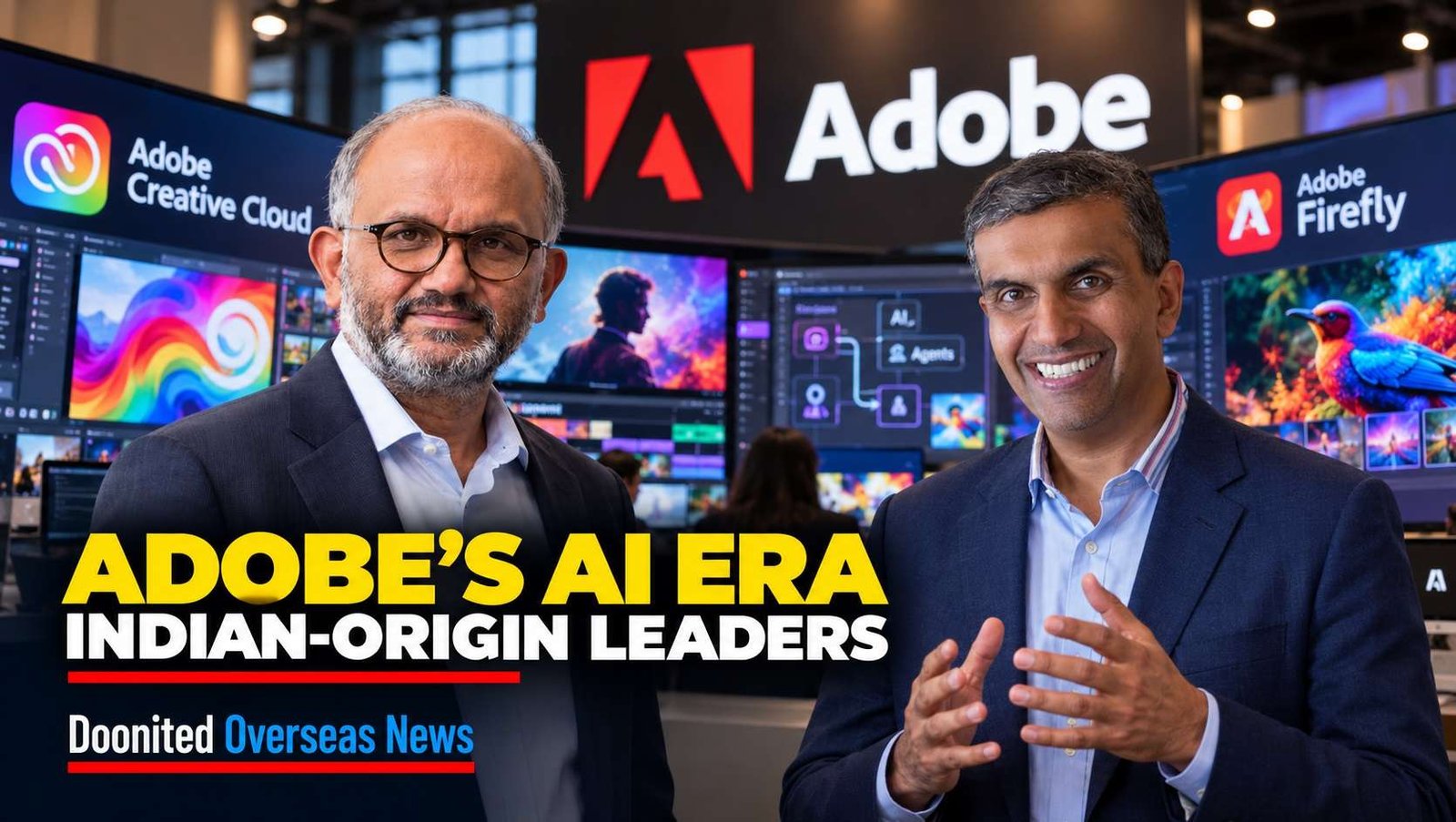
After 18 years as Adobe CEO, Indian-origin technology leader Shantanu Narayen will become executive chair on December 1, 2026, handing the CEO role to fellow Indian-origin executive Anil Chakravarthy. The transition gives Adobe something unusual in Silicon Valley: continuity of Indian-origin leadership at a moment when AI is redefining creative software and digital marketing.
Adobe is preparing for a historic leadership change—but not a dramatic break with its past.
On December 1, 2026, Shantanu Narayen will step down as Adobe’s chief executive after 18 years and become executive chair. He will be succeeded by Anil Chakravarthy, currently president of Adobe’s Customer Experience Orchestration business and worldwide field operations. Chakravarthy will also join Adobe’s board.
The transition is significant for Adobe.
It is also significant for the global Indian community.
Two Indian-origin technology executives are at the centre of Adobe’s leadership transition, with Narayen’s extraordinary tenure giving way to a successor who has already spent more than six years helping shape Adobe’s enterprise and AI strategy.
The bigger question is whether Chakravarthy can take the company through the next technological shift: from cloud-based creative software to an era of agentic AI that can participate directly in creative, marketing and customer-experience workflows.
Narayen’s 18-year transformation
When Narayen became Adobe CEO in 2007, the company was best known for products such as Photoshop, Illustrator and Acrobat.
Much of that software was historically sold through licences.
Under Narayen, Adobe made one of the technology industry’s most consequential business-model transitions: it moved its major creative products toward subscription-based Creative Cloud services.
That transition was initially controversial among some customers, but it ultimately changed Adobe’s economics and relationship with its users.
Narayen told Adobe employees in March that during his tenure the company had grown from approximately 3,000 employees to more than 30,000, while annual revenue increased from less than $1 billion to more than $25 billion. He also said Adobe’s technology had reached billions of people either directly or through digital experiences created using its products.
That is the first part of Narayen’s legacy.
The second is arguably more important now.
He helped position Adobe for the AI era.
From Creative Cloud to creative AI
Adobe did not arrive at generative AI from outside the creative industry.
It already possessed decades of expertise in image editing, design, video, documents, fonts, digital marketing and creative workflows.
The emergence of generative AI therefore presented both an opportunity and a threat.
AI models could generate images, video and text increasingly well. That created the possibility that users might need fewer traditional creative applications.
Adobe’s response was to put AI inside the professional creative workflow, rather than treating it simply as a replacement for Photoshop or Illustrator.
Firefly became the centre of that strategy.
In 2026, Adobe expanded Firefly into what it describes as a creative AI studio, while introducing a creative agent capable of orchestrating multi-step workflows across Photoshop, Premiere, Illustrator, InDesign and Frame.io.
That is an important strategic shift.
Instead of telling users, “AI can make the content for you,” Adobe is increasingly saying:
Tell the system what outcome you want, and let AI coordinate the tools required to get there—while the human remains the creative decision-maker.
Adobe’s own 2026 global creator research found that 85% of surveyed creators said the final creative decision should remain theirs, despite the increasing role of AI in their workflows.
That principle could become central to Adobe’s competitive positioning.
Why Anil Chakravarthy is an interesting successor
Chakravarthy is not an outsider brought in to disrupt Adobe.
He is an insider with experience across enterprise software, data management and Adobe’s customer-experience business.
He joined Adobe in January 2020 to lead Digital Experience. Later that year he also assumed responsibility for worldwide field operations, and in December 2021 became president of Digital Experience and worldwide field operations.
Before Adobe, Chakravarthy was CEO of Informatica for four years and had previously held senior roles at Informatica, Symantec, VeriSign and McKinsey.
His academic background is also strongly technical: a Bachelor of Technology in Computer Science and Engineering from the Institute of Technology, Varanasi, followed by a master’s degree and PhD from MIT.
That combination is particularly relevant to Adobe’s next phase.
Chakravarthy has been working on the part of Adobe where AI, data, marketing, customer experience and enterprise software intersect.
Adobe is moving beyond creative AI
The coming Adobe is therefore likely to be considerably larger than Photoshop plus Firefly.
Under Chakravarthy’s leadership of Customer Experience Orchestration, Adobe has developed products including Adobe CX Enterprise, GenStudio and Brand Visibility.
Adobe’s CX Enterprise strategy is designed around agentic AI that can help businesses manage customer journeys, content and engagement across multiple stages of the customer lifecycle.
The company is also adapting to a fundamental change in how consumers discover businesses.
People increasingly ask AI systems for recommendations rather than beginning every journey with a conventional search engine.
Adobe’s Brand Visibility product is designed around that emerging environment, helping companies understand how their brands appear across AI-powered search and discovery surfaces. Adobe reported that AI traffic to U.S. retail websites increased 1,324% between October 2024 and May 2026, while travel-sector AI traffic increased 2,215% over the same period.
These are Adobe’s own measurements rather than an independent industry-wide estimate, but they illustrate the strategic problem the company is trying to solve.
The internet’s discovery layer is changing.
Adobe wants to provide the tools businesses use to survive that change.
The Indian-origin leadership story is unusually strong
There is another dimension that makes this succession noteworthy.
Adobe is not simply replacing one CEO with another technology executive.
It is transferring leadership from one Indian-origin technology leader to another.
Narayen was born in Hyderabad and educated in India and the United States. Chakravarthy also received his undergraduate engineering education in India before completing advanced studies at MIT.
Their careers illustrate two different generations of Indian technology migration.
Narayen represents the generation that moved from engineering and enterprise software into the leadership of a major American technology company.
Chakravarthy represents a later generation whose career has moved through global enterprise technology, data infrastructure and increasingly AI-driven business transformation.
For the Indian diaspora, that continuity is more meaningful than a simple nationality statistic.
It demonstrates how Indian technical education can become the foundation for global technology leadership decades later.
India’s creators are already part of Adobe’s AI story
The India connection is also becoming commercially important for Adobe.
In August 2026, Adobe reported that 96% of Indian creators surveyed who use creative AI said it had accelerated the growth of their business or audience, while 85% said creative AI was integrated or essential to their workflow.
The survey covered more than 16,000 creators across eight countries, including India.
This is particularly relevant as India’s creator economy expands across YouTube, Instagram, advertising, e-commerce, film, gaming, design and independent digital businesses.
Adobe therefore has an enormous potential market among Indian creators—not simply as software subscribers, but as entrepreneurs whose businesses increasingly depend on producing large amounts of visual and digital content.
And many of those creators are themselves part of the Indian diaspora.
Indian-origin creators working in the United States, United Kingdom, Canada, Australia, the Gulf and Southeast Asia operate in the same global digital economy.
Adobe’s global AI strategy is also becoming more open
Another important part of the transition is Adobe’s decision not to keep its creative AI capabilities entirely inside Adobe applications.
In June, the company announced that its creative agent and professional creative tools were being brought to platforms including ChatGPT, Claude, Copilot, Gemini and Slack.
That strategy reflects an important reality.
AI is making software more interconnected.
Users may no longer open Photoshop first and then begin a task.
They may start by talking to an AI assistant and invoke Photoshop, Premiere or another Adobe capability through that conversation.
Adobe therefore needs its technology to remain valuable even when Adobe’s own application is not the first interface the user sees.
That is a difficult strategic challenge—but potentially a powerful one.
The risks facing Chakravarthy
The succession should not be viewed simply as a victory lap.
Adobe faces serious competitive pressure.
Generative AI has dramatically reduced the cost and complexity of creating images, video and other digital content. New AI-native companies are moving rapidly, while technology giants such as Microsoft, Google, OpenAI and others are incorporating creative capabilities into their own ecosystems.
Adobe therefore has to prove that professional-grade creative control, trusted workflows and enterprise integration are worth paying for when increasingly capable AI tools are becoming widely accessible.
There are also questions around copyright, creator compensation, training data, provenance and the authenticity of AI-generated content.
Adobe has positioned Firefly around commercially safer generative AI and greater creative control, but the broader industry debate is far from settled.
The company’s future will depend partly on whether it can persuade professionals that AI enhances their creative authority rather than undermining it.
Narayen’s real legacy may be the succession itself
Narayen’s most important achievement may ultimately be more than the subscription transition or Adobe’s financial growth.
It may be that he leaves behind a company with a credible succession plan at precisely the moment when its industry is being disrupted again.
Adobe says Chakravarthy is the right leader for its next chapter because of his experience building its Customer Experience Orchestration business, developing AI-powered products and working with enterprise customers. Narayen has also said he will work closely with Chakravarthy after the transition. Adobe Newsroom
That creates continuity without simply preserving the status quo.
Narayen transformed Adobe from a software-licensing company into a cloud-subscription powerhouse. Chakravarthy now has to transform that cloud platform into an intelligent, agentic technology ecosystem.
The first transformation changed how Adobe sold software.
The second could change what Adobe’s software actually does.
For the global Indian community, there is an additional lesson.
Narayen’s journey showed that an Indian-born engineer could lead one of America’s defining creative-software companies.
Chakravarthy’s appointment suggests something even more interesting: Indian-origin leadership is now becoming part of the succession pipeline at the highest levels of global technology—not just an exceptional individual success story.
Indian-origin global leadership + India’s growing creator economy + the worldwide AI transformation.
The leadership change also has a practical dimension for Indian and diaspora professionals in design, marketing, advertising, software, media, content creation and digital entrepreneurship.
Adobe’s evolution suggests that the next generation of creative work will increasingly combine human judgment, professional software and AI agents.
For Indian creators building global audiences, that is not a distant technology trend.
It is already becoming part of how they make a living.

World Beyond the News
Octopuses Can Change Their Appearance
Octopuses can rapidly alter their skin colour and texture to communicate, camouflage themselves and respond to danger.
Some Cities Exist Across Two Continents
A small number of cities are geographically associated with two continents, creating unusual cultural and geographic identities.
Earth’s Climate Is Measured in Many Ways
Scientists track temperature, atmospheric gases, sea level, ice cover and other indicators rather than relying on a single climate number.
Streaming Changed How Audiences Discover Shows
Recommendation systems and global streaming releases allow audiences to discover programmes far beyond their original markets.