
Vilas Dhar: The Indian-American Shaping the Global Debate on AI, Power and Public Good
As governments and technology companies compete to define artificial intelligence, Vilas Dhar is arguing that the bigger contest is about who gets to shape the rules. From philanthropy and civil society to the United Nations and India’s AI ecosystem, his work places an Indian-origin voice inside one of the world’s most consequential technology debates.
Artificial intelligence is increasingly being discussed as a race: who has the most powerful models, the largest data centres, the fastest chips and the deepest pools of capital.
Vilas Dhar wants the world to ask a different question: who governs the technology once it becomes part of everyday life?
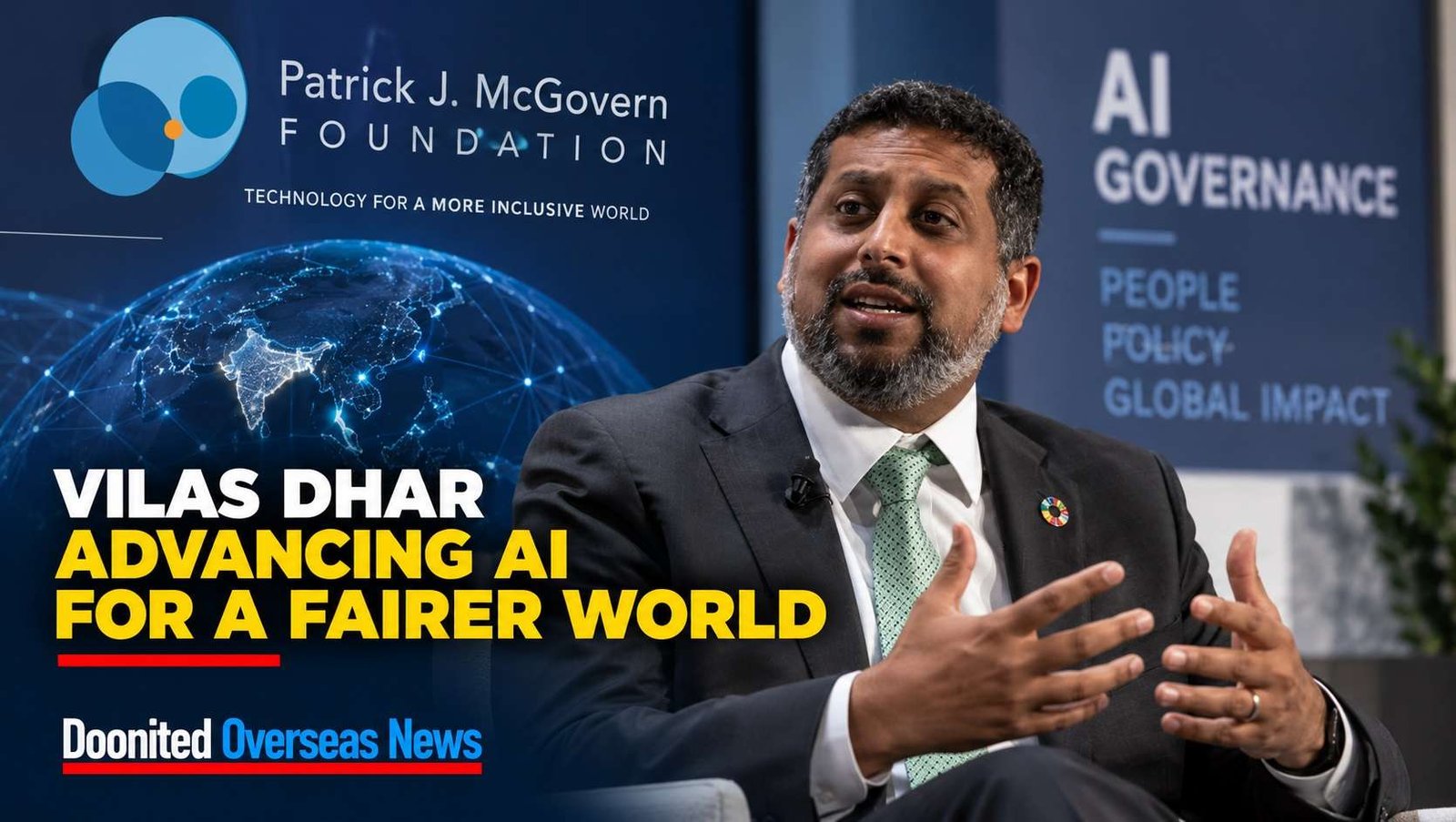
As President of the Patrick J. McGovern Foundation, Dhar leads a $1.5 billion philanthropy focused on artificial intelligence, data science and social impact. Under his leadership, the foundation says it has directed more than $500 million in commitments toward public-purpose AI, supporting work involving climate action, public health, education, human rights, journalism and democratic governance.
For Doonited Overseas, Dhar’s story is significant for another reason. He represents a growing category of Indian-origin global leaders whose influence is not confined to technology companies. They are helping shape the institutions, policies and civic systems around technology.
That distinction may become increasingly important as AI begins affecting the lives of Indians and Indian-origin communities across borders.
From computer science to AI governance
Dhar’s professional profile sits at an unusual intersection.
He is trained in computer science and biomedical engineering, but also holds a law degree and a master’s in public administration. His academic credentials include bachelor’s degrees in biomedical engineering and computer science from the University of Illinois, a JD from New York University School of Law and an MPA from Harvard Kennedy School. The Patrick J. McGovern Foundation has also described his doctoral research at the University of Birmingham as focused on policy and economic infrastructure for a data-enabled society.
That combination helps explain the direction of his work.
Rather than treating AI solely as a technical product, Dhar approaches it as a question of institutions: who has access to technology, who controls data, who benefits economically, who bears the risks and whether communities have any meaningful say in how AI is deployed.
The foundation describes him as an entrepreneur, technologist and human-rights advocate working to strengthen social institutions and broaden opportunity.
His current portfolio extends well beyond philanthropy. He serves on the UN Secretary-General’s High-Level Advisory Body on AI and has roles connected to the Global Partnership on AI, OECD AI work, the World Economic Forum and Stanford’s Institute for Human-Centered Artificial Intelligence.
The $1.5 billion question: what should AI serve?
The scale of the McGovern Foundation matters because philanthropy can influence areas where commercial incentives are weak.
The foundation’s recent funding provides a useful illustration. In 2025, it announced $75.8 million across 149 grants supporting organisations in 13 countries. Projects covered climate resilience, human rights, journalism, crisis response, digital literacy and health equity. The foundation said this brought its AI-related grant commitments over the preceding decade to more than $500 million.
The strategy is not simply to give money to organisations experimenting with AI.
The foundation also describes programs that provide nonprofits with data scientists, technical experts and long-term assistance to develop their own data and AI capabilities. Its Data and Society work aims to help civil-society organisations build the technical capacity to use data responsibly rather than remain dependent on outside technology providers.
That is an important distinction.
If AI becomes essential infrastructure, access to AI expertise could become as important as access to physical infrastructure. A government agency, nonprofit or community organisation that cannot understand algorithms, evaluate models or manage data could increasingly find itself dependent on systems designed elsewhere.
Dhar’s argument is that this creates a governance problem, not merely a technology problem.
India becomes part of the conversation
Dhar’s connection with India has become particularly visible during the country’s push to establish itself as a major participant in the global AI ecosystem.
At the India AI Impact Summit in February 2026, Dhar was listed among the speakers at multiple events examining AI governance and the public interest. A UN event in New Delhi featuring the Global Dialogue on AI Governance also focused on connecting national and regional AI initiatives with emerging international governance mechanisms. United Nations
In a February 2026 interview around the summit, Dhar argued that India has a distinctive opportunity to build AI infrastructure for public benefit. The discussion highlighted the potential of India’s digital public infrastructure, large population and technical workforce while also stressing the importance of governance.
This gives his India connection greater significance than simply being an Indian-origin success story.
India is simultaneously a huge technology market, a software and engineering hub, a major source of global technology workers and an increasingly important participant in international discussions over AI.
That makes India a useful test case for Dhar’s broader argument: Can a country use AI at population scale while ensuring that the benefits do not accrue only to the companies building the technology?
Why the diaspora should pay attention
For Indians living abroad, AI governance is already becoming a practical issue.
Indian-origin professionals are heavily represented across software engineering, data science, medicine, finance, research and technology entrepreneurship. They are working in countries that are developing very different approaches to privacy, automated decision-making, workplace AI, copyright, cybersecurity and regulation.
A software engineer in California, a doctor in London, a researcher in Germany or an entrepreneur in Singapore may all face different rules governing the same underlying technology.
That creates a new challenge for the global Indian professional community.
The diaspora has historically benefited from international mobility of talent. But AI is making the mobility of data, skills and technological infrastructure equally important.
Questions about who can train models on particular datasets, where data can be processed, whether automated systems can make employment decisions and how AI-generated material is regulated could increasingly affect international careers and businesses.
Dhar’s work sits directly in that emerging space.
AI and the danger of concentrating power
One of Dhar’s recurring arguments is that technological power should not remain concentrated in a small number of companies or institutions.
In a 2026 essay, he argued that the central AI battle is ultimately about governance and who gets to decide how technology affects society. His criticism is aimed not at innovation itself, but at the assumption that technological progress automatically produces social progress. Patrick J. McGovern Foundation
That is an increasingly relevant debate.
The leading AI companies possess enormous computing resources, sophisticated models and access to capital that governments, universities and civil-society organisations cannot easily match.
Yet governments will ultimately be responsible for questions involving employment, public services, national security, education and citizen rights.
The uncomfortable question is whether democratic institutions can develop the technical expertise necessary to govern systems that are becoming more complicated every year.
Dhar’s answer is to treat AI governance as civic infrastructure.
The idea changes the discussion from “How do we regulate AI?” to “What institutions do societies need to make AI accountable?”
The opportunity — and the limitation
There is a strong case for this approach, but it is not without difficulties.
Philanthropic funding can support experiments, research and civil-society capacity, but it cannot substitute for elected governments, public institutions or democratic accountability. Nor can a foundation’s priorities automatically represent the interests of every society in which AI is deployed.
There is also a genuine tension between encouraging innovation and imposing safeguards.
Too little governance can leave people exposed to discrimination, misinformation, surveillance or poorly tested systems. Too much or poorly designed regulation could make it harder for smaller companies, researchers and developing economies to compete.
The challenge is therefore not simply to regulate more.
It is to build better institutions capable of understanding technology while remaining accountable to the public.
An Indian-origin voice in a global debate
Dhar’s trajectory reflects a broader evolution in the role of the Indian diaspora.
Earlier generations of Indian professionals abroad were often celebrated primarily for achievements in engineering, medicine, academia and business. Today’s global Indian community is increasingly represented in another arena: shaping the rules governing technology itself.
Dhar is one example.
His influence extends from philanthropic capital to international AI governance, civil society and public policy. His India engagement also demonstrates that the relationship between India and its global technology community is no longer simply about people leaving India and succeeding overseas.
It is increasingly about ideas, institutions, investment and expertise moving in both directions.
Doonited Overseas Editorial View
The most interesting part of Vilas Dhar’s story is not the size of the foundation he leads. It is the question behind its strategy.
The AI race is frequently measured in models, chips, data centres, valuations and computing power. But societies will ultimately judge AI by different measures: whether it creates opportunity, whether people retain agency, whether institutions can hold powerful actors accountable and whether countries outside the technological frontier can participate.
That makes governance a competitive advantage of its own.
For the Indian diaspora, Dhar’s career offers a particularly relevant lesson. Global influence is no longer created only by building the next technology company. It can also come from building the institutions, policies and public-interest systems that determine what technology becomes.
And as AI moves deeper into everyday life, that may turn out to be one of the most consequential forms of influence of all.

World Beyond the News
Octopuses Can Change Their Appearance
Octopuses can rapidly alter their skin colour and texture to communicate, camouflage themselves and respond to danger.
Some Cities Exist Across Two Continents
A small number of cities are geographically associated with two continents, creating unusual cultural and geographic identities.
Earth’s Climate Is Measured in Many Ways
Scientists track temperature, atmospheric gases, sea level, ice cover and other indicators rather than relying on a single climate number.
Streaming Changed How Audiences Discover Shows
Recommendation systems and global streaming releases allow audiences to discover programmes far beyond their original markets.