
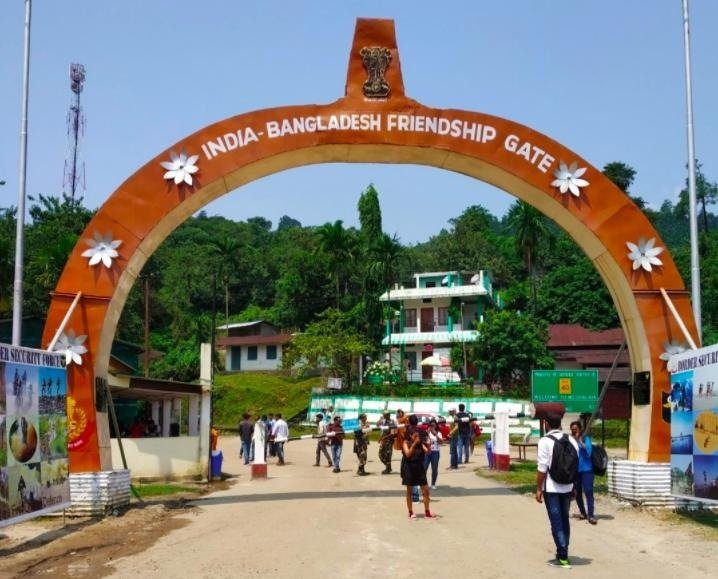
India–Bangladesh Relations: A Neighbourhood Story Built on History, Trade and Shared Rivers
India and Bangladesh share one of South Asia’s most complicated relationships—and perhaps one of its most consequential.
The two countries are neighbours separated by a border, but connected by much more than geography. Their relationship has been shaped by the history of the 1971 Liberation War, Bengali language and culture, cross-border rivers, trade, transport links, energy cooperation and millions of people whose lives are influenced by what happens on either side of the frontier.
The interesting question today is not whether India and Bangladesh have differences. They clearly do.
The more important question is whether the depth of their practical interdependence can continue to provide a foundation for cooperation despite political changes.
A relationship larger than politics
According to India’s Ministry of External Affairs, India and Bangladesh share historical, cultural and linguistic ties and have developed cooperation across political and security matters, trade, development, connectivity, energy and people-to-people exchanges.
That breadth matters because governments can change, but geography does not.
Bangladesh occupies a strategically important position for India’s Northeast, while Bangladesh itself benefits from access to Indian markets, infrastructure and connectivity. The relationship therefore has a practical dimension that goes beyond diplomatic statements.
The recent political turbulence in Bangladesh has tested that relationship. India’s Assistant High Commission in Rajshahi acknowledges that political developments since 2024 affected public perceptions of India and that there were incidents affecting Indian diplomatic properties. At the same time, the mission says high-level communication and bilateral engagement have continued.
That is a more realistic picture than describing the relationship as either permanently friendly or permanently hostile.
Trade creates a powerful reason to keep talking
One of the less dramatic but more important parts of the relationship is commerce.
According to the latest figures published by the Assistant High Commission of India in Rajshahi, India exported US$9.73 billion in goods to Bangladesh during FY2025–26 through February 2026, while imports from Bangladesh were US$1.62 billion, putting reported bilateral merchandise trade at US$11.35 billion for that period.
Trade is not simply an economic statistic.
For businesses, transport operators, farmers, manufacturers and consumers, smoother cross-border commerce can translate into markets, supplies and employment.
The two countries also introduced settlement of bilateral trade in Indian rupees in 2023, intended to reduce transaction costs and dependence on the US dollar for eligible trade. Cooperation has expanded into areas such as startups and textiles as well.
Rivers connect the two countries—and create challenges
Perhaps nowhere is the reality of shared geography clearer than in water.
India and Bangladesh share 54 transboundary rivers. Their water relationship therefore cannot be separated from flood management, agriculture, livelihoods and environmental concerns. The two sides have been exchanging water-level and flood-forecast information on cross-border rivers on a daily basis since July 2023, according to the Indian mission.
This is an important lesson for South Asia: a river does not stop at an international boundary.
Managing such rivers requires communication even when governments disagree on other issues.
Railways, ports and energy tell another story
The relationship has also produced physical connections that would have been difficult to imagine several decades ago.
Six rail links that had existed before 1965 have been revived, with the Agartala–Akhaura connection inaugurated in 2023. Three passenger train services—Maitri Express, Bandhan Express and Mitali Express—were established between cities in India and Bangladesh, although passenger services have faced suspension for security reasons. Freight movement has continued on scheduled routes.
Energy cooperation has become another significant pillar. The Indian mission says Bangladesh currently imports 1,160 MW of electricity from India, while the Maitri Super Thermal Power Plant in Khulna, built with Indian support, supplies electricity to Bangladesh’s national grid.
These projects demonstrate something important: diplomacy becomes more durable when it produces tangible benefits for ordinary people.
The cultural bridge is perhaps the strongest
Politics can generate headlines. Culture often creates quieter and longer-lasting connections.
Rabindranath Tagore and Kazi Nazrul Islam belong to a shared Bengali literary heritage. Music, cinema, festivals, language and family connections continue to create familiarity across the border. The Indian mission describes cultural cooperation as an important bridge between the two societies.
This does not mean cultural similarities eliminate political disagreements. They do not.
But they provide a human foundation on which difficult conversations can take place.
DOONITED Editorial Perspective
India–Bangladesh relations should neither be romanticised nor reduced to the latest political dispute.
There are genuine disagreements, security concerns and periods of mistrust. Those issues deserve honest discussion. But it would be equally misleading to ignore the extensive network of trade, rivers, railways, energy, culture and human connections that has developed over decades.
The intelligent approach is therefore pragmatic: protect the relationship where cooperation benefits both peoples, address disagreements through sustained dialogue, and judge the partnership by what it delivers to people on both sides of the border.
For India, Bangladesh is not simply another foreign-policy file. It is a neighbour whose geography, economy, culture and future are closely intertwined with India’s own.
And in South Asia, sometimes the strongest argument for cooperation is not friendship—it is the simple recognition that neighbours have to find practical ways to live, trade and prosper together.

World Beyond the News
Why Elephants Stay Close to Their Herd
Elephants live in highly social family groups and use calls, touch and body movements to maintain strong bonds.
Most of the Deep Ocean Remains Difficult to Explore
Extreme pressure, darkness and distance make deep-ocean exploration one of Earth’s greatest scientific challenges.
Spacecraft Can Travel Without Traditional Roads
Spacecraft use carefully calculated trajectories and gravity assists to travel enormous distances through space.
Why Movie Trailers Are Released in Stages
Major films often use teaser trailers, full trailers and final promotional spots to build awareness over time.