

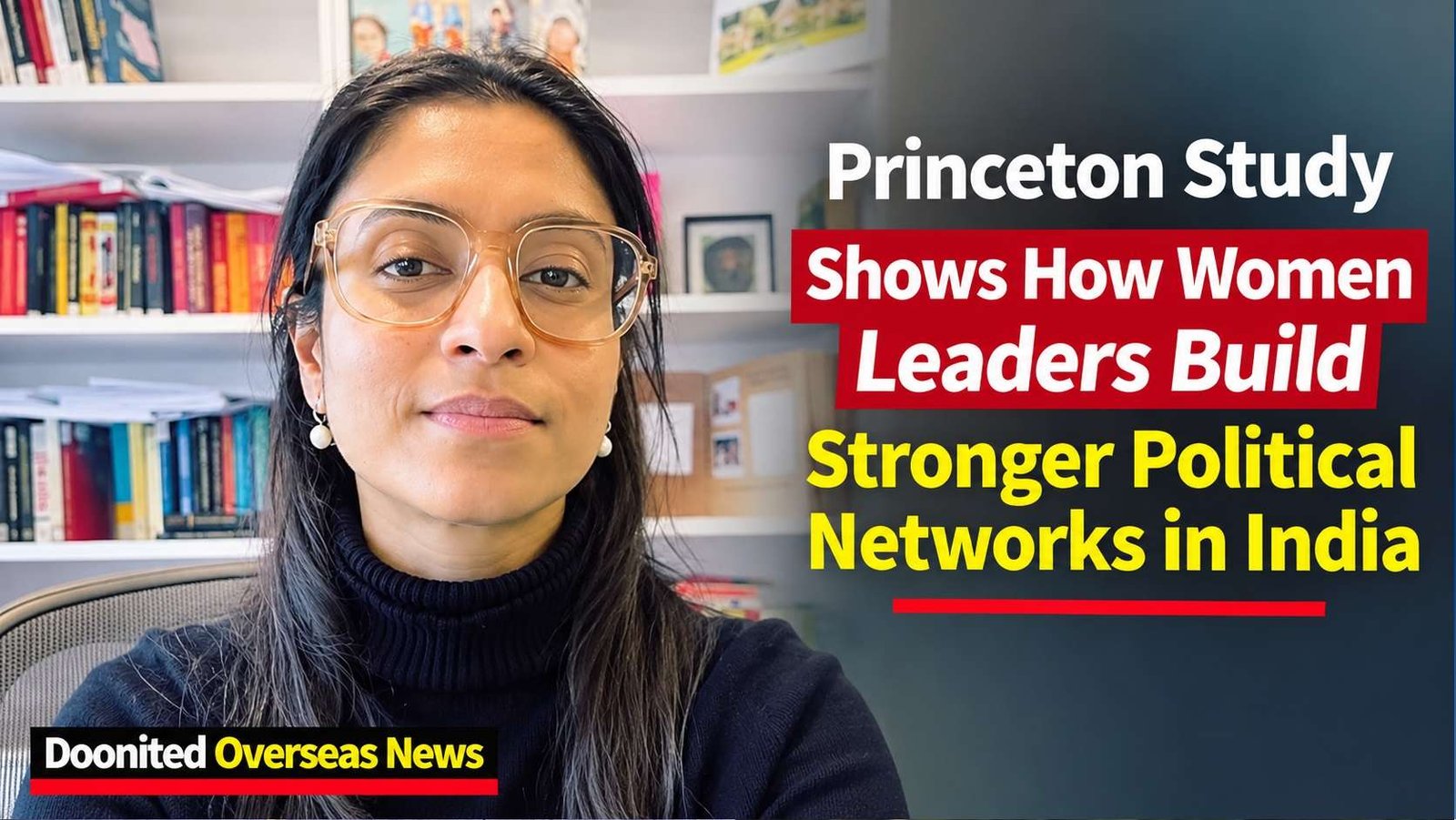
Tanushree Goyal: How an Indian Researcher at Princeton Is Rethinking Women’s Political Power from the Grassroots Up
What happens when a woman enters elected office? The impact may extend far beyond the council chamber. Research by Princeton political scientist Tanushree Goyal suggests that women representatives can change how political parties organise, recruit activists and communicate with women voters.
Political representation is often measured by counting how many women occupy elected positions. But the more difficult question is what happens beyond the election: do more women become active participants in political life, influence party decisions and gain access to the networks through which political power is exercised?
This is the question at the centre of Tanushree Goyal’s research. An Assistant Professor of Politics and International Affairs at Princeton University in the United States, Goyal studies gender, political participation and the political economy of development, with India as her primary research focus.
Her work challenges a familiar explanation of women’s political inclusion: that female politicians mainly inspire other women by serving as visible role models. Goyal identifies another mechanism, rooted in the everyday organisation of political parties. Women representatives can actively recruit women into party work, helping them overcome social and organisational barriers that might otherwise keep them outside politics.
The argument is significant because it shifts attention from representation at the top to the networks that connect political institutions with ordinary citizens.
The Delhi research: looking beyond elected seats
Goyal’s research examines municipal politics in Delhi, where gender quotas reserve half of the 272 municipal wards for women candidates. This arrangement creates an opportunity to investigate whether the presence of women representatives changes political participation in surrounding constituencies.
Her study combines citizen surveys, interviews with party activists and incumbent politicians, fieldwork and a research design based on the allocation of reserved seats.
The evidence includes surveys of 1,664 citizens, 1,243 party activists and 92 incumbent local politicians.
One of the central findings concerns political contact. Approximately 15 per cent of respondents in constituencies reserved for women reported being contacted by women party activists, compared with 6.4 per cent in unreserved constituencies.
The research also found that the gender gap in contact between party activists and women voters was reduced by half in reserved constituencies. Goyal estimates that, in a constituency with approximately 20,000 women voters, this difference represents around 1,540 additional women being contacted.
These interactions matter. Door-to-door political communication can provide information about candidates, party positions, elections and access to public services. Citizens who are routinely overlooked by campaign networks may consequently have less information and fewer opportunities to participate.
How women representatives change party organisation
The research identifies recruitment as a crucial link.
Women politicians are more likely than their male counterparts to bring women into grassroots party activities. Goyal argues that women representatives may find it easier to persuade family gatekeepers to allow other women to participate in political work. Recruiting women can also help representatives build their own support networks within political parties.
These activists do more than attend meetings. They canvass neighbourhoods, communicate party messages, organise campaigns and maintain contact with voters.
The findings challenge the assumption that women’s political involvement is primarily a consequence of inspiration. Instead, the presence of women in elected office can change the practical conditions under which other women enter political activity.
Goyal also challenges assumptions about the effectiveness of women party workers. Her research indicates that women activists can be particularly effective in reaching voters and reducing inequalities in campaign contact.
The implication is important: political inclusion is not only about giving women a seat at the table. It is also about changing who gets invited into the organisation, who does the work and whose voices become electorally significant.
From grassroots networks to higher political office
Goyal’s work extends beyond voter participation to examine how women build political careers.
In a separate study published in the American Journal of Political Science, she investigates how women’s presence in local politics affects their advancement within political parties.
The research finds that women representatives can use grassroots activist networks to establish informal connections across party hierarchies and strengthen their position when party nominations and promotions are decided.
This creates a bottom-up route to influence. Women do not simply depend on senior party leaders recognising their abilities; they can build organisational support that makes them more difficult to overlook.
Her forthcoming book, Representation from Below: The Grassroots Origins of Women’s Political Power in India, published by Cambridge University Press, brings these arguments together. Drawing on fieldwork, survey evidence and natural experiments, it examines how women built local party networks, expanded women’s participation and influenced how political organisations responded to voters.
Cambridge lists the book for publication in November 2026, with the print edition scheduled for December.
An international academic career focused on India
Goyal’s academic journey has taken her from India to the Netherlands, the United Kingdom and the United States.
She completed a bachelor’s degree in Computer Science and Engineering before earning a Research Master’s in Social Sciences from the University of Amsterdam in 2016. She received her PhD in Political Science from the University of Oxford in 2021, where she was associated with Nuffield College.
Before joining Princeton, she was a postdoctoral scholar at the Harvard Academy and a non-resident visiting fellow at the University of Pennsylvania’s Center for the Advanced Study of India.
Her research has appeared in journals including the American Political Science Review, the American Journal of Political Science and the Journal of Politics. Her academic recognition includes the Mancur Olson Best Dissertation Award in Political Economy and the Juan Linz Prize for comparative democracy research.
For the Indian diaspora, her work represents a meaningful form of international academic contribution: research conducted within a leading American university that examines India’s institutions and offers evidence relevant to wider debates about democracy and gender.
Why the findings matter beyond India
Goyal’s research is based on Indian local politics, but the underlying question has wider relevance: does representation become more meaningful when it changes the way institutions recruit and engage citizens?
The findings should not be treated as proof that every gender quota will automatically produce equal participation. The Delhi study examines a particular institutional setting, and political parties, social norms and electoral systems differ across countries.
Nor does increased campaign contact by itself guarantee that women will gain equal decision-making power or that parties will consistently respond to their needs.
But the research offers a valuable way to evaluate political inclusion. Instead of asking only how many women are elected, it asks whether their presence changes the organisation of politics below them.
That is the central contribution of Goyal’s work. Women’s political power may begin in elected office, but it can grow through the neighbourhood networks, party workers and everyday interactions that connect democracy to citizens.
The most consequential change may therefore be not simply seeing more women in politics, but seeing more women able to organise, participate and shape what politics becomes.

World Beyond the News
Octopuses Can Change Their Appearance
Octopuses can rapidly alter their skin colour and texture to communicate, camouflage themselves and respond to danger.
Some Cities Exist Across Two Continents
A small number of cities are geographically associated with two continents, creating unusual cultural and geographic identities.
Earth’s Climate Is Measured in Many Ways
Scientists track temperature, atmospheric gases, sea level, ice cover and other indicators rather than relying on a single climate number.
Streaming Changed How Audiences Discover Shows
Recommendation systems and global streaming releases allow audiences to discover programmes far beyond their original markets.