
Namaste: How Two Sanskrit Syllables Became One of the World’s Most Recognised Indian Greetings
There are few Indian words that have travelled as far as Namaste.
It can be heard in an Indian home, at a temple, in a Bollywood film, at an international diplomatic event—and increasingly at yoga studios thousands of kilometres from India.
Sometimes it is spoken with genuine understanding.
Sometimes it is simply followed by the words, “Thank you, everyone. Namaste.”
And sometimes it appears at the end of a yoga class with such predictable regularity that the ancient Indian greeting almost seems to have acquired a job description.
But the real history of Namaste is considerably richer.
It is not simply a Sanskrit version of “hello.”
Nor is its historical meaning literally the now-popular Western yoga interpretation about “the divine light in me recognising the divine light in you.”
The actual story begins with something much simpler:
bowing.
What does Namaste actually mean?
The Sanskrit word namas carries meanings including bowing, obeisance, reverential salutation and adoration. The related verbal root nam means to bend or bow.
The familiar explanation of namaste is generally analysed as:
namas + te
with te meaning “to you.”
So the literal sense is approximately:
“A bow to you” or “I bow to you.”
That is considerably less mysterious than some modern explanations—but perhaps more interesting.
Because a greeting based on bowing immediately tells us something about the social philosophy behind the gesture.
You are not invading another person’s physical space.
You are acknowledging them.
You are showing respect.
And you can do it without a handshake, hug or elaborate introduction.

The gesture is older than the yoga studio
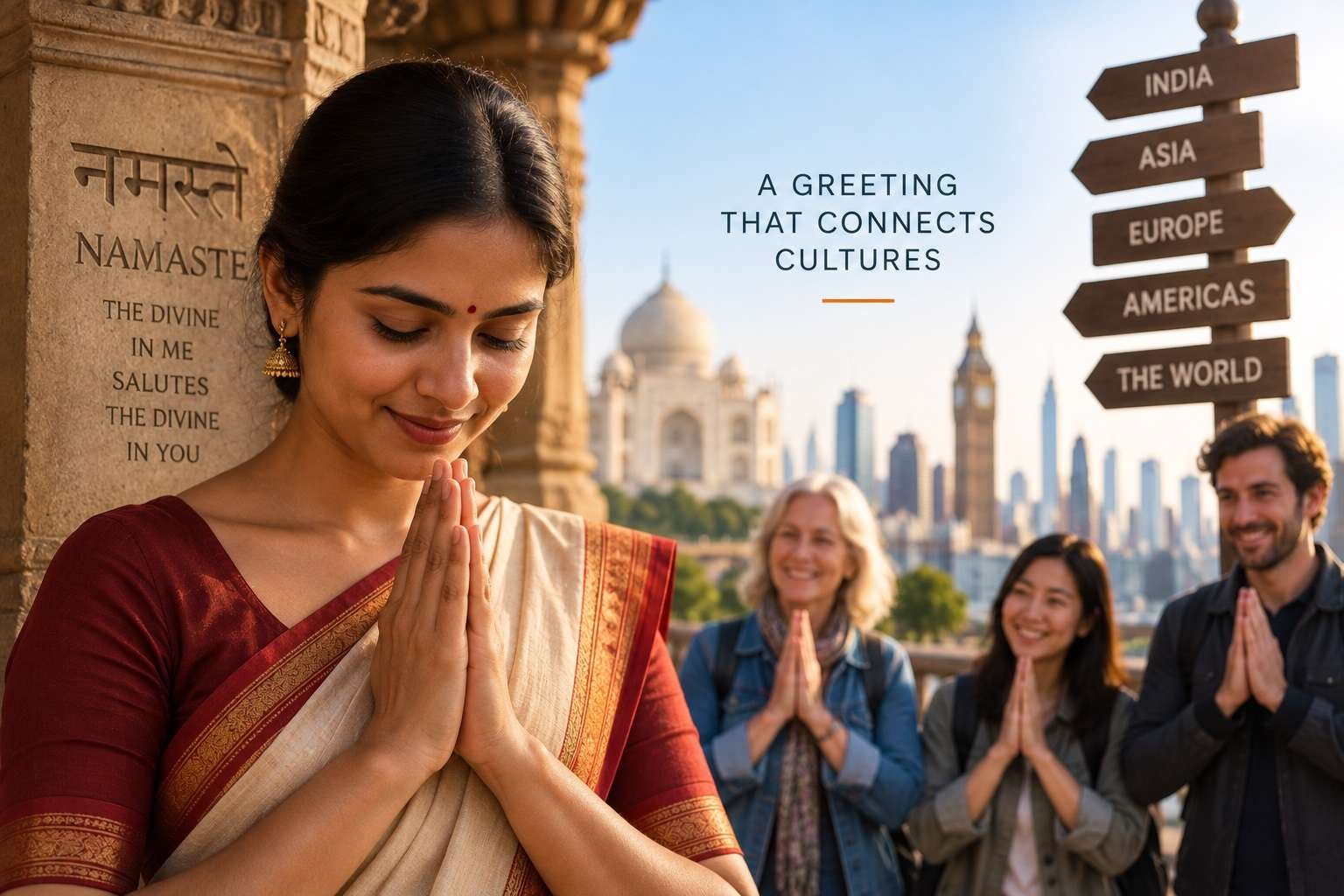
The familiar image is instantly recognisable:
Palms together.
Hands held around the chest.
A slight inclination of the head.
A respectful expression.
This is commonly described as añjali mudrā.
The archaeological history, however, needs careful handling.
It is tempting to say that the gesture can be traced directly to the Indus Valley Civilization simply because some ancient figurines have been interpreted as showing hands together.
But archaeology rarely works that neatly.
An object that looks like a modern greeting does not automatically prove that people thousands of years ago used it with exactly the same meaning.
What we can establish more securely is that joined hands in añjali became an identifiable Indian religious and artistic gesture in later periods.
The British Museum, for example, documents Indian objects showing añjali mudrā. One 7th-century Indian relief from Kashmir depicts a kneeling figure with palms pressed together.
Another museum object describes joined hands in añjali specifically as a posture of supplication and greeting.
That distinction matters.
The gesture has an ancient Indian history, but we should not manufacture an unbroken archaeological chain where the evidence does not establish one.
From reverence to everyday greeting
One of the fascinating aspects of Namaste is how a gesture associated with reverence could become part of ordinary social interaction.
Indian languages and traditions have long had multiple forms of greeting.
Namaste and Namaskar coexist with regional expressions and practices.
In everyday life, the gesture can communicate respect toward an elder, teacher, guest or another person.
It can also function simply as a greeting or farewell.
And that flexibility may be one reason it survived.
The same gesture can operate at several levels:
social, cultural, religious and ceremonial.
A person can use it without consciously thinking about Sanskrit grammar or Vedantic philosophy.
Just as an English speaker does not stop to analyse the history of the word “goodbye” every time they leave a room.
Language survives because people use it.

Namaste is not India’s only greeting
There is another misconception worth correcting.
Namaste is sometimes presented outside India as the Indian greeting.
India is far too linguistically and culturally diverse for that description.
Different regions and communities have their own expressions.
Vanakkam has a strong cultural association with Tamil-speaking communities.
Sat Sri Akal is widely associated with Sikh greeting traditions.
Namaskar is another widely used form.
India’s greeting culture therefore reflects the country’s diversity rather than one universal formula.
Namaste became internationally recognisable partly because it was easy to understand visually.
Two hands.
One gesture.
No translation required.
Buddhism, Jainism and the wider Indian cultural world
The joined-hands gesture also appears across religious traditions originating in South Asia.
It is found in Buddhist and Jain contexts as well as Hindu traditions, although its precise meaning depends upon the setting.
That is another reason to be cautious about reducing Namaste to one narrowly defined theological statement.
The gesture has had multiple contexts and functions.
Sometimes it expresses reverence.
Sometimes respect.
Sometimes greeting.
Sometimes devotion.
Sometimes humility.
The physical form may be similar while the cultural meaning changes with the situation.
That flexibility is not a weakness.
It is part of the reason the gesture travelled so successfully.
Then came yoga—and the global transformation
The international rise of yoga dramatically changed the visibility of Namaste.
Yoga travelled from India into Western societies through a complicated history involving teachers, spiritual movements, physical culture and eventually a huge global wellness industry.
Namaste became part of that international vocabulary.
For millions of people outside South Asia, it became associated with:
yoga, meditation, mindfulness, peace and spirituality.
The transformation has been remarkably successful.
A person who has never visited India may recognise Namaste instantly.
That is cultural transmission on a remarkable scale.
But it also produced a curious side effect.
The greeting sometimes became detached from its broader Indian social context and transformed into a kind of wellness-brand vocabulary.

The “divine light” explanation
One of the most popular modern explanations says that Namaste means something like:
“The divine in me bows to the divine in you.”
It is an appealing interpretation.
It also fits comfortably into contemporary yoga and spiritual discourse.
But there is an important distinction between a philosophical interpretation and a literal etymological translation.
The Sanskrit word does not literally translate into that sentence.
The linguistic foundation is the much simpler idea of bowing or offering respectful salutation.
The deeper spiritual interpretation can certainly be discussed in relation to Indian philosophical traditions, including ideas about the self and ultimate reality.
But it should not be presented as though Sanskrit dictionaries literally define Namaste as “the divine light in me recognises the divine light in you.”
That distinction is particularly important when explaining Indian culture to an international audience.
Why the Western version isn’t necessarily a problem
There is a temptation to criticise every Western adaptation of an Indian cultural practice.
That would also be too simplistic.
Cultures have always travelled by adaptation.
Food changes.
Music changes.
Words change.
Religious practices change.
Even the pronunciation of foreign words changes.
The question is not whether Namaste has acquired new meanings.
It clearly has.
The more important question is whether those new meanings erase the original cultural context.
If Namaste becomes merely a decorative word printed on yoga merchandise, something has been lost.
If someone uses it while understanding that it expresses respect and has deep roots in South Asian traditions, cultural exchange is doing something much more constructive.
Why Namaste works so well in a modern world
There is a surprisingly contemporary quality to the gesture.
It requires no physical contact.
It works across age groups.
It can be formal without being aggressive.
It communicates respect without requiring elaborate language.
And in a world increasingly conscious of personal space and contact, that has obvious practical value.
The COVID-19 pandemic even gave Namaste a brief global moment as politicians, diplomats and health officials looked for alternatives to handshakes.
Suddenly, an ancient Indian gesture looked remarkably modern.
India, as usual, had apparently arrived early.
DOONITED Editorial Perspective
The most interesting thing about Namaste is not that the West has adopted it.
It is why the gesture survived long enough to be adopted in the first place.
A greeting based on respect has an extraordinary advantage: it does not become obsolete very easily.
But India should also resist turning Namaste into a simplistic piece of cultural marketing.
There is no need to claim that every ancient Indian practice invented every modern wellness idea.
There is no need to attach an unprovable archaeological story to every gesture.
And there is certainly no need to tell the world that a Sanskrit word has only one meaning.
Indian civilisation is more interesting than that.
Namaste became global not because it was frozen in antiquity, but because it was flexible enough to travel while retaining its central idea of respectful salutation.
That is the real cultural achievement.
The bigger insight
A word can travel farther than its people.
Namaste crossed borders without passports.
It moved through religion, migration, literature, diplomacy, yoga, popular culture and tourism.
Today, someone in New York, London, Melbourne or Berlin may use the word without speaking a single Indian language.
That does not make the word less Indian.
It demonstrates something more interesting:
culture becomes global when other people find something in it that they can understand, use and make meaningful in their own lives.
The challenge for India is to ensure that when the world says Namaste, it sees more than a yoga-class ritual.
It sees a small but remarkably durable idea:
respect can be expressed without domination, and greeting another person can begin with acknowledging their presence.
And perhaps that is why, after thousands of years of linguistic and cultural change, two hands still say so much.

World Beyond the News
Bees Communicate Where Food Is
Honeybees use movement patterns known as waggle dances to communicate information about food locations.
Street Food Reflects Local History
Many famous street foods developed from migration, trade, local ingredients and the everyday needs of working communities.
A Day on Venus Is Extremely Long
Venus rotates so slowly that one rotation relative to distant stars takes longer than its trip around the Sun.
Human Achievement Continues to Push Limits
Athletes, engineers, scientists and explorers regularly establish new benchmarks in speed, endurance, scale and precision.