

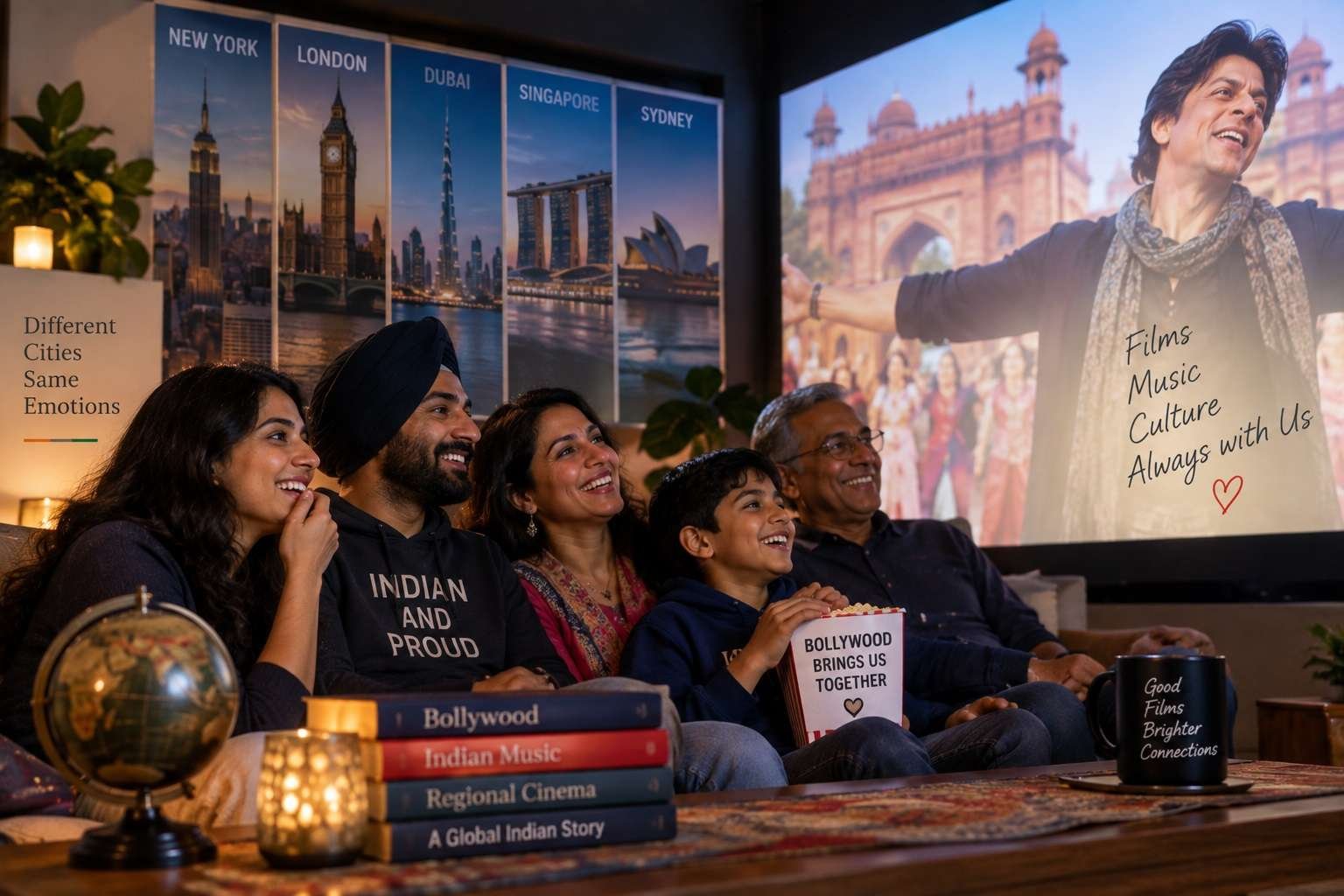
Bollywood Abroad: How Indian Cinema Became a Second Home for the Diaspora
A song begins.
Perhaps it is an old Kishore Kumar number.
Perhaps it is a Shah Rukh Khan dialogue that an entire generation can recite.
Or perhaps it is a contemporary film playing on a streaming service in a living room thousands of kilometres from India.
For an Indian living abroad, the screen can do something remarkably simple.
It can make a distant place feel close.
A familiar song can suddenly bring back a wedding.
A film showing an Indian family can remind someone of grandparents.
A festival scene can recreate a childhood memory.
And a language heard every day on screen can provide something increasingly precious for children growing up outside India:
a connection to the sound of home.
Bollywood is therefore much more than an entertainment industry for India’s diaspora.
It can function as a cultural memory machine.
Cinema travels with people
Indian cinema did not become global because streaming platforms suddenly discovered India.
The diaspora carried Indian films abroad long before Netflix, YouTube and smartphones.
Indian communities established themselves across East Africa, the Gulf, Britain, North America, Southeast Asia and elsewhere.
Where communities went, cultural consumption followed.
Cinema halls, video cassettes, television broadcasts, music recordings and later DVDs helped overseas Indians maintain connections with films being watched in India.
The technology changed.
The emotional requirement did not.
People wanted to see stories that looked, sounded and felt familiar.

The diaspora does not watch only for entertainment
For someone born in India, a Bollywood film may simply be a Friday-night movie.
For someone raised abroad, it can sometimes perform another function.
It can answer small questions about a culture they are trying to understand.
How do Indian weddings work?
Why does everyone touch an elder’s feet?
What happens during Diwali?
Why is food so central to family gatherings?
Why does every family argument somehow become a full-scale dramatic production?
Cinema doesn’t provide a textbook answer.
It provides an emotional picture.
And that can be especially powerful for children of Indian immigrants.
They may not experience India every day.
But they can see it.
They can hear Hindi, Punjabi, Urdu or other languages.
They can encounter Indian music, clothing, festivals, family relationships and humour.
The film becomes a cultural reference point.
Songs may be even more powerful than films
Interestingly, the strongest diaspora connection may not always be the movie itself.
It may be the song.
Music travels exceptionally well across generations.
Parents can introduce children to songs they heard growing up.
A classic romantic song can become a family memory.
A wedding playlist can connect three generations.
An old Bollywood song can suddenly turn a quiet living room in London, Dubai or Toronto into something resembling an Indian wedding.
And music does not require complete linguistic understanding.
A young person may not understand every line of a 1970s Hindi song.
They can still recognise the melody.
They can still recognise the emotion.
Music often reaches memory before language catches up.
Bollywood and the second generation
This becomes particularly important for second-generation diaspora Indians.
A child born in New York or Melbourne may speak English more fluently than Hindi.
A teenager growing up in London may understand Punjabi but rarely use it at school.
A young Indian Australian may know Indian traditions through family gatherings rather than everyday life.
Cinema can provide another layer.
It creates a cultural environment where Indian identity does not have to be explained entirely by parents.
The child can discover it independently.
Of course, this doesn’t mean watching Bollywood automatically preserves a language.
Language requires actual use.
But cinema can create motivation to engage with the language.
A film can make a child ask:
“What did that word mean?”
That question is small.
But it can be the beginning of a much larger connection.
The diaspora has also changed Bollywood
The relationship works in both directions.
Indian cinema does not merely influence overseas Indians.
Overseas audiences influence the economics and storytelling of Indian cinema.
The international market has become commercially important for major Indian films.
Producers increasingly consider overseas release strategies, international marketing, subtitles, dubbing and global streaming audiences.
And the diaspora itself has increasingly appeared in Indian storytelling.
The immigrant experience has moved from the background into the plot.
Indian characters living abroad are no longer automatically portrayed as people who have simply “made it.”
Modern stories can show loneliness, identity conflicts, interracial relationships, generational disagreements, racism, professional pressure and the complicated question of where home actually is.
That is a more mature picture of migration.
The biggest change: India is no longer one cinematic market
Calling all Indian cinema “Bollywood” is increasingly inaccurate.
Bollywood traditionally refers to the Hindi-language Mumbai film industry.
But Indian cinema today includes powerful regional industries.
Tamil cinema has an enormous overseas audience.
Telugu cinema has expanded dramatically through films such as Baahubali and RRR.
Malayalam cinema has built strong audiences among Gulf Malayalis and beyond.
Kannada, Bengali, Marathi and other language industries also have their own international audiences.
This matters because the Indian diaspora is not linguistically uniform either.
A Tamil family in Singapore may connect more strongly with Tamil cinema than Hindi cinema.
A Telugu family in the United States may follow Telugu releases closely.
A Malayali household in Dubai may have an entirely different cinematic diet.
The global Indian audience is therefore becoming more multilingual, not less.
Streaming has changed the distance between India and the diaspora
The old model involved waiting.
Waiting for a film to reach an overseas cinema.
Waiting for a DVD.
Waiting for television.
Waiting for a relative to bring a recording from India.
Streaming has dramatically reduced that distance.
Major platforms now distribute Indian films internationally, while dedicated regional streaming services have expanded access to language-specific content.
The result is significant.
For many diaspora viewers, Indian entertainment is no longer a delayed cultural import.
It can become part of their normal media diet.
But there is an important caveat.
International availability varies according to licensing agreements, platform rights and territory.
So the claim that every major Indian film is available globally on exactly the same day as its Indian release is too broad.
The more accurate point is that digital distribution has substantially reduced the historical delay between Indian releases and overseas access.
Bollywood gatherings become community gatherings
Cinema can also create physical community.
Diaspora audiences frequently gather for major Indian releases, concerts and cultural events.
A theatre showing an Indian blockbuster is not necessarily just a place to watch a movie.
It can become a meeting point.
Families meet friends.
Young people meet other Indians.
People discuss the film afterward.
Restaurants become busier.
Social media fills with reactions.
The film becomes an event.
This is particularly important for diaspora communities living in cities where Indian populations are geographically dispersed.
Cinema creates a shared cultural calendar.
But Bollywood is not a perfect cultural ambassador
Here is where the conversation needs some honesty.
Bollywood does not represent India perfectly.
No film industry could.
Its India is often more glamorous, more dramatic and considerably better dressed than ordinary life.
Indian families can be more complicated than a three-hour screenplay.
And real weddings generally contain considerably less choreographed dancing than Bollywood would have us believe.
Cinema also carries stereotypes, commercial pressures and sometimes simplistic portrayals of social issues.
Diaspora audiences can therefore enjoy Bollywood while recognising that entertainment is not ethnography.
A film can introduce Indian culture.
It cannot explain all of India.

The global Indian screen is becoming more sophisticated
The most interesting development may be the movement from nostalgia toward representation.
Earlier diaspora cinema often revolved around a simple question:
How do Indians living abroad remain connected to India?
Newer stories increasingly ask:
What does it actually mean to be Indian when your life exists between cultures?
That is a much more interesting question.
A second-generation Indian may feel completely at home in Britain and still identify strongly with Indian culture.
A person may speak English at work, another Indian language at home and a third language socially.
Someone may eat pizza on Monday, dosa on Tuesday and sushi on Wednesday without experiencing an identity crisis.
Identity has become more flexible.
Cinema is beginning to reflect that.
DOONITED Editorial Perspective
Bollywood’s greatest contribution to the diaspora may not be preserving “traditional Indian values.”
That phrase is too broad.
Its more important contribution may be preserving shared cultural memory while allowing that memory to evolve.
The Indian diaspora is not frozen in the India of its parents.
It is creating new versions of Indian identity.
Films, music and streaming platforms provide the common references through which those identities can be negotiated.
A parent may say:
“You must watch this old Amitabh Bachchan film.”
The teenager may reply:
“It’s three hours long!”
Then, mysteriously, two hours later, everyone is still watching.
That is cultural transmission in its most practical form.
Not through a lecture.
Through entertainment.
The bigger insight
A country can export products.
It can export technology.
It can export services.
But exporting stories is different.
Stories travel directly into people’s emotional lives.
That is why Indian cinema matters to the diaspora.
A film does not merely show India.
It can remind someone of a language, a song, a parent, a wedding, a festival, a childhood home or a family conversation.
And when those memories are shared across generations, cinema becomes more than entertainment.
It becomes a bridge between where a family came from and where it now lives.
Bollywood may have started in Mumbai.
But its audience has never respected geographical boundaries.
And increasingly, neither does Indian cinema itself.

World Beyond the News
Bees Communicate Where Food Is
Honeybees use movement patterns known as waggle dances to communicate information about food locations.
Street Food Reflects Local History
Many famous street foods developed from migration, trade, local ingredients and the everyday needs of working communities.
A Day on Venus Is Extremely Long
Venus rotates so slowly that one rotation relative to distant stars takes longer than its trip around the Sun.
Human Achievement Continues to Push Limits
Athletes, engineers, scientists and explorers regularly establish new benchmarks in speed, endurance, scale and precision.