
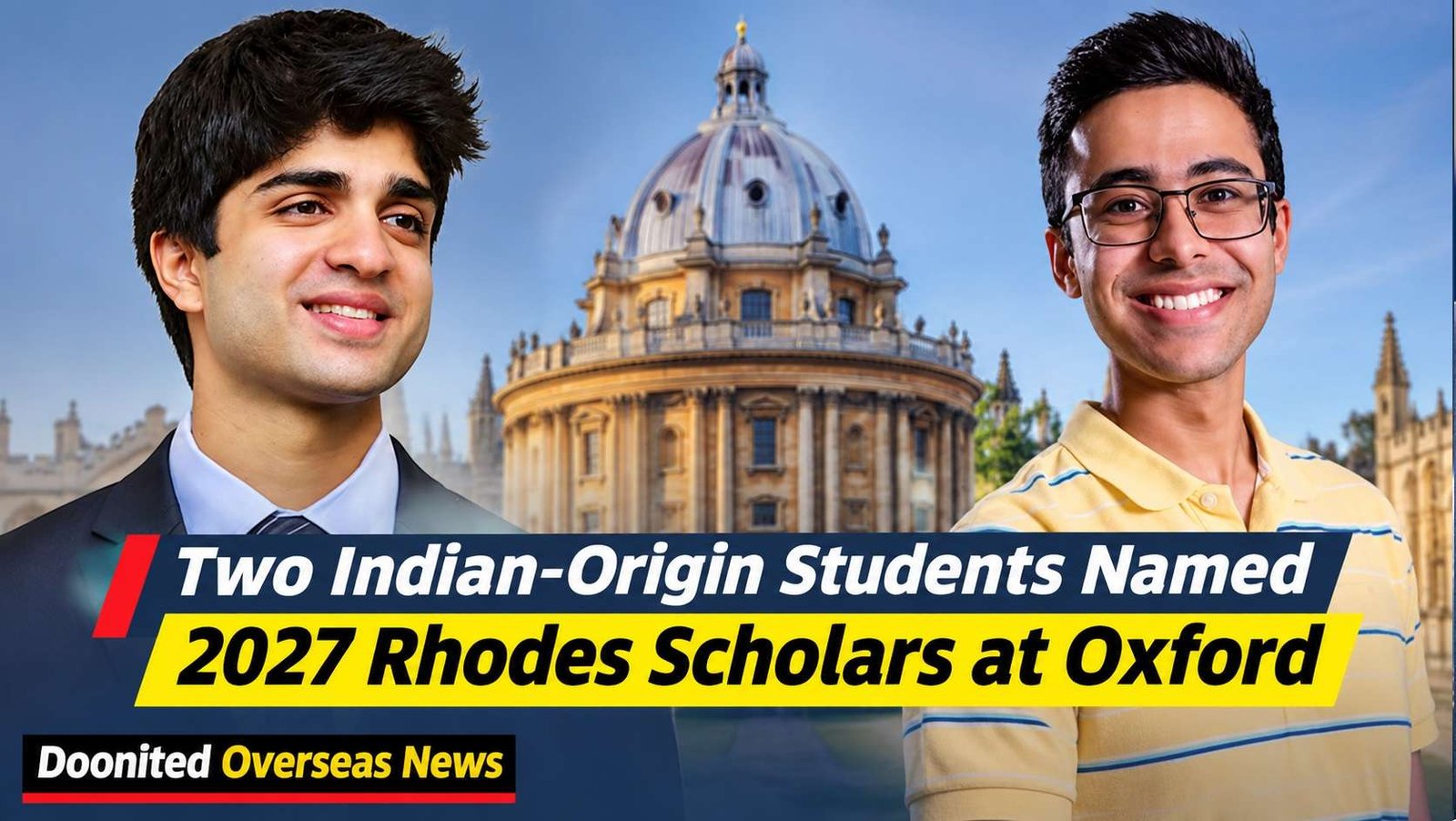
Two Indian-American Students Earn 2027 Rhodes Scholarships, Taking Harvard and UNC Research to Oxford
Harvard senior Aran Sonnad-Joshi and UNC-Chapel Hill physics student Anish S. Aradhey have been selected among 32 American Rhodes Scholars-elect. Their contrasting interests — addiction policy and astrophysics — reflect the growing influence of Indian-American talent across academic disciplines.
Two Indian-American students are heading towards one of the world’s most prestigious postgraduate academic opportunities after being selected among the 32 American Rhodes Scholars-elect for 2027.
Aran Sonnad-Joshi of Harvard University and Anish S. Aradhey of the University of North Carolina at Chapel Hill were elected on November 14, 2026, following the United States selection process conducted by the Rhodes Trust. Both are expected to begin postgraduate studies at the University of Oxford in October 2027, subject to the Trust’s final ratification and the required Oxford admission arrangements.
Their selection is a notable achievement for the Indian-American community, but their academic interests also make this a particularly distinctive story. One is working at the intersection of public health, social policy and addiction research; the other is investigating some of the universe’s most powerful astronomical objects.
Aran Sonnad-Joshi: Connecting science with social policy
Sonnad-Joshi, from Atlanta, Georgia, is a senior at Harvard University, where he is pursuing a double concentration in Social Studies and Molecular and Cellular Biology.
His research focuses on intergenerational substance use, addiction prevention and the historical origins of American international drug policy. His work brings together scientific understanding of substance-use disorders and questions about how governments and societies respond to addiction.
Beyond academics, Sonnad-Joshi serves as policy director of Y2Y Harvard Square, a student-run youth homeless shelter in the Greater Boston area. He is also president of the Harvard Advocate, Harvard College’s literary magazine, and a research associate at the Weatherhead Center for International Affairs.
At Oxford, his proposed postgraduate pathway includes master’s-level study in evidence-based social intervention and policy evaluation, alongside health service improvement and evaluation. His longer-term interests reflect an ambition to connect clinical practice with more effective public policy and community health interventions.
His work at Y2Y is especially significant in this context. It places him close to the practical challenges of youth homelessness, housing insecurity and substance use — issues that require responses extending beyond medical treatment alone.
Anish S. Aradhey: From Chilean telescopes to Oxford astrophysics
Aradhey, from Harrisonburg, Virginia, is completing a physics degree at the University of North Carolina at Chapel Hill.
His research examines the relationship between supermassive black holes and the galaxies that host them. These enormous objects, found at the centres of many galaxies, are important to understanding how galaxies evolve and how their central regions influence surrounding matter.
His scientific experience includes operating telescopes at an observatory in Chile, presenting research at international conferences and publishing multiple peer-reviewed papers. He is also a recipient of the prestigious Barry Goldwater Scholarship, which recognises outstanding undergraduate achievement and potential in science, engineering and mathematics.
At Oxford, Aradhey intends to pursue a Doctor of Philosophy (D.Phil.) in Astrophysics, continuing his research into black holes and galaxy evolution.
His experience also extends beyond laboratory and observational research. During a summer teaching internship in rural Mississippi, he designed a middle-school astronomy curriculum, connecting advanced scientific interests with science education for younger students.
A highly competitive American selection process
The scale of the competition highlights the significance of their achievement.
According to the Rhodes Trust’s November 14 announcement, more than 3,000 students began the American application process. Of these, 1,006 received formal endorsements from their colleges and universities. Selection committees in 16 US districts then interviewed 238 finalists before choosing 32 scholars-elect.
The selection involved several stages, rather than a single university-level award. Academic excellence is central, but the Trust also identifies leadership, service, character and a commitment to making a positive difference as important qualities in its selection philosophy.
The 32 American scholars will join recipients selected through 25 other Rhodes jurisdictions, forming an international cohort of just over 100 scholars.
What the scholarships mean
The Rhodes Scholarship is a fully funded postgraduate award for study at Oxford. Its support includes university course fees, an annual living stipend, visa-related costs and travel to and from the United Kingdom. The standard scholarship tenure is two years, although doctoral pathways can have different funding arrangements and conditions.
For Indian-origin families and students living in the United States, the achievement of Sonnad-Joshi and Aradhey offers a wider message: excellence in higher education can lead to influence across disciplines, from public health and social reform to fundamental scientific research.
Their stories also challenge the narrow perception that Indian-American academic success is concentrated in engineering, medicine or technology. Their work demonstrates the breadth of contributions being made in social sciences, community leadership and astrophysics.
Neither Oxford study nor the scholarship itself guarantees a particular career outcome. But the opportunity gives both scholars access to an internationally connected academic environment, where their research can develop alongside students and scholars from across the world.
For the global Indian diaspora, their selection is a moment worth recognising — not simply as two individual academic victories, but as examples of young researchers using education, public service and scientific inquiry to address questions with global relevance.

World Beyond the News
Why Elephants Stay Close to Their Herd
Elephants live in highly social family groups and use calls, touch and body movements to maintain strong bonds.
Most of the Deep Ocean Remains Difficult to Explore
Extreme pressure, darkness and distance make deep-ocean exploration one of Earth’s greatest scientific challenges.
Spacecraft Can Travel Without Traditional Roads
Spacecraft use carefully calculated trajectories and gravity assists to travel enormous distances through space.
Why Movie Trailers Are Released in Stages
Major films often use teaser trailers, full trailers and final promotional spots to build awareness over time.