

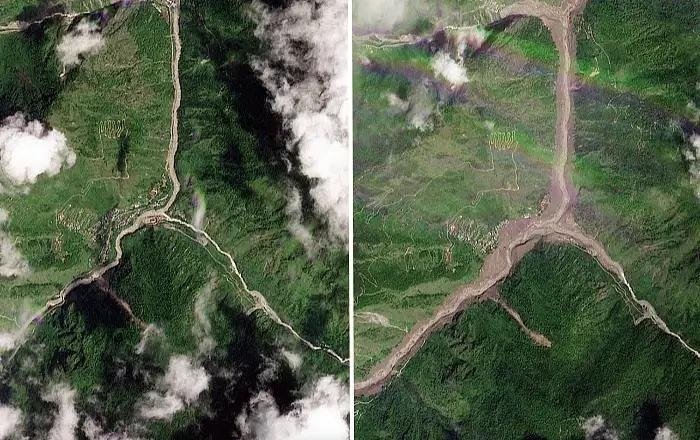
Nepal Floods: Hundreds of Children Still Missing as India Joins the Search for Hope
A disaster can destroy a road, a bridge or a building in minutes. But when children disappear in that destruction, the meaning of the disaster becomes much larger.
Ten days after the devastating flash floods that swept through Nepal’s Bhote Koshi and Trishuli river corridors, hundreds of families are still waiting for answers. Approximately 600 students remain unaccounted for in the districts of Rasuwa and Nuwakot, according to figures compiled by local education authorities, municipalities and educational institutions. Communication failures and damaged infrastructure are making verification particularly difficult.
The tragedy began on August 26, when a powerful flash flood surged through northern and central Nepal. Nepal’s Ministry of Foreign Affairs says the disaster caused extensive destruction to homes, roads, bridges, hydropower facilities and other critical infrastructure in Rasuwa, Nuwakot, Dhading and surrounding areas. Search and rescue operations were still continuing on September 4.
When a school becomes part of the disaster story
The most painful dimension of the crisis is unfolding around schools.
Reports from Rasuwa and Nuwakot indicate that educational institutions were directly affected, with some schools completely destroyed and others rendered unusable. For children who survived, the immediate challenge is no longer simply returning to class. Families and authorities first have to establish who is safe, who has been displaced and who remains missing.
UNICEF reported shortly after the disaster that more than 17,000 children had been affected across Rasuwa, Nuwakot and Dhading. It warned that children who survived faced increased risks related to health, nutrition, protection and exploitation in the aftermath of the floods.
That figure helps explain why the story cannot be reduced to a casualty count.
For a child, a flood can mean the loss of a home, school, parent, sibling, identity documents, books and the ordinary routine that provides a sense of security.
Why finding the missing has become so difficult
The geography of the affected region is an important part of the story.
The flood damaged roads and bridges, while mud, rocks and debris have obstructed access to several locations. Nepal’s health authorities have described the disaster as affecting six districts and reported damage to health posts, hospitals and access routes.
The result is a cruel problem: families need information precisely when the communications and transport systems required to obtain that information have been badly damaged.
This is why the figure of around 600 missing children should be understood as an unaccounted-for figure, not a confirmed death toll. Some children have already been located, while new reports of missing students continue to emerge as authorities verify school and municipal records.
That distinction matters. In a disaster, inaccurate numbers can create additional trauma for families already living through uncertainty.
India’s connection is not just geographical
For Indian readers, Nepal’s tragedy has a direct human dimension.
India has been involved in the rescue and relief response. Indian reporting, citing the Ministry of External Affairs, said 163 Indian nationals had been rescued by September 1. India also deployed a specialised tunnel-rescue team to assist with operations around hydropower tunnels in Nepal.
Nepal’s Foreign Ministry has also confirmed that tunnel rescue teams from India, China and South Korea were working with the Nepali Army, with rescue equipment, drones and other materials being used in the continuing operation.
This is an important Indian angle—not because the disaster should be turned into an India story, but because neighbouring countries share the same Himalayan environment, river systems, infrastructure vulnerabilities and disaster risks.
The lesson beyond the tragedy
The Nepal floods offer South Asia a difficult but necessary lesson.
Mountain disasters do not respect administrative boundaries. A hazard that begins in a high-altitude environment can rapidly affect settlements, roads, hydropower projects and communities far downstream.
The immediate priority is rightly the search for missing people and the care of survivors. But once the emergency phase passes, Nepal and its neighbours will have to examine early-warning systems, evacuation planning, resilient infrastructure, school safety, communications and disaster-response capacity in vulnerable mountain regions.
The disaster has already demonstrated why preparedness cannot begin after the water arrives.
DOONITED Editorial Perspective
The most important number in this story may not be the final death toll.
It may be the number of children who can still be found.
When approximately 600 students remain unaccounted for, every search operation is also a race against uncertainty. Governments, rescuers, schools and communities need accurate records, functioning communication networks and coordinated rescue systems—not speculation and not sensational headlines.
Nepal’s tragedy is first and foremost a tragedy for Nepalese families. But it is also a warning for the wider Himalayan region, including India.
The constructive lesson is clear: disaster preparedness is not an optional investment for mountain communities. It is a form of protection for the next generation.

World Beyond the News
Why Elephants Stay Close to Their Herd
Elephants live in highly social family groups and use calls, touch and body movements to maintain strong bonds.
Most of the Deep Ocean Remains Difficult to Explore
Extreme pressure, darkness and distance make deep-ocean exploration one of Earth’s greatest scientific challenges.
Spacecraft Can Travel Without Traditional Roads
Spacecraft use carefully calculated trajectories and gravity assists to travel enormous distances through space.
Why Movie Trailers Are Released in Stages
Major films often use teaser trailers, full trailers and final promotional spots to build awareness over time.