
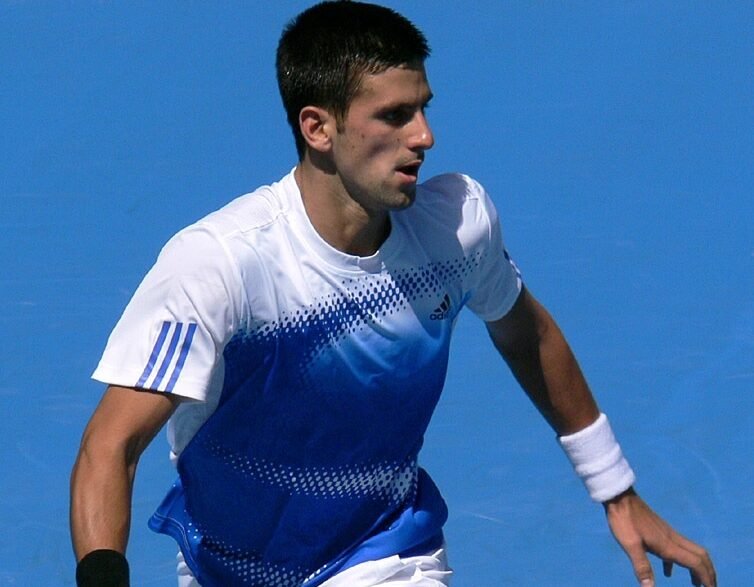
Novak Djokovic Retirement: The Decision Belongs to the Champion, Not the Crowd
Editor, Doonited News
There is a particular cruelty in watching a sporting legend struggle with the one opponent nobody can defeat forever: time.
Novak Djokovic’s first-round exit from the 2026 US Open has reopened an increasingly familiar question — should the 39-year-old Serbian champion retire?
The question is legitimate. But the decision is not ours to make.
Djokovic’s defeat to Argentina’s Mariano Navone was extraordinary by the standards of a career built on extraordinary consistency. Navone won 7-6(5), 5-7, 4-6, 6-2, 6-1 after four hours and 36 minutes at Arthur Ashe Stadium. It was Djokovic’s first opening-round defeat at a Grand Slam since 2006.
More concerning than the result was what happened physically.
Djokovic struggled with nausea and vomiting and battled cramping and pain involving his back and shoulder. He eventually lost control of the match after taking a two-sets-to-one lead. In his own account after the match, he indicated that physical problems had been following him through much of the season.
That makes the retirement debate understandable.
But understandable does not mean decisive.
The body is asking a difficult question
At his peak, Djokovic’s greatest weapon was not simply his serve, forehand or two-handed backhand. It was his ability to absorb punishment and remain competitive deep into matches.
Age changes that equation.
A player can still possess extraordinary technique and competitive intelligence while losing some of the physical margin that once made those qualities overwhelming. Djokovic’s recent struggles suggest that this is becoming an important part of his reality.
Former world No. 1 Andy Roddick has therefore made an important distinction. He acknowledged that people can legitimately wonder whether a particular match might be Djokovic’s last. But he rejected the idea that fans should order the champion into retirement.
His message was essentially simple: Djokovic gets to make that decision himself.
That is more than a defence of one tennis player. It is a useful principle in sport.
What does Djokovic actually want?
There is no confirmed retirement announcement.
Djokovic has previously expressed his desire to compete at the 2028 Los Angeles Olympics, where he would be 41. His motivation is understandable: he won Olympic singles gold at Paris 2024, one of the major achievements still missing from his extraordinary résumé before that victory.
Whether his body allows him to reach Los Angeles is a completely different question.
And that distinction matters.
A stated ambition is not a guarantee. An injury is not automatically a retirement announcement. And one devastating defeat, however significant, should not be transformed into a conclusion that the athlete himself has not reached.
The other side of the argument
There is also a legitimate case for Djokovic to consider stopping sooner rather than later.
Tennis is not a sport where reputation protects a player from physical reality. Every match demands movement, recovery, acceleration and repeated high-intensity effort. Djokovic’s US Open performance showed just how quickly a physically compromised body can overwhelm even the finest tactical mind.
There is also a question of legacy.
Djokovic has already achieved what very few athletes in any sport can seriously contemplate: 24 Grand Slam singles titles, Olympic gold and a career that has placed him among the defining figures of modern tennis. His greatness does not depend on winning another trophy.
That is precisely why the retirement decision should be personal rather than public.
Leaving too early may create regret. Staying too long may create unnecessary suffering. Only Djokovic and those closest to him can properly weigh that balance.
What Indian sports fans can take from the debate
For Indian readers, this is also a useful sporting lesson.
India’s sporting culture often celebrates athletes who refuse to give up. Persistence is admired — sometimes almost without qualification. But longevity should not be confused with endlessly proving oneself.
There comes a point in every athlete’s career when the question changes from “Can I still win?” to “What do I want from the remaining years of my career?”
That is not surrender.
It is maturity.
Djokovic’s career has always been driven by an unusually strong competitive instinct. Asking him to abandon that instinct simply because spectators believe the ending should arrive now misunderstands what made him a champion in the first place.
The DOONITED perspective
The intelligent position is neither to demand Djokovic’s retirement nor to pretend that nothing has changed.
Something has changed.
His physical struggles are real, and the first-round defeat is a serious warning sign. But so is the fact that he remains a 24-time Grand Slam champion who has repeatedly challenged expectations about athletic longevity.
The crowd can debate. Former champions can offer advice. Analysts can examine the numbers. Fans can hope for one more great run.
But the final call belongs to Novak Djokovic.
A great champion deserves the right to decide not only how he competes, but also when he stops.
And perhaps the most respectful way to watch the final chapter of Djokovic’s career is not to rush toward its last page.
Let him write it.

World Beyond the News
Dolphins Use Individual Signature Whistles
Bottlenose dolphins develop distinctive whistles that function somewhat like individual acoustic identifiers.
The Pacific Is Earth’s Largest Ocean
The Pacific Ocean covers more area than any other ocean basin and stretches between Asia, Australia and the Americas.
Artificial Intelligence Learns Statistical Patterns
Modern machine-learning systems identify patterns in large datasets and use those patterns to generate predictions or outputs.
Why Some Stories Spread So Quickly
Emotion, novelty, visual appeal and easy sharing can make a story travel rapidly across social platforms.