
Amandeep Singh Gill: The Indian Diplomat Helping Shape the World’s AI Governance
As artificial intelligence moves from a technology-sector debate into a question of international policy, an Indian diplomat is helping build the institutions through which governments, scientists, businesses and civil society will debate its risks, opportunities and global rules.
Artificial intelligence is developing faster than most governments can regulate it. Algorithms are increasingly influencing employment, education, healthcare, finance, information, security and public services, while access to computing power, data and technical expertise remains highly unequal between countries.
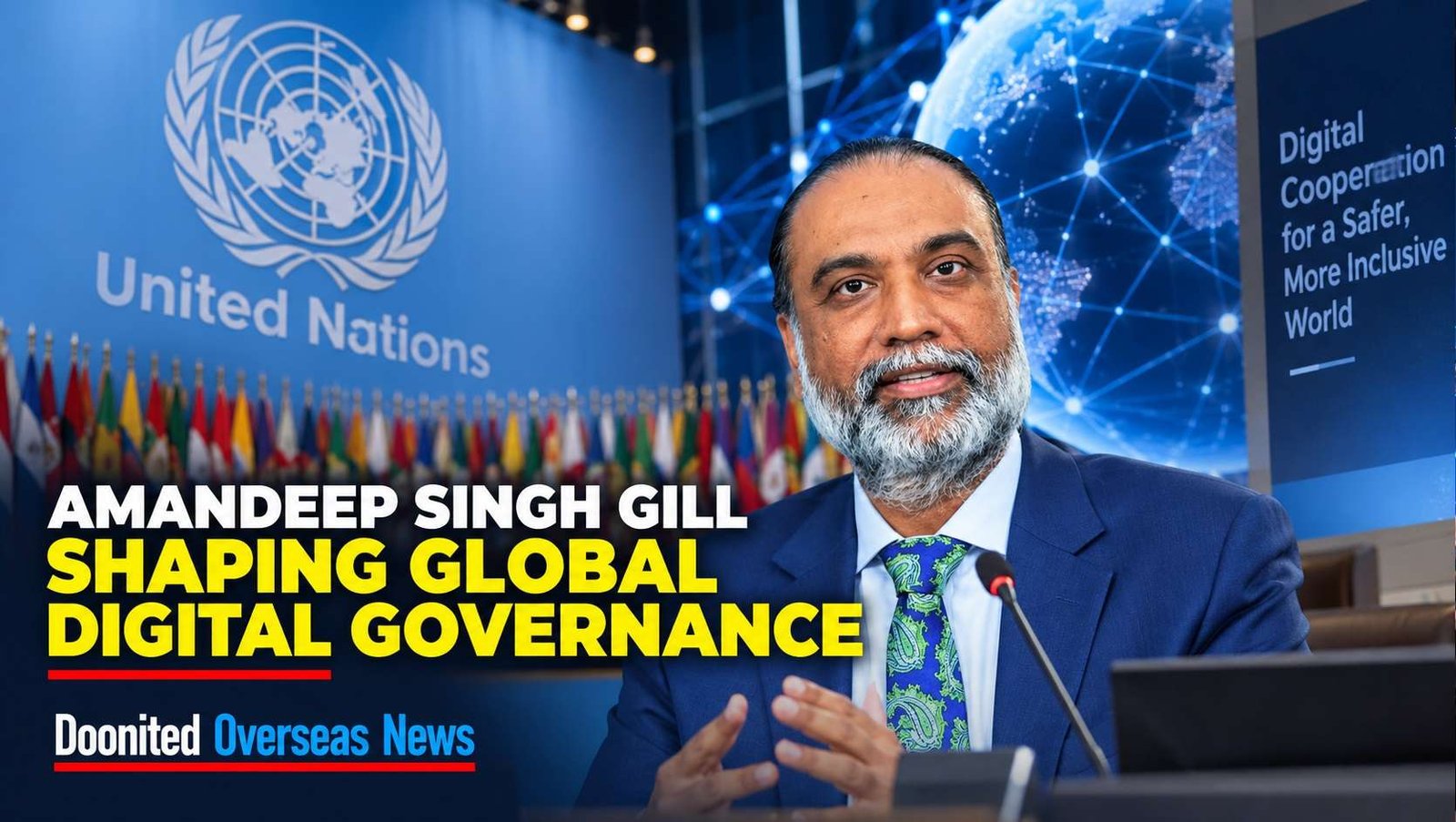
At the centre of the United Nations’ attempt to deal with that imbalance is Amandeep Singh Gill, an Indian diplomat who has moved from the world of disarmament and international security into one of the defining policy challenges of the digital age.
Gill is the United Nations Under-Secretary-General and Special Envoy for Digital and Emerging Technologies. Since January 1, 2025, he has headed the UN Office for Digital and Emerging Technologies (ODET), the organisation’s system-wide focal point for digital and emerging technologies.
His importance to the global Indian community is not simply that an Indian diplomat holds a senior UN position. It is that his career illustrates a less visible form of Indian global influence: Indian professionals helping shape the international institutions that determine how emerging technologies will affect societies everywhere.
From Indian diplomacy to the technology frontier
Gill joined the Indian Foreign Service in 1992 and built a career around some of the most complicated areas of international diplomacy.
He served in Indian missions in Tehran, Colombo and Geneva and headed the Disarmament and International Security Affairs Division in India’s Ministry of External Affairs from 2013 to 2016. From 2016 to 2018, he was India’s Ambassador and Permanent Representative to the Conference on Disarmament in Geneva. He later became Executive Director of the Secretariat supporting the UN Secretary-General’s High-Level Panel on Digital Cooperation.
That background matters because AI governance is increasingly intersecting with traditional questions of international security.
Gill’s academic background is equally unusual. He holds a B.Tech in electronics and electrical communications from Panjab University and an advanced diploma in French history and language from the University of Geneva. His career has combined technology, diplomacy, international security and multilateral negotiations. The UN also records that he is fluent in English, French, Hindi and Punjabi.
In 2024, TIME included him among its 100 Most Influential People in AI, recognising his role in coordinating international engagement on artificial intelligence. TIME
The UN’s AI job has changed
Gill’s current position is considerably broader than the technology-envoy role he previously held from 2022 to 2024.
ODET was established on January 1, 2025, following a UN General Assembly decision after the adoption of the Global Digital Compact at the 2024 Summit of the Future. Its mandate includes supporting implementation of the Compact and coordinating UN engagement with digital and emerging technologies.
The Global Digital Compact is particularly important because it attempts to establish common principles for the digital age.
Among its objectives are closing digital divides, expanding participation in the digital economy, protecting human rights online, improving data governance and advancing international governance of AI. It specifically recognises that developing countries need greater access to talent, data, computing resources and capacity-building.
This is where Gill’s role becomes especially relevant to countries such as India.
AI governance is also about who gets left behind
The global AI debate is often presented as a contest among technology companies and technologically advanced economies.
But there is another question: what happens to countries that do not have the computing infrastructure, investment, data, research capacity or skilled workforce required to participate?
Gill has repeatedly placed that question at the centre of the UN approach.
At the World Artificial Intelligence Conference in Shanghai in July 2026, he described the UN approach around three connected pillars: science, policy and capacity. He argued that no country can effectively govern AI by itself and highlighted gaps in infrastructure, expertise, data and computing resources.
That concern is becoming more concrete.
A September 2026 UN report found that financing for AI capacity-building in developing countries remains fragmented and geographically uneven and recommended consideration of a Global Fund for AI Capacity-Building.
For countries with large populations and ambitious digital economies, this is not an abstract diplomatic issue. The ability to develop local AI systems, train specialists and retain talent could influence future competitiveness.
Building institutions, not a single “AI law”
One misconception about Gill’s position is that the United Nations is becoming a global AI regulator.
It is not.
The UN’s new architecture is primarily designed to create scientific evidence, international dialogue, coordination and capacity-building, rather than a single worldwide AI regulator with enforcement powers.
In August 2025, the General Assembly established the Independent International Scientific Panel on AI and the Global Dialogue on AI Governance.
The scientific panel has 40 experts and provides evidence on AI capabilities, opportunities, risks and impacts. The first annual Global Dialogue was held in Geneva on July 6–7, 2026.
Gill is responsible for coordinating the secretariat supporting this emerging architecture.
That distinction is important. The international system is not attempting to replace national regulation. Instead, it is trying to make different national and regional approaches more compatible while ensuring that countries with less technological power have a seat at the table.
Why this matters to Indians living overseas
For the Indian diaspora, the implications extend well beyond diplomacy.
Millions of Indians and people of Indian origin work in technology, engineering, healthcare, finance, education and research across North America, Europe, the Middle East, Asia-Pacific and Africa.
AI governance will increasingly influence their professional lives.
Employment rules surrounding automated decision-making, privacy and data transfers, AI-assisted recruitment, intellectual property, digital identity, cybersecurity and workplace automation are likely to develop differently across jurisdictions. International efforts to establish common principles could therefore have practical consequences for globally mobile Indian professionals and businesses.
The Global Digital Compact explicitly calls for responsible, accountable, transparent and human-centric AI, with effective human oversight. It also recognises the importance of linguistic and cultural diversity in AI systems.
That last point is particularly relevant to the Indian diaspora.
India’s global communities operate across dozens of languages and cultural environments. An AI ecosystem designed primarily around a handful of dominant languages and markets risks reproducing existing digital inequalities. Ensuring that AI works effectively for multilingual societies is therefore not simply a cultural issue; it is increasingly an economic and technological one.
India’s connection is bigger than one diplomat
Gill’s career also reflects a broader change in India’s international profile.
India is no longer participating in technology diplomacy only as a consumer of foreign technology. It has become an important technology market, software and services hub, startup ecosystem and source of global technical talent.
Gill’s own 2025 official visit to India included meetings with the Ministry of External Affairs, the Ministry of Electronics and Information Technology, technology companies and civil-society stakeholders. Discussions included AI and data governance as well as youth and digital inclusion.
In February 2026, he also participated in events around India’s AI Impact Summit, including discussions on global AI governance and children’s safety and wellbeing in AI environments. United Nations
The relationship therefore runs in both directions: India contributes talent, ideas and technological experience to international discussions, while global AI governance debates can influence how India’s technology ecosystem connects with the rest of the world.
The harder question is implementation
The establishment of international AI institutions is significant, but institutions alone will not solve the AI divide.
The difficult part is implementation.
Countries need skilled researchers, reliable infrastructure, high-quality data, affordable computing, effective privacy safeguards and regulatory capacity. Businesses need predictable rules. Universities need access to research resources. Smaller countries need ways to participate without becoming permanently dependent on technology developed elsewhere.
This is why Gill’s emphasis on science, policy and capacity is more consequential than the headline of “AI regulation” might suggest.
The international debate is gradually moving from asking whether AI should be governed to asking who has the capacity to participate in governing it, whose data and languages are represented, who receives the economic benefits and who carries the risks.
For the Indian diaspora, that is a familiar globalisation question in a new technological form.
Doonited Overseas Editorial View
Amandeep Singh Gill’s significance lies less in being an Indian at the United Nations than in the particular bridge his career represents: technology, diplomacy and the developing world’s place in the next technological revolution.
The global Indian community has traditionally measured its influence through entrepreneurs, scientists, executives, doctors and academics. The AI era adds another category: people shaping the rules under which technology itself will operate.
Gill’s work does not mean India controls the global AI conversation, nor does it guarantee that the UN’s approach will resolve competing national interests. But it demonstrates that Indian expertise is increasingly present not only in building technology, but also in the institutions attempting to decide how that technology should serve humanity.
That may ultimately prove just as important.

World Beyond the News
Dolphins Use Individual Signature Whistles
Bottlenose dolphins develop distinctive whistles that function somewhat like individual acoustic identifiers.
The Pacific Is Earth’s Largest Ocean
The Pacific Ocean covers more area than any other ocean basin and stretches between Asia, Australia and the Americas.
Artificial Intelligence Learns Statistical Patterns
Modern machine-learning systems identify patterns in large datasets and use those patterns to generate predictions or outputs.
Why Some Stories Spread So Quickly
Emotion, novelty, visual appeal and easy sharing can make a story travel rapidly across social platforms.