
Bharat Innovates 2026: Can India Turn Deep Research Into Global Technology?
The harder problem has often been what happens after the invention. Bharat Innovates 2026 is attempting to tackle precisely that gap—taking research-born technologies out of laboratories and connecting them with investors, industry and international markets.
For decades, India’s technology story was often told through software.
Then came startups.
Now another chapter is becoming increasingly visible:
deep tech.
Semiconductors. Biotechnology. Quantum computing. Defence systems. Space technology. Advanced materials. Robotics. Clean energy.
These are technologies that cannot always be built in a weekend with a laptop, a pitch deck and a motivational quote.
They require laboratories, specialised equipment, intellectual property, patient capital, engineering talent and, very often, years of experimentation before a commercial product emerges.
That is the problem Bharat Innovates 2026 is trying to address.
What is Bharat Innovates?
Bharat Innovates is an initiative of India’s Ministry of Education, operating with strategic guidance from the Office of the Principal Scientific Adviser.
Its purpose is straightforward but ambitious: identify promising research and technology emerging from India’s higher-education and research ecosystem and help connect it with the resources required to reach the market.
The programme is designed around technologies emerging from institutions including IITs, IISc and other research organisations.
The first global showcase was held in Nice, France, from June 14 to 16, 2026, as part of the India-France Year of Innovation.
It brought together 120 curated deep-tech innovators and 45 research and innovation projects representing 15 leading higher-education institutions. The organisers say the event attracted more than 2,000 participants from 29 countries and generated more than 1,350 B2B matchmaking meetings. More than 80 startup pitches were made to over 50 investors, with $254 million in announced funding commitments.
That makes the programme considerably more than an exhibition.
It is an attempt to build a pipeline.
Thirteen technology frontiers—not just three
Semiconductors, biotechnology and defence may be the most obvious strategic areas, but Bharat Innovates is much broader.
Its programme covers 13 critical technology domains.
These include advanced computing, healthcare and MedTech, space and defence, energy and sustainability, semiconductors, biotechnology, smart cities and mobility, blue economy, next-generation communications, agri and food technologies, advanced materials, manufacturing and Industry 4.0, and disaster management and resilient infrastructure.
That breadth is important.
The technologies of the future rarely live in neat boxes.
A semiconductor can power a defence system.
AI can improve healthcare.
Biotechnology can transform agriculture.
Advanced materials can improve batteries.
Robotics can work in factories, farms or hazardous environments.
The real opportunity lies in the connections between these fields.
Why semiconductors matter
Few technologies illustrate India’s strategic challenge better than semiconductors.
Modern economies depend on chips for everything from smartphones and automobiles to telecommunications, industrial equipment, defence systems and artificial intelligence.
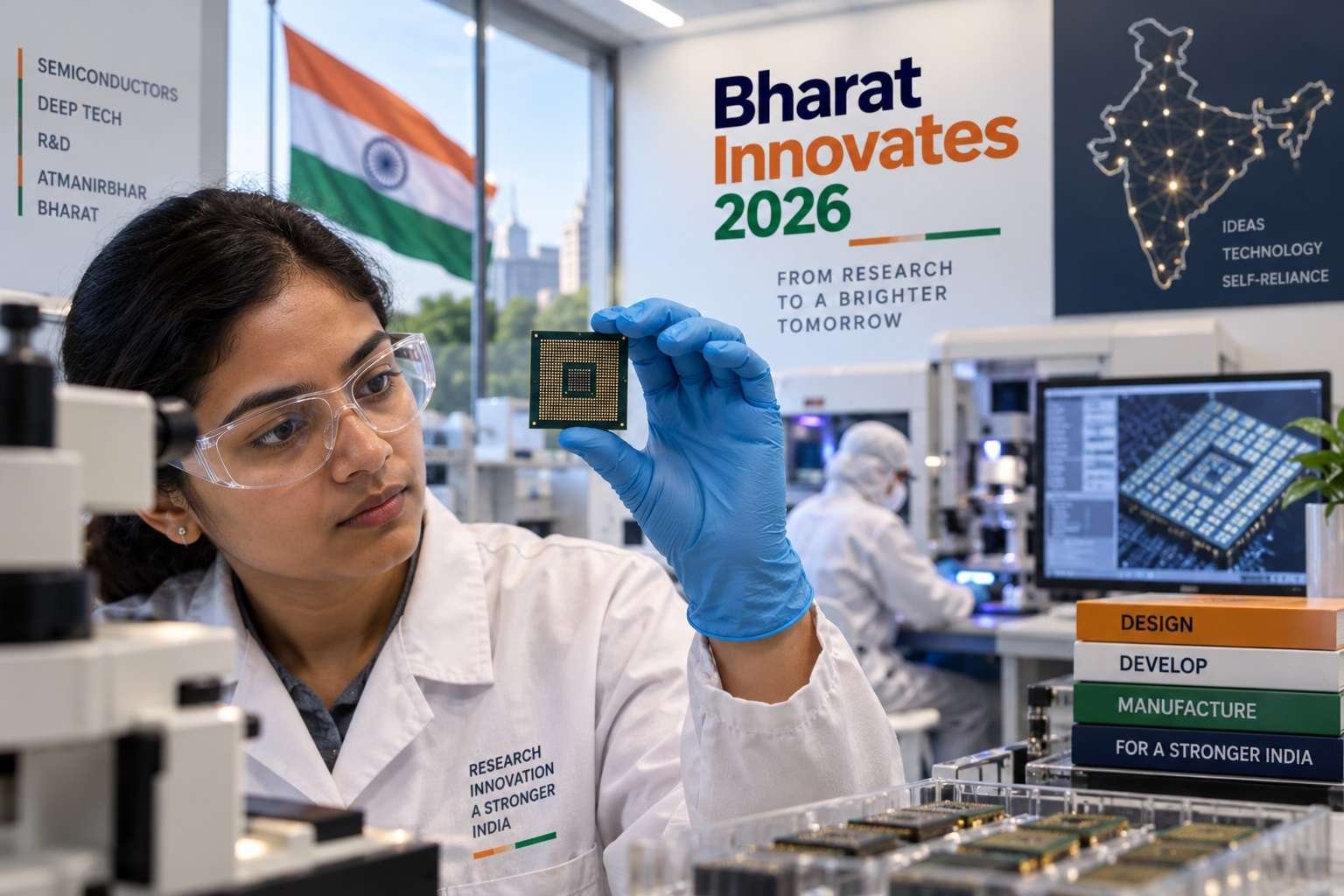
Bharat Innovates’ semiconductor programme covers the chain from chip design and fabless companies to manufacturing equipment, materials, packaging and testing. It also includes compound semiconductors such as gallium nitride and silicon carbide.
This is significant because technological self-reliance does not mean simply owning a chip factory.
A functioning semiconductor ecosystem requires designers, electronic-design-automation tools, materials suppliers, manufacturing equipment, fabrication, packaging, testing and customers.
In other words, the chip is only the visible tip.
Underneath it is an enormous industrial ecosystem.
Biotechnology: the slow technology revolution
Biotechnology presents a different challenge.
A software startup can sometimes release a product rapidly.
A biotechnology company may spend years developing a technology, proving its safety, completing validation and navigating regulatory requirements.
Bharat Innovates therefore gives biotechnology a place within its deep-tech ecosystem.
The 2026 cohort includes companies working in areas such as therapeutics, diagnostics, vaccines, biomanufacturing and other biological technologies.
One example is Ahammune Biosciences, which is developing a non-steroidal topical molecule aimed at vitiligo repigmentation. Another is the MSN Vaccine Platform, associated with BRIC-THSTI, working on vaccine technology.
These are precisely the kinds of technologies where conventional startup thinking—“grow fast and figure everything out later”—is unlikely to work.
Science has a habit of refusing to negotiate with PowerPoint presentations.
Defence is becoming a technology ecosystem
The defence component is equally significant.
Bharat Innovates describes its defence technology focus around indigenous platforms, critical components, secure communications, cybersecurity, unmanned systems, surveillance, electronic warfare, testing and dual-use technologies.
This is important because modern defence capability increasingly depends on technologies that also have civilian applications.
Autonomous systems can be used in defence and logistics.
Advanced sensors can support border surveillance and industrial inspection.
Secure communications can have military and civilian uses.
Artificial intelligence can assist defence systems as well as commercial industries.
The goal therefore is not simply to manufacture more military equipment.
It is to develop technology ownership.
The missing bridge: research to market
This may ultimately be Bharat Innovates’ most important contribution.
India has outstanding research institutions.
It also has a large startup ecosystem.
But historically, the path between a university laboratory and a globally competitive commercial product has not always been smooth.
Researchers may lack access to industrial partners.
Startups may struggle to obtain patient capital.
Investors may find technologies too early-stage.
Corporates may hesitate to adopt unproven systems.
And universities may not always have the commercial infrastructure required to translate intellectual property into products.
Bharat Innovates explicitly attempts to connect these pieces through mentoring, technology and market validation, investment, industry partnerships, pilots, proof-of-concepts, co-development and international market access.
That is the real ambition.
Not another technology exhibition.
A bridge.
India also needs patience
There is, however, a danger in celebrating deep tech too quickly.
A successful exhibition does not make a semiconductor company globally competitive.
A prototype is not a product.
A laboratory result is not a mass-market technology.
And funding commitments are not the same thing as revenue.
Deep-tech companies can take years to reach commercial scale because the underlying science, manufacturing and regulatory challenges are genuinely difficult.
That is why patient capital matters.
It is also why industry partnerships matter.
A brilliant invention that cannot be manufactured economically remains, ultimately, a brilliant invention sitting on a shelf.
The international dimension
Holding the global showcase in Nice was itself significant.
India was not presenting its technology ecosystem only to domestic investors.
It was putting Indian deep-tech companies in front of international investors, corporations, research institutions and potential technology partners.
The official programme says the event generated more than 50 collaboration agreements and created new pathways for joint research, startup acceleration, technology commercialisation, talent exchange and international market access.
That international connection could become increasingly valuable.
Deep technology is global by nature.
A semiconductor designed in Bengaluru may be manufactured elsewhere.
A medical technology developed in India may eventually serve patients in Europe.
An Indian space technology company may sell to international customers.
A defence technology may generate civilian applications overseas.
The objective should therefore not be simply “Made in India.”
It should increasingly become:
“Invented in India. Built for the world.”
The real test begins after the showcase
Bharat Innovates has achieved something important by creating visibility and connections.
But the harder phase comes next.
Will the startups secure follow-on funding?
Will prototypes become certified products?
Will universities and companies sign meaningful long-term partnerships?
Will Indian industry become an early customer?
Will intellectual property remain in India?
Will international markets actually buy the resulting technologies?
Those questions will determine whether Bharat Innovates becomes a landmark in India’s deep-tech journey or simply another successful technology event.
DOONITED Editorial Perspective
India should be ambitious about deep technology—but it should also be patient.
The country does not need another race to produce the largest number of startups.
It needs more companies capable of surviving the difficult journey from laboratory science to industrial scale.
Bharat Innovates is valuable because it recognises that distinction.
The programme connects researchers with capital, industry and global networks. Its 2026 results suggest that international interest exists.
Now India has to convert that interest into factories, products, patents, customers, exports and long-term companies.
The real measure of success will not be how many people attended the showcase in Nice.
It will be how many technologies that began in Indian laboratories eventually become indispensable somewhere in the world.
A research paper is an achievement. A prototype is progress. A successful global technology company is transformation.
Bharat Innovates is trying to build the bridge between all three.

World Beyond the News
Dolphins Use Individual Signature Whistles
Bottlenose dolphins develop distinctive whistles that function somewhat like individual acoustic identifiers.
The Pacific Is Earth’s Largest Ocean
The Pacific Ocean covers more area than any other ocean basin and stretches between Asia, Australia and the Americas.
Artificial Intelligence Learns Statistical Patterns
Modern machine-learning systems identify patterns in large datasets and use those patterns to generate predictions or outputs.
Why Some Stories Spread So Quickly
Emotion, novelty, visual appeal and easy sharing can make a story travel rapidly across social platforms.