

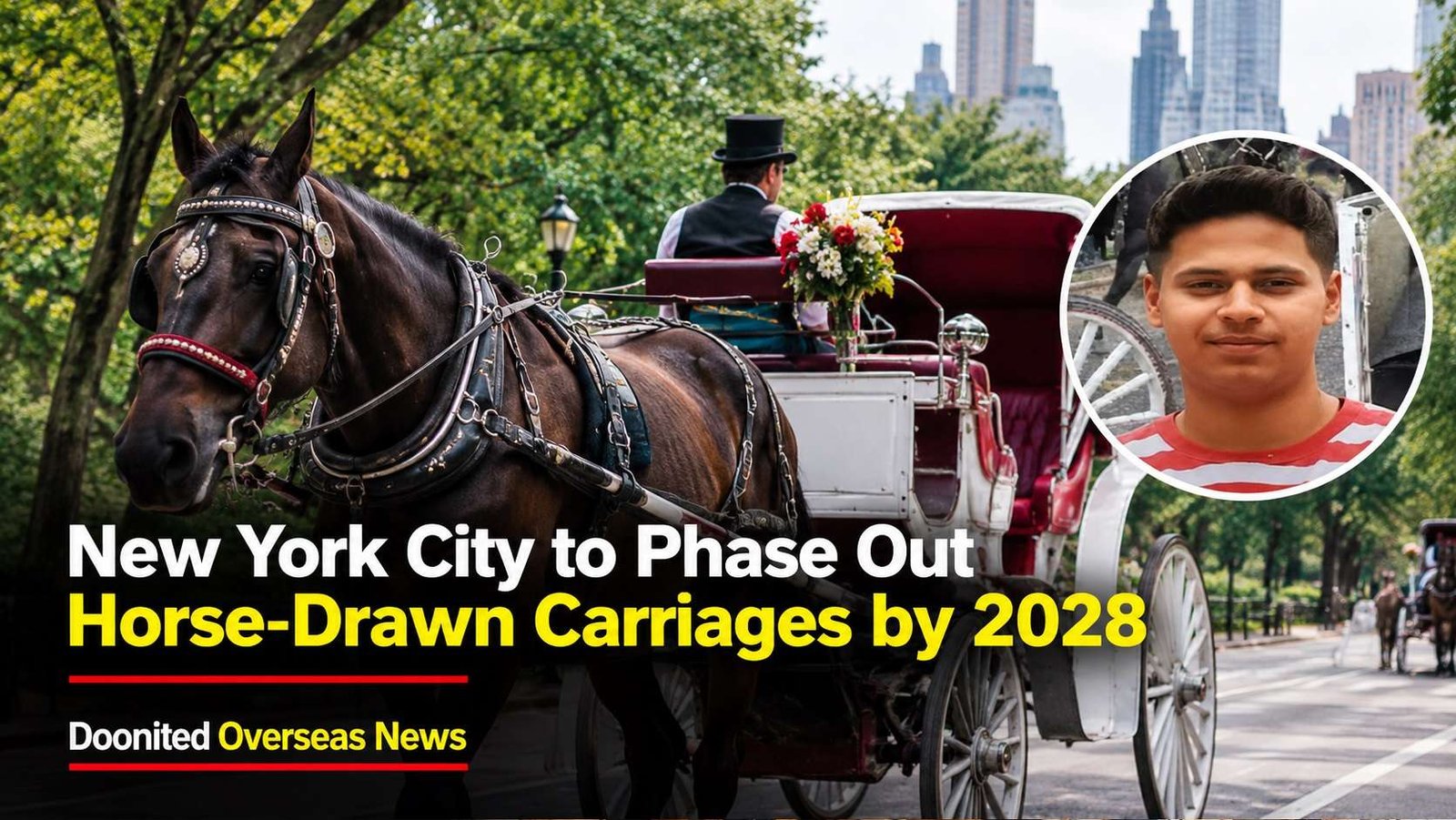
Romanch’s Law: How an Indian Teenager’s Death Could Change New York’s Tourist Industry
New York City’s Council has voted to phase out commercial horse-drawn carriages by June 2028, following the death of 18-year-old Indian tourist Romanch Mahajan in Central Park. The measure links visitor safety and animal welfare with a difficult question: how can a city end a long-standing tourist tradition while protecting the workers who depend on it?
An Indian family’s visit to New York’s Central Park ended in tragedy in June. Four months later, the death of 18-year-old Romanch Mahajan has helped propel a long-contested proposal to end one of the city’s most recognisable tourist traditions.
On October 22, 2026, the New York City Council voted to approve Romanch’s Law, legislation intended to phase out the commercial horse-drawn carriage industry by June 1, 2028. The measure follows decades of debate about animal welfare, passenger safety and the future of carriage operators.
The Council’s vote is a major legislative milestone, but an important qualification remains: the official legislative record lists the bill as awaiting the mayor’s signature. The phase-out is therefore a legislatively approved plan, not a change that visitors should assume has already taken full effect.
For overseas Indians, the case has a particularly personal dimension. Mahajan, from Pathankot in Punjab, was visiting New York with his family to celebrate his high school graduation. His death has connected an individual family’s loss with a wider debate about tourism safety, public accountability and how cities respond when long-standing practices become contested.
The Central Park accident
On June 17, 2026, Mahajan was riding in a horse-drawn carriage with family members in Central Park when the horse bolted. According to reporting by the Associated Press, the driver had reportedly stepped away from the horse to photograph the passengers. The carriage ran out of control, and passengers were thrown from it.
Mahajan suffered critical head injuries and later died. The Central Park Conservancy identified him as the victim.
The accident occurred amid renewed concern about the carriage industry. Just days earlier, another horse had died after collapsing in the park, intensifying scrutiny of the risks faced by animals working in busy urban conditions.
The incident did not create the campaign to end carriage rides. Activists, animal-welfare organisations and some city officials had argued for years that horses should not have to pull carriages through traffic and crowded public spaces. But Mahajan’s death gave the debate a new urgency and a human cost that could not be separated from the policy discussion.
What Romanch’s Law would change
The legislation, sponsored by Council Member Christopher Marte, sets a deadline for ending the regular commercial horse-drawn cab industry.
Under the bill, licences for carriage horses, horse-drawn cabs and drivers would no longer be issued from June 1, 2028. Existing licences would expire permanently on May 31, 2028, without renewal. The legislation also restricts the use of horses for commercial carriage rides, while allowing for limited permits for certain temporary events, subject to public-safety and congestion considerations.
The proposal is significant because previous efforts to end the industry had stalled. Earlier campaigns included Ryder’s Law, named after a carriage horse that collapsed and died in 2022. The debate continued through disagreements over animal welfare, alternative vehicles, costs and the livelihoods of operators.
Romanch’s Law takes a different approach: rather than simply replacing horse-drawn carriages with another form of carriage, it establishes a timetable to wind down the commercial industry.
The legislation also addresses what happens to the horses after their working lives end. It prohibits their sale or transfer for slaughter, resale for slaughter, or use in another horse-drawn cab business or other inhumane purpose. Owners may retain their horses, while the city is expected to help identify humane arrangements for their future care.
These provisions matter because ending a business does not, by itself, guarantee a safe retirement for the animals involved.
Animal welfare and visitor safety
Central Park is both a major tourist destination and a public space shared by pedestrians, cyclists, workers and visitors. Horse-drawn carriages have operated there since 1858, when they served a different transportation environment from the one that exists today.
The modern park attracts tens of millions of visitors annually. Supporters of the phase-out argue that combining large animals, carriages and increasingly crowded urban spaces creates risks that cannot be eliminated through incremental regulation alone.
The American Society for the Prevention of Cruelty to Animals (ASPCA) has supported ending the industry, citing concerns about horses working in noisy traffic and other demanding urban conditions. The Central Park Conservancy has also backed the legislation.
Critics of carriage rides have long raised concerns about heat, traffic incidents, animal stress and the availability of suitable working conditions. The central policy question is whether these risks can be adequately managed—or whether the activity should end altogether.
The Council’s decision favours a phase-out. Its success, however, will depend on implementation: the quality of the horses’ retirement arrangements, enforcement of the restrictions and the city’s ability to manage the transition without creating new welfare problems.
What happens to the workers?
The industry’s future also affects people whose incomes depend on carriage rides. Drivers are not the only workers involved; stable employees and others connected with the businesses may also be affected.
Romanch’s Law requires the mayoral administration to establish a transition plan by April 1, 2027. The proposed programme is to include employment referrals, career counselling, hiring fairs and information about education and training opportunities.
The city must also consider assistance with the disposition of horses and equipment, as well as compensation for carriage owners for the value of their businesses, licences and equipment. These are important distinctions: a requirement to consider compensation does not automatically guarantee every owner a particular payment.
The challenge is to make the transition credible. Workers will need timely information, accessible training and realistic opportunities to move into other employment. The city will also need to clarify how business owners and stable workers qualify for assistance and how the programme will be funded.
A phase-out that protects horses but leaves workers without meaningful support would remain an incomplete transition.
A lesson for international visitors
For Indian families travelling abroad, Mahajan’s story is a reminder to consider safety alongside the appeal of a tourist experience. It does not establish that all horse-drawn carriage rides are unsafe, nor does it mean visitors should assume that the new restrictions are already in force.
Travellers should follow operator instructions, pay attention to safety guidance and check current local rules before booking activities involving animals or moving vehicles.
The broader significance of Romanch’s Law lies in the response to a tragedy. A practice that had survived years of political debate now faces a clear legislative deadline, with animal welfare and workers’ livelihoods both incorporated into the proposed transition.
Mahajan’s death cannot be undone. Whether the legislation ultimately delivers safer public spaces, humane outcomes for the horses and a fair path forward for workers will depend on what happens between the Council’s vote and the June 2028 deadline.

World Beyond the News
Octopuses Can Change Their Appearance
Octopuses can rapidly alter their skin colour and texture to communicate, camouflage themselves and respond to danger.
Some Cities Exist Across Two Continents
A small number of cities are geographically associated with two continents, creating unusual cultural and geographic identities.
Earth’s Climate Is Measured in Many Ways
Scientists track temperature, atmospheric gases, sea level, ice cover and other indicators rather than relying on a single climate number.
Streaming Changed How Audiences Discover Shows
Recommendation systems and global streaming releases allow audiences to discover programmes far beyond their original markets.