
From Ravi Shankar to Diljit Dosanjh: How Indian Music Found the World
There was a time when the sound of India travelling around the world was largely associated with one instrument.
The sitar.
And, more specifically, with one extraordinary musician:
Ravi Shankar.
Then came Bollywood.
Then A.R. Rahman.
Then Punjabi pop.
Then independent artists, hip-hop, electronic music, Instagram, YouTube and Spotify.
Today, an Indian song can travel from Mumbai to Manchester, from Delhi to New York and from Punjab to Los Angeles without waiting for a record company executive in London to approve its passport.
Indian music has entered the global conversation.
But this is not really a story about one musical explosion.
It is a story about seven decades of cultural transmission.
Ravi Shankar opened an important door
Indian classical music had international connections before the 1960s.
But Ravi Shankar became one of its most important global ambassadors.
His collaboration with Western musicians—particularly violinist Yehudi Menuhin and later George Harrison of The Beatles—introduced Indian musical ideas to audiences who had previously encountered very little of them.
In 1967, Shankar performed at the Monterey International Pop Festival in California. Two years later he appeared at Woodstock. The Woodstock festival’s own archive describes his Monterey appearance as his first major introduction to Western festival audiences.
George Harrison’s fascination with the sitar also helped bring Indian musical ideas into the Beatles’ world.
The relationship became much larger than a celebrity collaboration.
It became a cultural exchange.
Indian ragas, instruments and rhythmic ideas entered conversations happening inside Western popular music.
The important point is not that Ravi Shankar suddenly “introduced India” to the West.
India was already there.
He helped make the world listen differently.
From classical music to cultural experimentation
The 1970s expanded the conversation.
Indian classical traditions began interacting with jazz, rock and experimental music.
One of the best-known examples was Shakti, the Indo-jazz fusion group associated with John McLaughlin and Indian musicians including L. Shankar, Zakir Hussain and T.H. Vinayakram.
The philosophy was fascinating.
Why should musical traditions remain in separate boxes?
A jazz guitarist could converse with tabla.
Indian rhythmic structures could interact with Western improvisation.
The result was not simply “Indian music with Western instruments.”
It was a new musical language.
That idea would become increasingly important decades later.
Because the next generation would take the same principle into pop, hip-hop, electronic music and global dance music.
Then cinema became India’s giant loudspeaker
If Ravi Shankar opened one international door, Indian cinema opened millions more.
Bollywood songs became one of the easiest ways for overseas audiences to encounter Indian music.
And unlike classical music, film music arrived attached to characters, stories, dance and emotion.
You did not need to understand the structure of a raga.
You only needed to remember the chorus.
The Indian diaspora played a crucial role.
Indian communities abroad created demand for films, music and live performances.
Music became part of weddings, family gatherings, festivals and community celebrations.
A Bollywood song could therefore perform two jobs simultaneously:
entertainment for the audience and cultural memory for the diaspora.
“Jai Ho” changed the conversation
Then came one of the most recognisable international milestones.
“Jai Ho,” from Slumdog Millionaire, won the Academy Award for Best Original Song and later the Grammy for Best Song Written for Visual Media.
The GRAMMY’s official records list A.R. Rahman, Gulzar and Tanvi Shah as the Grammy-winning writers.
But its significance went beyond an award ceremony.
The song demonstrated that Indian musical elements could move through a major international film and become part of mainstream global popular culture.
It was not simply an Indian song being heard abroad.
It was an Indian musical sensibility participating in an international entertainment product.
That distinction matters.
The diaspora was always part of the engine
There is a tendency to describe global Indian music as though it was exported from India to the rest of the world.
The reality is more complicated.
The Indian diaspora has been part of the ecosystem.
Communities in Britain, Canada, the United States, Australia, the Gulf and elsewhere created audiences for Indian music.
And then something interesting happened.
The diaspora stopped being merely the audience.
It started producing artists.
Punjabi music is perhaps the clearest example.
Canada, Britain and the United States became important environments for Punjabi musicians and producers.
Artists could operate between India and overseas communities, creating music that was simultaneously local and international.
Punjabi music broke the old rules
The rise of Punjabi music has been one of the most important developments in contemporary Indian music.
And it is not simply because Punjabi songs became popular among Punjabis abroad.
The music increasingly crossed the boundaries of language.
Diljit Dosanjh is the obvious example.
In 2023, he became the first artist to perform at Coachella entirely in Punjabi, according to Billboard. His performance helped place Punjabi-language music in front of a huge international festival audience.
He subsequently appeared on The Tonight Show Starring Jimmy Fallon, while other Punjabi artists—including AP Dhillon—expanded the genre’s international visibility.
And now the milestone has become even more striking.
On September 12, 2026, Diljit Dosanjh became the first Punjabi artist to headline Wembley Stadium in London, according to Indian Express reporting.
That is not simply a concert statistic.
It demonstrates how a language that is spoken by a relatively small proportion of the world’s population can nevertheless produce globally significant popular music.
The secret is not abandoning Punjabi
Perhaps the most interesting lesson from Punjabi pop is that global success did not require the music to become English.
It remained Punjabi.
The sound evolved.
Production became more international.
Hip-hop, trap, electronic music and other influences entered the arrangements.
But the language and cultural identity remained visible.
That is a very different model of globalisation.
The artist does not necessarily become more international by becoming less Indian.
Sometimes the opposite happens.
The more confidently specific the identity, the more distinctive the global product can become.
Streaming changed everything
The internet removed one of the biggest barriers faced by Indian musicians:
distribution.
A musician no longer needs to convince a foreign radio station to play a song before reaching listeners abroad.
Spotify, YouTube, Instagram, TikTok and other platforms can move a track across borders almost instantly.
GRAMMY reported that global consumption of Indian music on Spotify grew by more than 2,000% between 2018 and 2023. It also highlighted Indian musicians such as Hanumankind, whose “Big Dawgs” entered the Billboard Global 200 Top 10.
That represents a fundamental change.
In the old music industry, international success was often decided by gatekeepers.
In the streaming era, discovery can happen through an algorithm, a playlist, a dance video or a teenager sharing a track.
The gatekeeper has become slightly less important.
The listener has become considerably more important.
Indian music is no longer synonymous with Bollywood
This may be the most significant development.
For decades, international audiences often encountered Indian popular music primarily through Bollywood.
That is changing.
Independent singers.
Punjabi artists.
Indian rappers.
Electronic producers.
Regional-language musicians.
Classical performers.
Fusion bands.
South Indian film industries.
All are contributing to India’s international musical identity.
The New Indian Express highlighted artists including Prateek Kuhad, Anuv Jain, Vidya Vox, Ritviz, Raja Kumari, Shakti and others as part of this expanding ecosystem.
This means the phrase “Indian music” is becoming much larger than “Bollywood music.”
And that is good news.
South India is increasingly part of the global sound
The international success of RRR and “Naatu Naatu” demonstrated another important shift.
Indian music reaching global audiences does not necessarily have to pass through Mumbai.
Telugu cinema can travel.
Tamil music can travel.
Malayalam music can travel.
Kannada music can travel.
Regional sounds can become international precisely because they sound distinctive.
GRAMMY notes that “Naatu Naatu” became the first Indian song to win the Academy Award for Best Original Song.
That achievement matters beyond the trophy.
It tells global audiences that India’s musical identity does not have one centre.
There are many.
Collaboration is becoming the new language
One of the strongest signs of Indian music’s growing international influence is collaboration.
GRAMMY’s 2025 analysis highlights collaborations involving artists such as Ed Sheeran and Arijit Singh, Martin Garrix and Indian artists, and the growing presence of Indian and South Asian musicians at global festivals.
These collaborations work because music does not require perfect cultural translation.
A beat can travel.
A melody can travel.
A voice can travel.
A rhythm can travel.
And suddenly two audiences are listening to the same track.
But global success has a downside too
There is a danger in celebrating every international collaboration as proof that India has “taken over” global music.
Streaming numbers can be misleading.
Social-media virality can be temporary.
Diaspora audiences can create the appearance of global popularity even when mainstream penetration remains limited.
And Western collaboration does not automatically make an Indian artist internationally successful.
The real test is whether audiences continue listening when the novelty disappears.
That requires good songwriting.
Strong performances.
Distinctive production.
Professional management.
International touring infrastructure.
And, ultimately, music that works without needing a press release explaining why it matters.
As the New Indian Express article notes, even digital metrics do not capture the entire concert-going audience.
That is an important caution.
A viral song is a moment. A sustainable international career is an industry.
DOONITED Editorial Perspective
India does not need to imitate K-pop to build a global music industry.
It does not need to turn every Indian song into an English-language production.
And it certainly does not need to remove the cultural characteristics that make Indian music distinctive.
The more promising model is already visible.
Keep the language.
Keep the rhythm.
Keep the cultural identity.
Then combine it with world-class production, digital distribution, professional touring and international collaboration.
That is how Indian music can become global without becoming generic.
Ravi Shankar did not become internationally important by sounding less Indian.
Diljit Dosanjh did not headline global stages by abandoning Punjabi.
That may be the central lesson.
Global does not have to mean culturally diluted.
Sometimes global means the world finally has enough access to hear something that was already distinctive.
The bigger insight
The journey from Ravi Shankar to Diljit Dosanjh is not simply the history of Indian music becoming popular overseas.
It is the story of technology, migration and identity changing the direction of cultural exchange.
Ravi Shankar needed festivals, record companies and influential Western musicians to reach new audiences.
Today’s artist can upload a song tonight and wake up tomorrow with listeners on three continents.
The diaspora once carried Indian music abroad through physical communities.
Streaming now carries it through digital communities.
And the two systems reinforce each other.
That is why Indian music’s global story is only beginning.
The next international Indian music star may not come from Bollywood, Mumbai or even India itself.
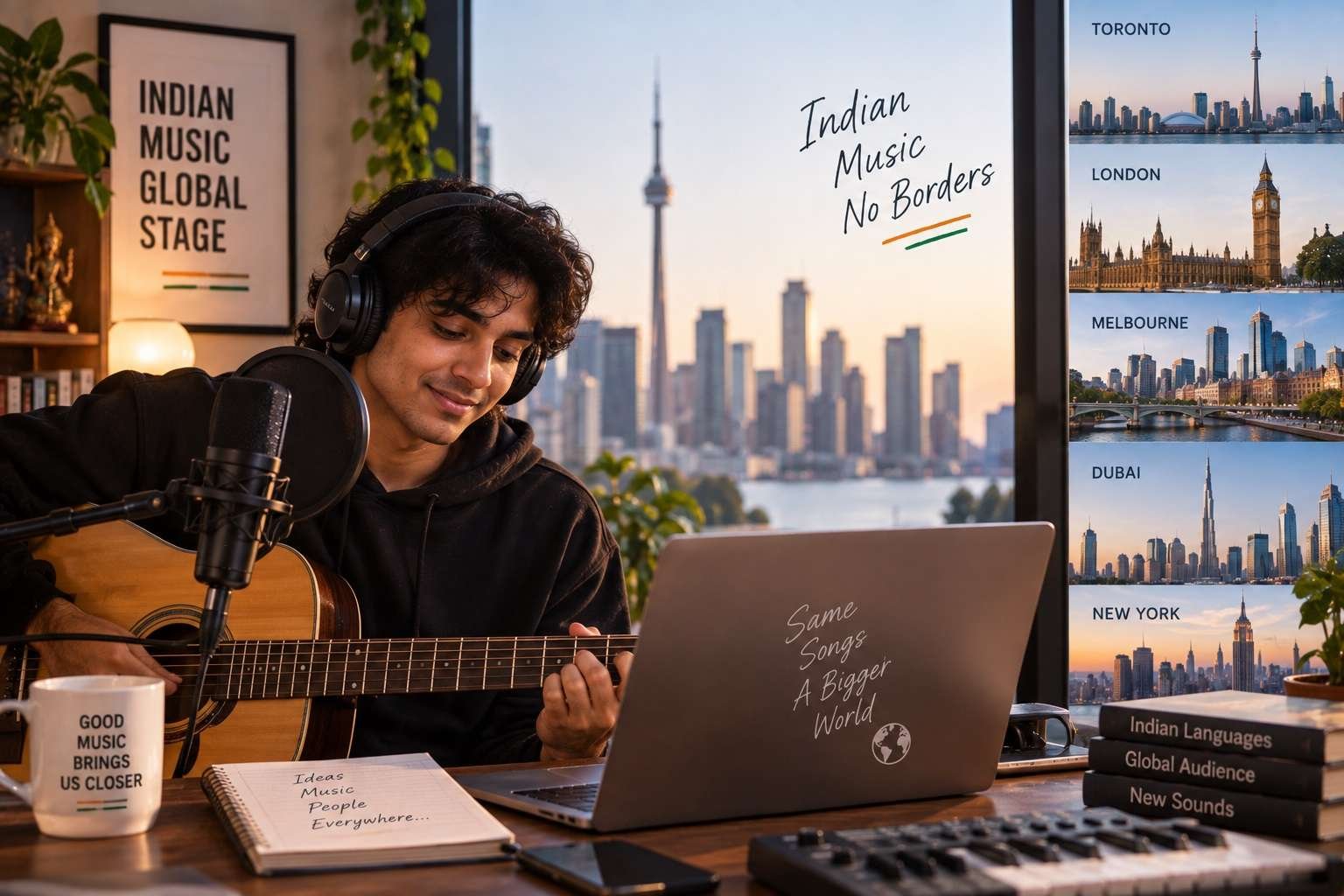
They may be sitting in Toronto, London, Melbourne, Dubai or New York—making music in an Indian language for a global audience that no longer thinks of that language as foreign.

World Beyond the News
Bees Communicate Where Food Is
Honeybees use movement patterns known as waggle dances to communicate information about food locations.
Street Food Reflects Local History
Many famous street foods developed from migration, trade, local ingredients and the everyday needs of working communities.
A Day on Venus Is Extremely Long
Venus rotates so slowly that one rotation relative to distant stars takes longer than its trip around the Sun.
Human Achievement Continues to Push Limits
Athletes, engineers, scientists and explorers regularly establish new benchmarks in speed, endurance, scale and precision.