
From Community Halls to Trafalgar Square: How Indian Festivals Went Global
There was a time when celebrating an Indian festival abroad meant finding a community hall.
Someone booked the hall.
Someone brought a sound system.
Someone arranged the food.
Children performed a dance.
Parents sat in rows.
And, if the samosas ran out early, the organising committee had a small crisis.
That world has changed.
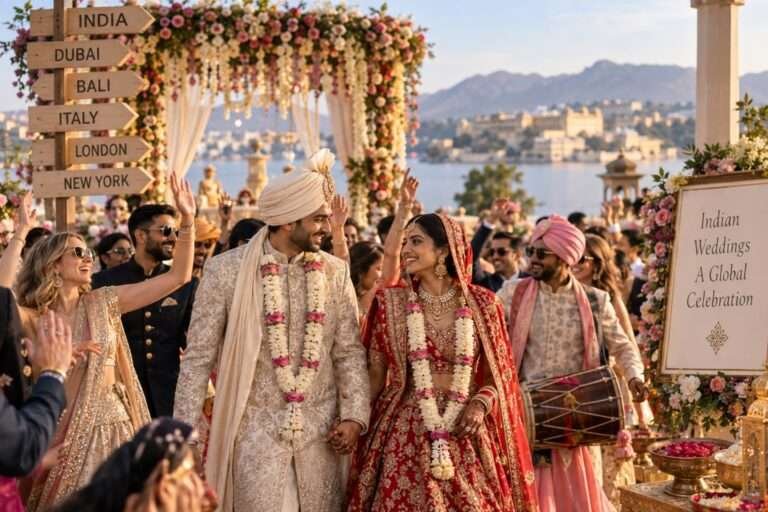
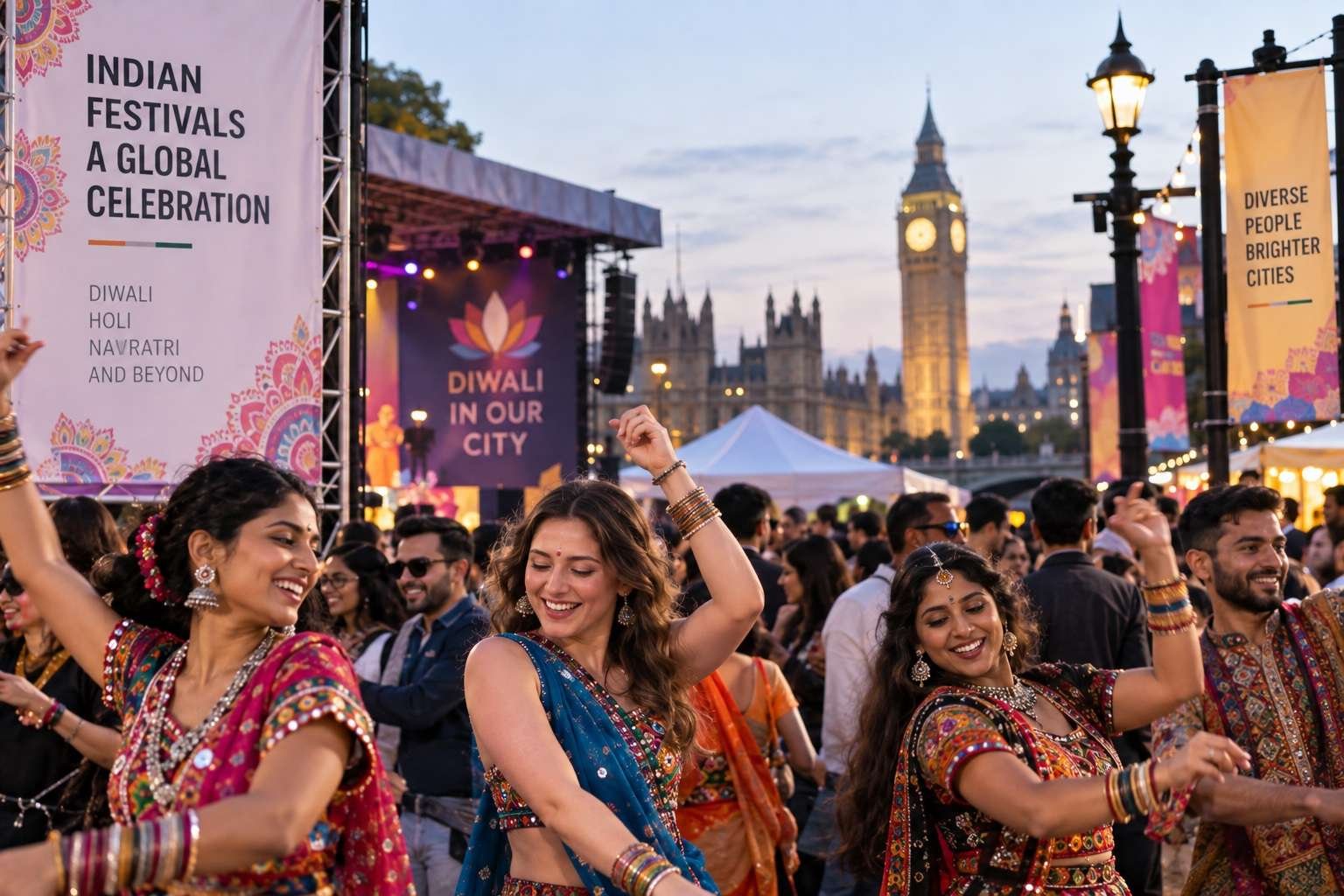
Today, Indian festivals are increasingly visible in some of the world’s most prominent public spaces.
Diwali is celebrated in Trafalgar Square in London. New York City closes its public schools for Diwali. The Empire State Building has illuminated its tower for the festival. And Indian-origin communities around the world are turning cultural celebrations into major civic events.
This is not simply a story about bigger festivals.
It represents something more important:
Indian identity abroad has moved from being something communities preserved privately to something increasingly celebrated publicly.
Trafalgar Square tells the story
London provides one of the clearest examples.
The city’s annual Diwali on the Square is held at Trafalgar Square, one of London’s most recognisable public spaces.
The 2026 event is scheduled for October 25 and is organised as a free public celebration open to everyone. The programme includes music, dance and performances from London’s Hindu, Sikh and Jain communities, along with activities such as sari and turban tying, yoga, meditation, henna and food stalls.
And this isn’t a symbolic event attended by a handful of insiders.
London City Hall estimated that the event attracts around 25,000–30,000 people in a typical year. In 2025, stewards recorded 18,500 people entering through the gates, with another 2,000 community participants, performers and volunteers involved.
That is an important correction to the often-repeated “50,000 attendees” figure.
The actual number is still impressive.
More importantly, the event has become part of London’s civic calendar.

From Indian festival to city festival
That distinction matters.
When a city government helps facilitate a cultural festival in a central public square, the message is subtly different from a private community celebration.
The festival is no longer saying:
“This is our community’s day.”
It is increasingly saying:
“This is part of the city’s cultural life—and everyone is welcome.”
London City Hall explicitly describes Diwali on the Square as an opportunity for Londoners and visitors to come together and as a celebration intended to foster unity.
The programming itself demonstrates the transformation.
It is not confined to religious ritual.
There is classical and contemporary dance, music, food, workshops, yoga, henna, puppetry and opportunities for people unfamiliar with Indian clothing to learn how saris and turbans are worn.
The result is something closer to a public cultural festival than a private diaspora gathering.
New York has gone even further
Perhaps the most consequential example is New York City.
Diwali is now included as a holiday in the New York City Public Schools calendar.
The official 2025–26 calendar lists October 20 as Diwali and states that schools are closed.
This followed years of advocacy and political discussion. The New York City Council formally adopted a 2022 resolution calling for Diwali to become an official public-school holiday. The resolution documented the growing Indian and South Asian population and argued that recognising Diwali would better reflect the city’s diversity.
This is more than a calendar adjustment.
A school holiday tells children something about belonging.
It says that a festival traditionally associated with one community has become significant enough to be recognised within the shared civic rhythm of one of the world’s most diverse cities.
And then there is the skyline
Culture does not only occupy streets.
Sometimes it occupies skyscrapers.
The Empire State Building has included Diwali in its tower-lighting programme. Its official 2025 calendar recorded the building illuminated in orange on October 20 in celebration of Diwali.
An earlier 2023 lighting was carried out in partnership with the Indian Federation Associations.
It may seem like a small gesture.
But symbols matter.
A festival once celebrated around a family lamp or inside a community centre suddenly becomes visible across a metropolitan skyline.
Millions of people do not need to attend the celebration to encounter the image.
They simply look up.

The diaspora became more confident
The demographic foundation behind this transformation is substantial.
The United Nations estimates that around 18.5 million people born in India were living abroad in 2024, making India the world’s largest source country for emigrants.
But that number should not be confused with India’s broader overseas population.
India’s Ministry of External Affairs counts NRIs and people of Indian origin together, producing a figure exceeding 35 million. The broader figure includes second- and later-generation communities who may never have been born in India.
That distinction is crucial.
The global Indian presence is no longer simply about people who left India.
It increasingly includes children and grandchildren of migrants who regard Indian culture as part of their own identity while simultaneously being thoroughly local citizens of their countries of residence.
And festivals provide one of the easiest ways to express that dual identity.
Bollywood opened the door—but it didn’t build the whole house
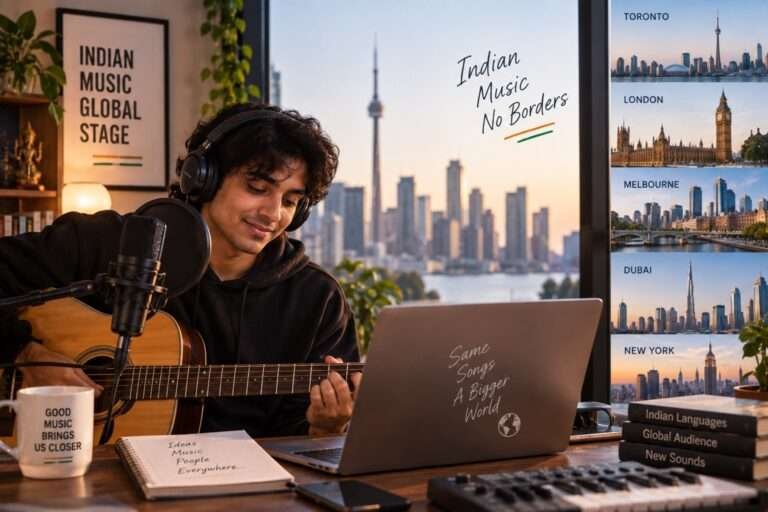
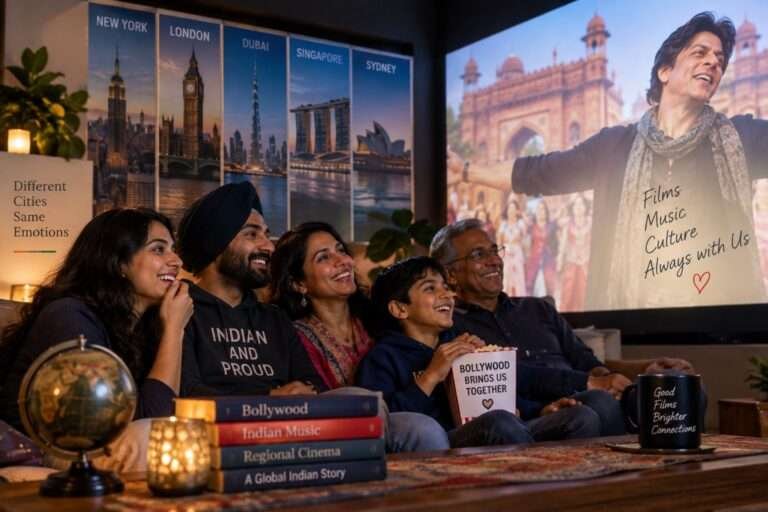
Indian cinema, music and dance have certainly helped.
A person unfamiliar with Hindu philosophy may not know the history of Diwali.
But they may recognise a Bollywood song.
Someone who has never visited Gujarat may nevertheless become curious about Garba after seeing enormous dance celebrations online.
Holi’s visual language—colours, music and crowds—is almost tailor-made for social media.
That cultural visibility has made Indian festivals easier for non-Indians to discover.
But it would be misleading to attribute the entire transformation to Bollywood.
The real engine is the diaspora itself.
Community organisations, temples, cultural associations, schools, volunteers, businesses and younger generations have done much of the work of turning private traditions into public programmes.
The Bollywood soundtrack may help attract the crowd.
Someone still has to organise the crowd.
From assimilation to participation
This may be the most important change.
Earlier immigrant generations often faced a difficult balancing act.
How much of the old culture should be retained?
How much should be adapted?
Would children born abroad continue the traditions?
Would celebrating differently make integration harder?
For later generations, the question increasingly looks different.
They can participate fully in British, American, Australian or Canadian civic life while also celebrating Diwali, Holi, Navratri, Onam, Baisakhi or other Indian traditions.
Integration no longer necessarily requires cultural invisibility.
That is a profound shift.
A young Indian-origin Londoner can dance Garba in Trafalgar Square and still be completely Londoner.
A New York student can have Diwali as a school holiday without that making the school any less American.
That is not cultural isolation.
It is cultural confidence.

But there is a danger in going mainstream
There is also a legitimate criticism.
Once festivals become large public spectacles, commercialisation inevitably follows.
Sponsors want visibility.
Brands want consumers.
Politicians want photographs.
Social media wants spectacular images.
Event organisers want bigger stages.
And suddenly a festival celebrating light, spirituality, community or heritage can become an endless competition over who rented the largest LED screen.
The danger is not modernisation itself.
Indian festivals have always evolved.
The danger is reducing culture to entertainment.
A public Diwali that contains lights, music and food but offers no understanding of what Diwali means becomes a colourful event with an Indian theme rather than a meaningful cultural celebration.
The strongest festivals therefore need both:
spectacle and substance.
DOONITED Editorial Perspective
The journey from the rented community hall to Trafalgar Square is not really about the size of the venue.
It is about the changing status of Indian identity abroad.
A community that once needed a private room to preserve its traditions can now find itself occupying a city’s central public space.
That is cultural confidence.
But there is an even more interesting development.
The next stage of Indian festivals abroad should not simply be about getting more non-Indians to attend.
It should be about giving them something meaningful to understand.
Why is Diwali celebrated differently by Hindus, Sikhs and Jains?
Why do different Indian regions mark the festival in different ways?
Why does Garba mean more than simply a dance?
Why does Onam matter to Malayalis?
Why does Baisakhi mean different things culturally and historically?
The global festival should become an invitation to understand India—not merely an opportunity to eat samosas and take photographs.
Although, admittedly, the samosas should remain.
The bigger insight
India’s global cultural influence is increasingly visible not only through Bollywood, technology, business or the Indian diaspora’s professional success.
It is visible through public space.
When Trafalgar Square hosts Diwali, when New York’s school calendar recognises the festival, and when one of America’s most recognisable skyscrapers lights up for Diwali, Indian culture is no longer operating only inside an ethnic neighbourhood.
It is participating in the civic identity of global cities.
And that may be the real transformation:
The Indian diaspora has moved from preserving culture abroad to helping shape the cultural life of the places it now calls home.
That is considerably more significant than simply making the festival bigger.

World Beyond the News
Bees Communicate Where Food Is
Honeybees use movement patterns known as waggle dances to communicate information about food locations.
Street Food Reflects Local History
Many famous street foods developed from migration, trade, local ingredients and the everyday needs of working communities.
A Day on Venus Is Extremely Long
Venus rotates so slowly that one rotation relative to distant stars takes longer than its trip around the Sun.
Human Achievement Continues to Push Limits
Athletes, engineers, scientists and explorers regularly establish new benchmarks in speed, endurance, scale and precision.