

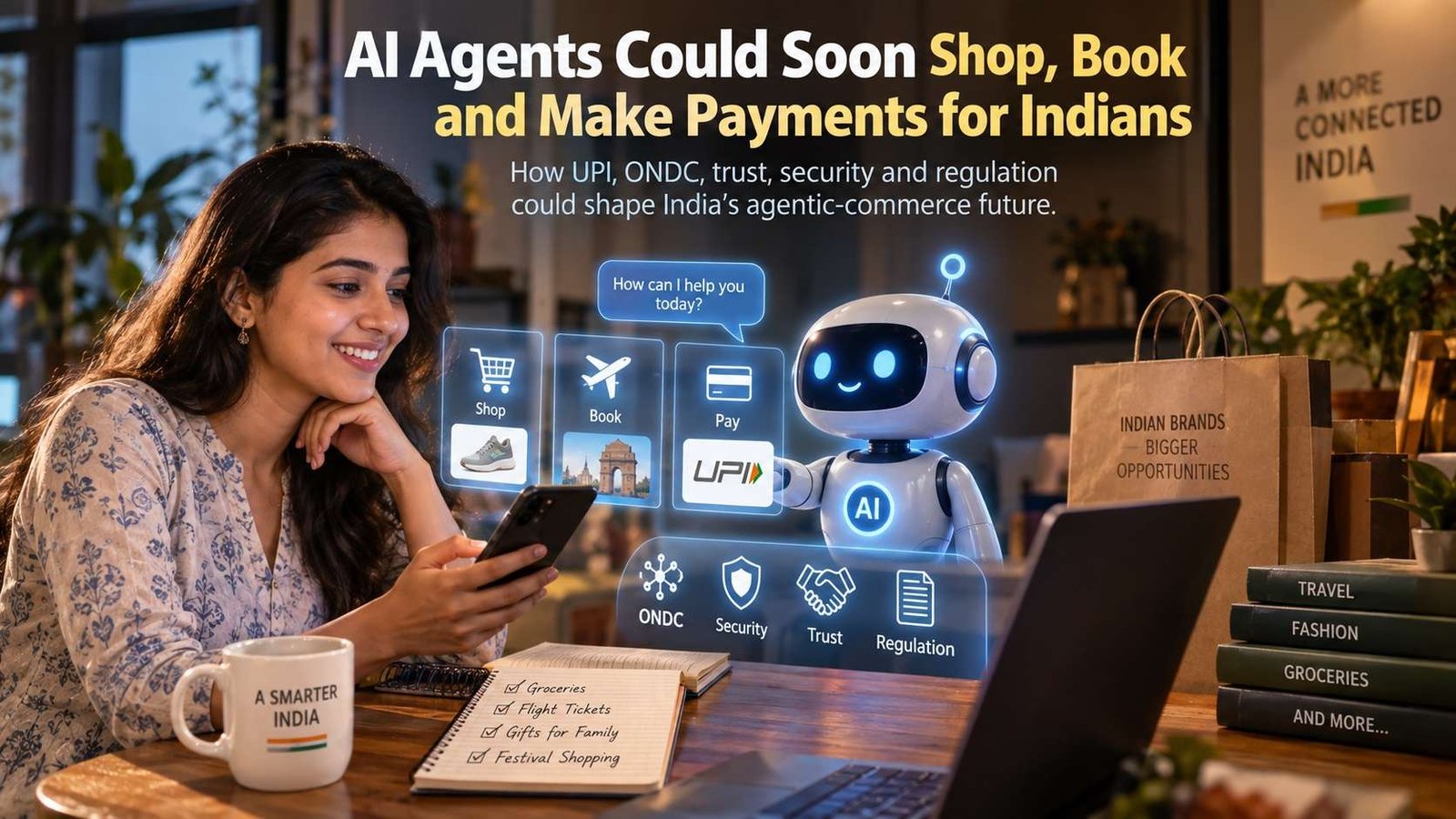
When AI Gets a Wallet: Is India Ready to Let Agents Shop, Book and Pay?
The next big step in artificial intelligence may not be another chatbot. It may be an AI that actually does things for you—including spending your money.
Imagine telling an AI assistant: “Find me the cheapest flight to Dubai next Friday, book a suitable hotel, and keep the total below ₹60,000.”
Instead of returning ten search results and asking you to complete everything yourself, the AI could compare options, make decisions according to your preferences, complete the booking and eventually make the payment.
That sounds futuristic.
For India, however, parts of that future are already being built.
The country’s enormous digital-payment ecosystem, particularly UPI, gives India an unusual foundation for agentic commerce. The question is no longer simply whether AI can understand what consumers want. It is whether Indians will trust an AI enough to let it act on their behalf.
And perhaps more importantly: who is responsible when the AI gets it wrong?
From answering questions to taking action
Traditional AI assistants largely operate as conversational systems. You ask something; they provide an answer.
Agentic AI is different.
An AI agent can potentially interpret a goal, search for information, use digital services, make decisions within defined rules and execute a sequence of actions.
That distinction is important.
A chatbot can tell you where to buy a pair of shoes.
An agent could potentially find the right size, compare prices, place the order and pay.
The difference is the last mile: execution.
India’s digital infrastructure makes this particularly significant.
UPI already enables instant account-to-account payments and has become deeply integrated into everyday commerce. NPCI’s own material describes UPI as an instant payment system and has also introduced AI-powered assistance for UPI-related queries and transaction support.
Now the industry is working on the harder question: how can an AI itself become an authorized participant in a transaction?
India is already preparing for agentic payments
In September 2026, NPCI officials discussed protocols to identify and authorize digital AI agents within the UPI ecosystem.
The proposed approach is intended to allow agents to operate within controlled parameters, potentially including user-defined limits and safeguards around identity, consent, auditability and settlement.
Reuters has reported that NPCI is developing an AI-agent registry intended to verify and monitor agents conducting UPI transactions. Initial use cases are expected to focus on relatively small and frequent digital payments, with more complicated applications potentially following later.
There is an important catch.
The proposed Unified Agentic Protocol has reportedly been put on hold while regulatory and safety concerns are addressed. The delay highlights the central problem with autonomous payments: making a transaction technically possible is much easier than making it safe, accountable and legally defensible.
That distinction matters.
The technology is moving faster than trust
A payment made by a human is relatively easy to understand.
You open an app, select a merchant, enter or authenticate the transaction and pay.
Now imagine an AI making the decision.
Suppose you tell your agent:
“Buy groceries every Sunday, but never spend more than ₹3,000.”
What happens if the AI interprets a promotional bundle incorrectly and spends ₹3,400?
What if the merchant changes the price?
What if the AI buys the wrong product?
What if an attacker manipulates information that the agent uses to make its decision?
And the biggest question:
Who pays when the machine makes the mistake?
These are not philosophical questions. They are practical questions for banks, regulators, merchants and consumers.
India’s proposed approach therefore needs more than clever AI. It needs identity, authentication, transaction limits, audit trails, consent mechanisms and clearly defined liability.
India has an advantage others may not
Despite the risks, India is unusually well positioned for this transition.
The country already has large-scale digital public infrastructure across payments and commerce.
UPI provides the payment rail. ONDC provides an open digital commerce network in which buyer applications can connect consumers with sellers across categories. ONDC says buyer applications can parse and match search requests against products available on the network.
That creates an interesting possibility.
An AI agent could eventually sit above these systems as a kind of digital purchasing assistant.
Instead of asking consumers to navigate ten different applications, the user could state an objective:
“Find me the best option under ₹2,000.”
The agent could search, compare and potentially transact.
This is where agentic commerce becomes more than another AI feature.
It could change the interface between consumers and the digital economy.
But India is not one language or one consumer
There is another challenge that international discussions about AI agents sometimes underestimate: India’s linguistic diversity.
An agent designed primarily around English may work perfectly for one group of consumers and poorly for another.
For agentic commerce to become genuinely mass-market in India, AI will need to understand regional languages, mixed-language conversations and the way people actually communicate.
A user may not say:
“Purchase the least expensive qualifying household product.”
They may say something closer to:
“Yeh wala sasta hai? Isko le lo.”
The technology has to understand the intent, not merely the grammar.
NPCI has already been exploring multilingual AI capabilities in its broader AI work, including payment-focused language models and AI systems designed for India’s payment ecosystem.
That is encouraging.
But language accuracy in a chatbot and language accuracy in a financial transaction are two very different standards.
If an AI misunderstands a restaurant recommendation, dinner may simply be disappointing.
If it misunderstands a financial instruction, someone’s bank account may be involved.
The biggest change may be psychological
There is also a cultural hurdle.
Indians have become remarkably comfortable with digital payments. QR codes are now an ordinary part of everyday commerce.
But handing payment authority to an AI is different.
People may happily ask AI to write an email.
They may hesitate before saying:
“Here are my credentials. You decide when to spend my money.”
That hesitation is healthy.
The success of agentic commerce will probably depend less on convincing consumers that AI is intelligent and more on convincing them that AI is controllable.
Consumers will want spending limits.
They will want instant notifications.
They will want transaction histories.
They will want the ability to stop an agent immediately.
And they will want to know exactly what the agent is allowed to do.
In other words, the winning AI agent may not be the one that behaves most independently.
It may be the one that gives users the best control over its independence.
The Doonited perspective: India’s real opportunity is trust
The most interesting aspect of India’s agentic-commerce story is therefore not that AI might soon buy groceries or book flights.
It is that India has an opportunity to build a model of controlled autonomous commerce around digital infrastructure already used at enormous scale.
That could become a competitive advantage.
But there is a danger in moving too quickly.
“AI can do it” is not the same as “AI should be allowed to do it.”
A useful agent should know the difference between a ₹500 grocery purchase and a ₹5 lakh financial transaction. It should know when to act, when to ask permission and—perhaps most importantly—when to say no.
The smartest AI may ultimately be the one that knows when not to press the payment button.
What this means for ordinary Indians
For consumers, agentic AI could eventually make online commerce dramatically easier.
A personal AI could potentially:
- compare prices;
- find travel options;
- monitor discounts;
- manage routine purchases;
- book services;
- make permitted payments;
- remember preferences;
- and complete repetitive digital tasks.
But consumers should not confuse convenience with safety.
Until regulatory frameworks and industry standards mature, users should treat autonomous financial features cautiously and understand exactly what permissions, limits and authentication mechanisms they provide.
India’s digital economy has already demonstrated that people will adopt technology at extraordinary speed when it is convenient.
The next challenge is making sure trust can move at the same speed.
That may determine whether agentic commerce becomes India’s next digital revolution—or simply another impressive technology that consumers use selectively.
The future may indeed be an AI that shops, books and pays for us. The real question is whether we can build one that knows what it is allowed to do.

World Beyond the News
Why Elephants Stay Close to Their Herd
Elephants live in highly social family groups and use calls, touch and body movements to maintain strong bonds.
Most of the Deep Ocean Remains Difficult to Explore
Extreme pressure, darkness and distance make deep-ocean exploration one of Earth’s greatest scientific challenges.
Spacecraft Can Travel Without Traditional Roads
Spacecraft use carefully calculated trajectories and gravity assists to travel enormous distances through space.
Why Movie Trailers Are Released in Stages
Major films often use teaser trailers, full trailers and final promotional spots to build awareness over time.