
Why Tiny Minerals Matter to Big Technology
Oil once defined the vocabulary of strategic resources.
Today, some of the most consequential materials in the global economy are far less glamorous.
They can fit into a laboratory container, appear as obscure entries on a periodic table and rarely make the evening news.
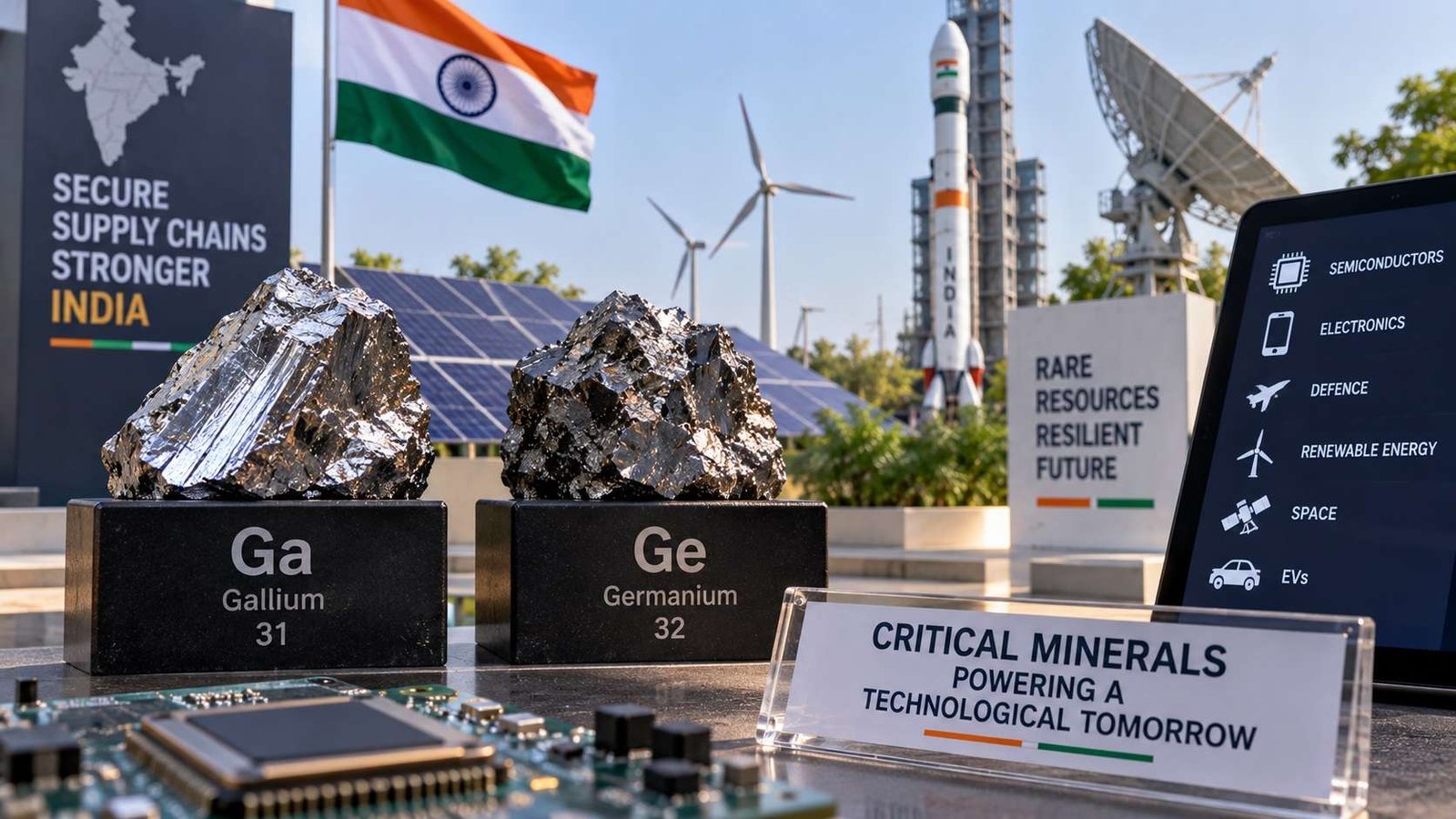
Yet gallium and germanium sit inside technologies that increasingly define economic and national security — from semiconductors and optical communications to defence electronics, infrared systems and advanced energy technologies.
For India, their importance is growing at precisely the moment the country is trying to build semiconductor manufacturing, expand high-technology production and strengthen domestic defence capabilities.
The uncomfortable question is therefore not simply whether India has enough minerals.
It is whether India can build a reliable supply chain from mineral resources to refined material to finished technology.
Why gallium and germanium matter
India’s Ministry of Mines included both gallium and germanium in its official list of 30 critical minerals released in 2023. The classification reflects their importance to strategic industries and the risks associated with concentrated supply chains.
Gallium is particularly important for compound semiconductors such as gallium arsenide (GaAs) and gallium nitride (GaN).
These materials have applications in high-frequency electronics, power electronics, radio-frequency systems and other specialised semiconductor technologies.
Germanium has a different but equally important profile. India’s Ministry of Mines identifies applications including optical fibre, satellites, solar cells, infrared night-vision systems and specialised optical equipment.
In other words, these are not simply mining commodities.
They are inputs into the infrastructure of the digital and security age.
The China concentration problem
The biggest vulnerability is not merely how much gallium or germanium exists underground.
It is where the processing and production capacity is located.
Reuters reported on September 18 that China accounts for approximately 98.9% of global gallium production and 68.6% of germanium production. Western countries are trying to diversify supply, but new projects have been slow to develop and are struggling to match existing Chinese capacity.
That concentration changes the economics of the minerals.
A supply disruption does not have to eliminate every tonne of material.
Even tighter export controls, licensing requirements or logistical interruptions can create uncertainty, increase prices and force manufacturers to search for alternative suppliers.
For a semiconductor company planning production months or years in advance, uncertainty itself is a cost.
India is not starting from zero
There is an important nuance in India’s story.
It would be inaccurate to describe India as having absolutely no gallium capability.
The Ministry of Mines has previously identified gallium as a by-product of alumina production. Its critical-minerals report noted that Hindalco’s Renukoot facility in Uttar Pradesh and NALCO’s Damanjodi refinery in Odisha had recovered gallium in the past, although that capability needs to be revisited and developed.
That is potentially significant.
Gallium is unusual because it is often recovered as a by-product, rather than mined as the primary target of a conventional gallium mine.
This means India’s existing aluminium and alumina ecosystem could potentially become part of a domestic gallium strategy.
But potential is not the same thing as production.
The country still needs economically viable recovery technology, refining capacity, industrial-scale processing and reliable customers.
Exploration is moving up the agenda
India’s policy response has been expanding beyond simply identifying critical minerals.
The Ministry of Mines has been auctioning critical and strategic mineral blocks, and in July 2026 the government announced its eighth tranche of auctions, comprising 20 blocks across nine states.
The portfolio includes gallium, titanium, tungsten, vanadium, graphite, rare-earth elements and other minerals considered important for strategic industries, clean energy and advanced manufacturing.
The government is also encouraging exploration and domestic value-chain development.
A March 2026 Ministry of Science & Technology update said India was scaling up critical-mineral exploration, encouraging startup participation and attempting to create stronger domestic value chains to reduce import dependence.
That is an important shift.
The objective is gradually moving from:
“Find the mineral.”
to:
“Build the entire chain around the mineral.”
The semiconductor connection
This matters enormously for India’s semiconductor ambitions.
India is investing heavily in semiconductor manufacturing through Semicon India and Semicon 2.0.
The government approved Semicon 2.0 in July 2026 with an outlay of ₹1,27,500 crore, with the programme covering research and development, chip design, semiconductor manufacturing, equipment and materials, talent and ATMP/OSAT capabilities.
A semiconductor ecosystem therefore requires more than silicon wafers and fabrication plants.
It requires specialised materials.
That is where critical-mineral policy intersects with semiconductor policy.
If India builds fabs and advanced electronics facilities while remaining vulnerable to concentrated overseas supplies of strategically important materials, part of the supply-chain problem simply moves upstream.
The factory may be in India.
The vulnerability may still be somewhere else.
Defence makes the issue even more sensitive
The same principle applies to defence.
Modern military systems depend on advanced electronics, radar, communications, infrared sensing, satellite systems and high-performance power electronics.
Materials such as gallium-based compound semiconductors can be important in specialised high-frequency and power applications.
Germanium has applications in optical and infrared technologies.
This does not mean that every Indian missile, radar or military platform depends directly on imported gallium or germanium.
It does mean that access to specialised semiconductor materials can become part of the broader technology-security equation.
That makes critical minerals an industrial issue and a strategic issue at the same time.
The green-technology connection
The demand story extends beyond defence and semiconductors.
Gallium compounds are used in technologies such as LEDs, high-efficiency electronics and certain advanced solar applications.
Germanium is used in fibre-optic systems and specialised solar cells, including technologies used in space applications.
As India expands renewable energy, telecommunications, data infrastructure and advanced electronics, demand for specialised materials can grow even if the quantities involved are tiny compared with commodities such as iron ore or coal.
That is the paradox.
A mineral does not need to be consumed in enormous quantities to become strategically important.
A few grams in the right component can matter more than tonnes of an ordinary industrial material.
Recycling could become India’s quiet advantage
Mining alone cannot solve the problem.
The Ministry of Mines has increasingly highlighted secondary resources and recycling as part of India’s critical-mineral strategy. A national workshop in April 2026 specifically focused on developing resilient critical-mineral value chains through exploration, private participation and recycling.
That could become particularly important for materials that occur in small concentrations or as industrial by-products.
Electronic waste, discarded telecommunications equipment, photovoltaic components and industrial residues may eventually become secondary sources of strategically valuable materials.
The circular economy, in this context, is not merely an environmental slogan.
It can become a supply-security strategy.
India also needs overseas assets
Domestic exploration will not be enough.
India has recognised this through Khanij Bidesh India Limited (KABIL), which was created to acquire or develop critical and strategic mineral assets overseas.
The government has already pursued overseas mineral opportunities, including lithium projects in Argentina.
That approach reflects an important reality:
No major industrial economy can realistically expect to be completely self-sufficient in every critical mineral.
The practical objective is diversification.
Domestic resources where possible.
Overseas assets where necessary.
Recycling where economical.
Strategic stockpiles where justified.
And multiple international suppliers wherever feasible.
The world is learning the same lesson
India is not alone in discovering that obscure minerals can become geopolitical assets.
Reuters reports that the United States and other Western economies are investing in new production and processing projects while exploring stockpiling, recycling and substitution. Yet developing alternative supply chains remains difficult, and analysts expect supply gaps for some niche metals to persist.
That is because building a mine is only the beginning.
Permitting takes time.
Processing technology takes investment.
Refineries need specialised infrastructure.
Manufacturers must qualify new material sources.
And customers must be willing to sign long-term contracts.
You cannot simply announce a new gallium supply chain on Monday and expect a semiconductor factory to trust it by Tuesday.
Doonited Editorial Perspective
India’s critical-mineral challenge should therefore not be reduced to a race against China.
The deeper issue is industrial capability.
India wants to become a semiconductor hub. It wants to expand defence manufacturing. It wants more renewable energy, telecommunications, electric mobility and advanced manufacturing.
All of those ambitions depend on materials that most consumers never think about.
The strategic response should consequently connect mining policy with semiconductor policy, electronics manufacturing, defence research, recycling, overseas mineral acquisition and industrial R&D.
India’s existing alumina industry could potentially contribute to gallium recovery. Its scientific institutions can develop extraction and recycling technologies. Its companies can invest in processing. Its diplomatic network can help secure overseas resources.
The opportunity is real.
So is the difficulty.
The objective should not be to claim that India can immediately become completely independent of foreign mineral supplies.
It should be to make sure that no single supplier, country or processing bottleneck can easily disrupt India’s technological ambitions.
The Doonited Insight
The next energy crisis may not necessarily begin with a shortage of oil.
It could begin with a shortage of something most people have never heard of.
Gallium. Germanium. Tellurium. Tungsten. Rare earths.
The lesson for India is simple:
Technology sovereignty begins much further upstream than the factory floor.
A semiconductor plant without secure materials is only part of a supply chain.
A truly resilient technology economy needs control, diversification or reliable access across the entire chain — from the mineral beneath the ground to the chip inside the machine.
And that is why these tiny metals are becoming such a big strategic story.

World Beyond the News
Bees Communicate Where Food Is
Honeybees use movement patterns known as waggle dances to communicate information about food locations.
Street Food Reflects Local History
Many famous street foods developed from migration, trade, local ingredients and the everyday needs of working communities.
A Day on Venus Is Extremely Long
Venus rotates so slowly that one rotation relative to distant stars takes longer than its trip around the Sun.
Human Achievement Continues to Push Limits
Athletes, engineers, scientists and explorers regularly establish new benchmarks in speed, endurance, scale and precision.