
Asian Games 2026: India’s First Gold, 11 Medals and the Stories Behind the Tally
India has its first gold medal of the Aichi-Nagoya Asian Games 2026—and it came from a team that has rapidly become one of the most successful forces in Asian women’s cricket.
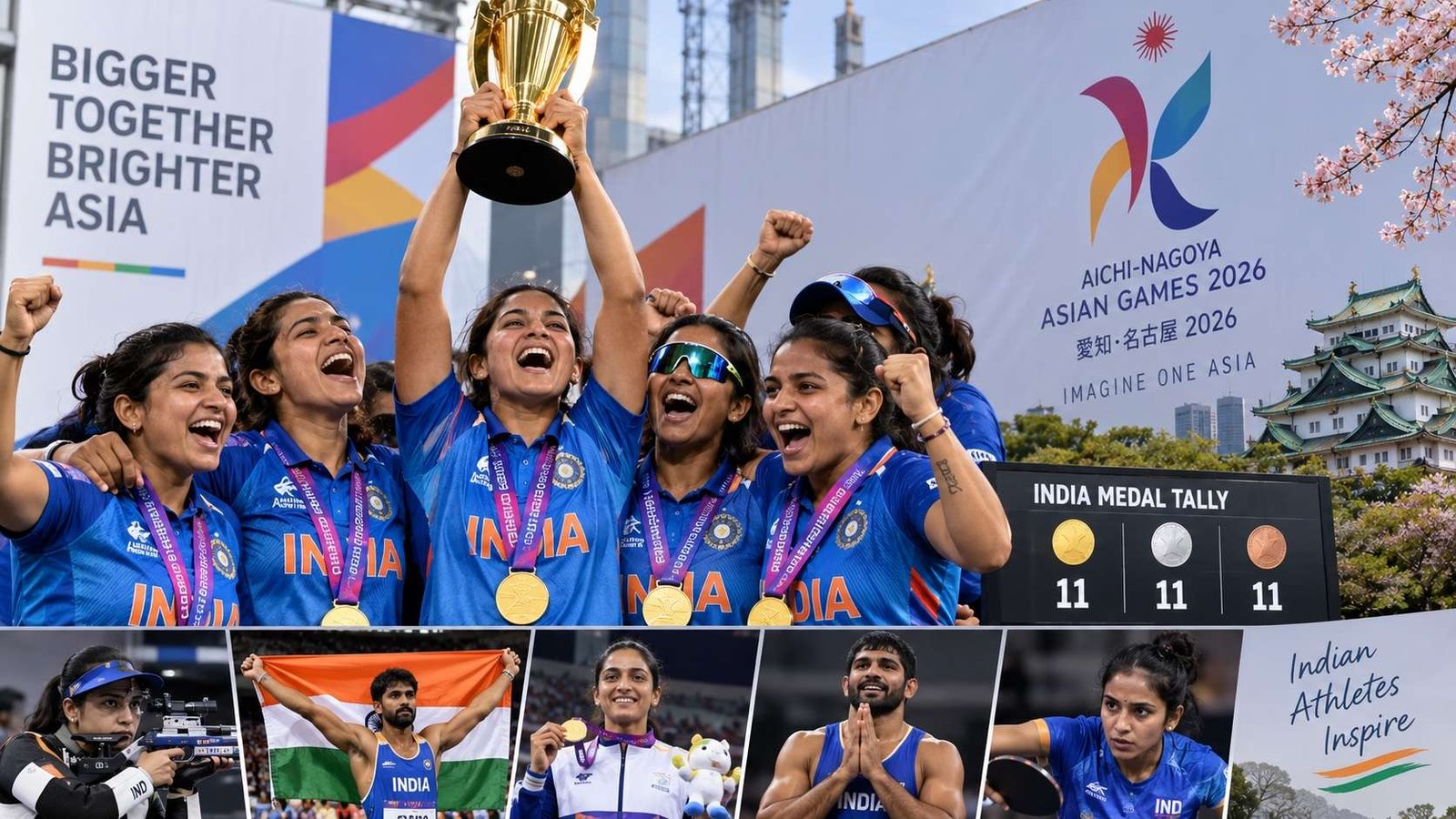
On September 22, the Indian women’s cricket team defeated Sri Lanka by 147 runs in the women’s T20 final, securing India’s first gold medal of these Asian Games. It was also India’s second consecutive Asian Games women’s cricket gold after the team won the inaugural women’s cricket gold at Hangzhou 2022.
By September 23, India’s overall medal tally had climbed to 11: one gold, five silver and five bronze, placing the country eighth in the overall standings at the time of the latest update.
The medal table, however, tells only part of the story.
The more interesting story is where India’s medals are coming from—and what that says about the country’s sporting depth.
The Gold That Changed the Conversation
India’s women’s cricket team produced a commanding performance in the final.
Batting first, India scored 216 for three. Smriti Mandhana made 79 from 45 balls, Shafali Verma contributed 48, while Richa Ghosh finished with an unbeaten 49 from 22 deliveries.
Sri Lanka was then dismissed for just 69 in 15.4 overs, giving India a 147-run victory. Deepti Sharma took three wickets for six runs, while Shafali Verma and Shreyanka Patil claimed two each.
Mandhana’s performance also carried a personal milestone: she became the first woman to reach 11,000 international runs.
It was a gold medal, but also something more subtle.
The Asian Games are traditionally associated with athletics, shooting, wrestling, boxing, weightlifting and other Olympic disciplines. Cricket’s presence gives the tournament an additional connection with the enormous Indian sporting audience.
For India, that means the Asian Games are increasingly becoming part sporting competition, part national television event.
The scoreboard, naturally, does not care about any of that.
It simply says: India 216/3, Sri Lanka 69.
India’s 11 Medals So Far
According to the latest medal table published on September 23, India’s 11 medals are:
| Medal | Athlete / Team | Event |
|---|---|---|
| 🥇 Gold | Indian women’s cricket team | Women’s T20 cricket |
| 🥈 Silver | Indian women’s 10m air rifle team | Shooting |
| 🥈 Silver | Elavenil Valarivan | Women’s 10m air rifle |
| 🥈 Silver | Indian men’s 10m air rifle team | Shooting |
| 🥈 Silver | Himanshu Dhillon | Men’s 10m air rifle |
| 🥈 Silver | Mirabai Chanu | Women’s 49kg weightlifting |
| 🥉 Bronze | Rudrankksh Patil | Men’s 10m air rifle |
| 🥉 Bronze | Suchika Tariyal | Women’s traditional MMA, 60kg |
| 🥉 Bronze | Indian women’s skeet team | Shooting |
| 🥉 Bronze | Indian men’s skeet team | Shooting |
| 🥉 Bronze | Jay Meena | Men’s singles soft tennis |
The latest four additions on September 23 were Mirabai Chanu’s silver, bronze medals for the men’s and women’s skeet teams, and Jay Meena’s historic soft-tennis bronze.
Mirabai Chanu Finally Gets Her Asian Games Medal
One of the day’s most significant individual achievements came from Mirabai Chanu.
The Olympic and world-level weightlifting star won silver in the women’s 49kg category, securing her first Asian Games medal after previous near-misses.
She lifted 198kg in total, including a best clean-and-jerk effort of 111kg.
The medal has an interesting historical dimension.
India’s previous Asian Games weightlifting medal had come from Karnam Malleswari at the 1998 Bangkok Games. India had subsequently gone without a weightlifting medal at the continental event for 28 years.
For a champion who already has Olympic and world championship credentials, the Asian Games silver therefore fills an unusual gap in the collection.
Sometimes even the biggest names have one empty box on the shelf.
Chanu has now filled hers.
Shooting: India’s Early Medal Engine
If cricket provided the headline gold, shooting has provided much of the medal volume.
India has collected medals in both rifle and shotgun events, including team and individual competitions. The country’s early shooting haul includes silvers from the women’s and men’s 10m air-rifle teams, individual silver medals for Elavenil Valarivan and Himanshu Dhillon, and bronzes for Rudrankksh Patil and the two skeet teams.
The concentration is notable.
India’s medal performance is not being carried by one discipline alone, but shooting has been particularly productive during the opening days.
That matters because Asian Games success requires depth across disciplines—not merely one or two superstar athletes.
Jay Meena’s Soft-Tennis Moment
Another story deserves attention precisely because it is less familiar to the average Indian sports follower.
Jay Meena won bronze in men’s singles soft tennis, giving India its first Asian Games medal in the sport.
It is the kind of result that can easily disappear beneath the larger cricket and shooting headlines.
But these are often the medals that reveal something important about a multi-sport event.
The Asian Games create opportunities for sports that receive comparatively little mainstream attention in India.
A cricket victory can dominate the news cycle.
A soft-tennis medal can quietly expand the country’s sporting map.
A Historic MMA Medal Too
India’s medal tally also includes a bronze from Suchika Tariyal in the women’s traditional MMA 60kg category.
Its significance extends beyond the medal count because MMA and related combat disciplines are part of the evolving Asian Games programme.
For Indian athletes, participation in such emerging disciplines can provide a pathway toward greater international competition and visibility.
The medal table, therefore, is also a record of sports India’s athletes are learning to compete in at a continental level.
India Is Eighth—But Medal Tables Need Context
As of the latest September 23 update, India stood eighth with 1 gold, 5 silver and 5 bronze medals. China led with 37 golds and 61 total medals, followed by Japan and South Korea.
But early medal tables can be misleading if treated like final league standings.
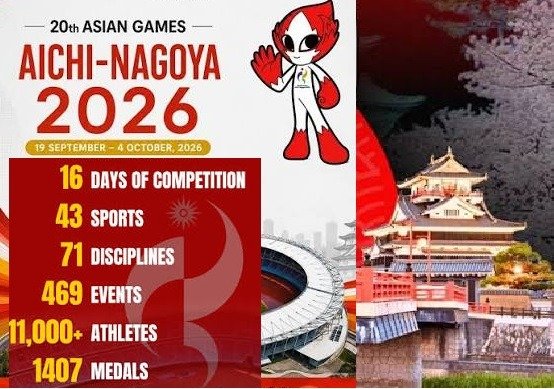
The Asian Games run from September 19 to October 4, and events are distributed throughout the programme. Some sports generate medals early, while others—particularly athletics, team sports and several combat disciplines—can alter the table considerably later.
So India’s eighth-place position on September 23 is a snapshot, not a final assessment.
The medal table is still being written.
The Bigger Indian Story Is Sporting Diversity
The most encouraging feature of India’s early campaign is not simply the number 11.
It is the variety.
India has medals from:
- Cricket
- Shooting
- Weightlifting
- MMA
- Soft tennis
That diversity matters.
A mature sporting ecosystem cannot depend indefinitely on one discipline.
India’s cricket strength is obvious. Its shooting programme has produced consistent international performers. Weightlifting has a history of champions. Combat sports continue to expand. And lesser-known disciplines are beginning to find their own medal pathways.
The challenge is converting isolated breakthroughs into sustained systems.
A medal is an outcome.
A sporting ecosystem is the machinery that produces the next medal after the current athlete retires.
What India Can Learn From the Early Tally
The early medals provide a useful lesson.
India’s sporting ambitions cannot be measured only by how many gold medals appear at the end of a major tournament.
Silver and bronze medals often reveal the depth immediately below the champion.
The next challenge is to convert that depth into more victories.
That requires sustained athlete development, coaching, sports science, competition exposure, facilities and—perhaps most importantly—long-term support for sports that do not routinely dominate television ratings.
If India wants a broad sporting culture rather than occasional sporting sensations, the less glamorous disciplines need attention between Games, not just applause during them.
Doonited Editorial Perspective
India’s first gold at Aichi-Nagoya is naturally a moment for celebration.
But the more meaningful story may be the combination of established strengths and emerging disciplines.
The women’s cricket team delivered the headline.
Shooting supplied a large part of the medal foundation.
Mirabai Chanu added a long-awaited weightlifting medal.
Suchika Tariyal and Jay Meena brought medals from disciplines that receive considerably less attention in India’s mainstream sporting conversation.
That is a useful picture of Indian sport in 2026: not one sporting India, but several Indias competing at once.
The next test is whether these individual successes can become institutional depth.
Because winning one medal creates a moment.
Building a system creates a sporting generation.
DOONITED INSIGHT
India’s most important Asian Games statistic may not be its current medal total. It may be the number of sports in which Indian athletes believe a medal is possible.
That belief is difficult to measure—but it can change the country’s sporting future.
Meaningful Learning for Readers
The Asian Games are a reminder that elite sport is not built only around famous names.
Some medal winners are household names. Others become known only after stepping onto the podium.
For viewers, that makes the medal table worth following beyond the headline events.
For young Indian athletes, the message is equally important:
There are more sporting paths to an international podium than the sports that dominate India’s television screens.
And that may ultimately be the most valuable medal of all—the expansion of India’s sporting imagination.


World Beyond the News
Bees Communicate Where Food Is
Honeybees use movement patterns known as waggle dances to communicate information about food locations.
Street Food Reflects Local History
Many famous street foods developed from migration, trade, local ingredients and the everyday needs of working communities.
A Day on Venus Is Extremely Long
Venus rotates so slowly that one rotation relative to distant stars takes longer than its trip around the Sun.
Human Achievement Continues to Push Limits
Athletes, engineers, scientists and explorers regularly establish new benchmarks in speed, endurance, scale and precision.