

How the RBI Managed a ₹11 Lakh Crore Liquidity Surge
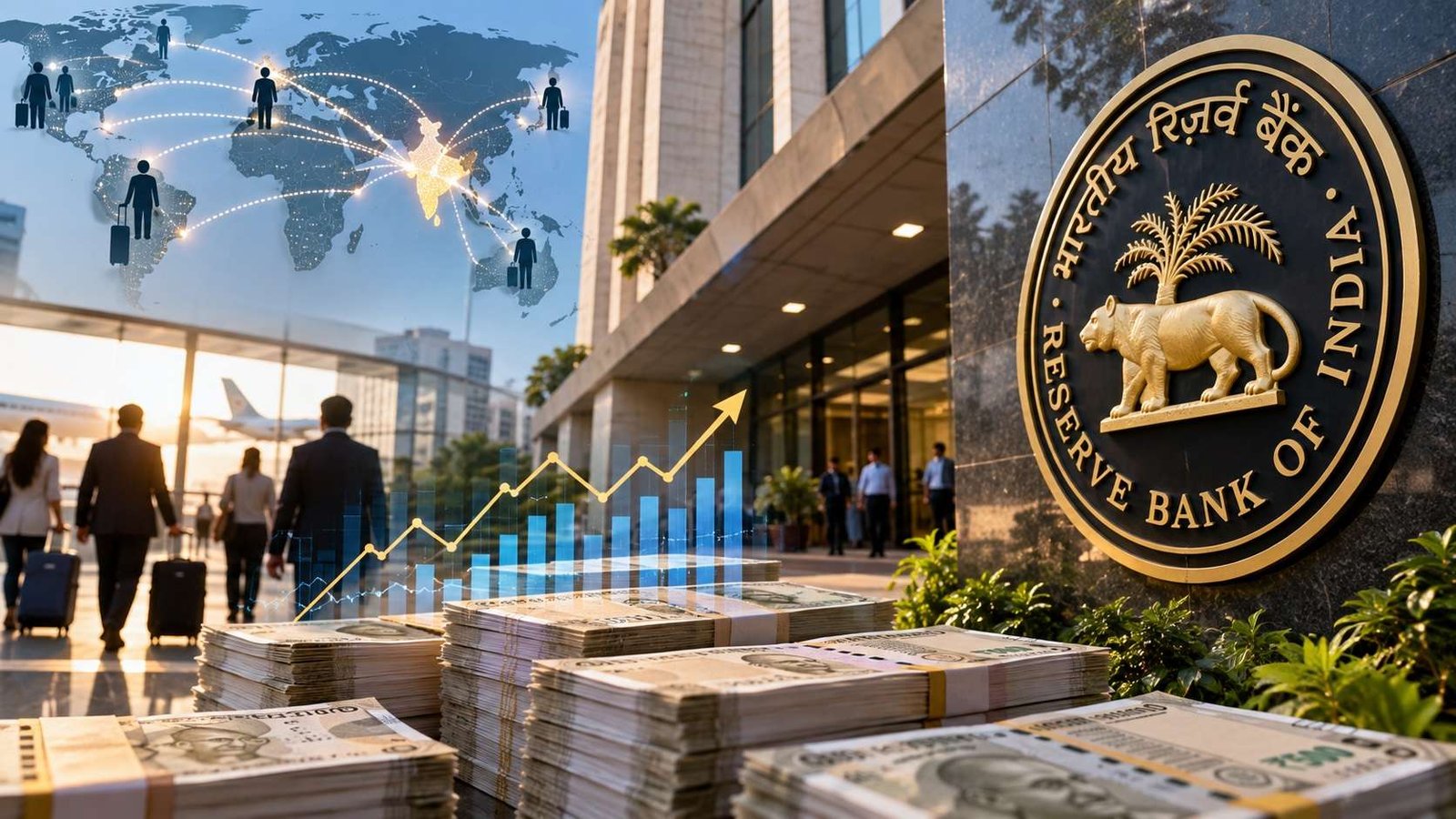
Money sent home by Indians living abroad is usually discussed in familiar terms: family support, property purchases, education, savings and the foreign exchange that helps pay for imports. In September 2026, overseas Indian money became part of a rather different story — one involving a record cash surplus in India’s banking system and a substantial balancing act by the Reserve Bank of India (RBI).
The RBI’s liquidity surplus reached a record ₹11.16 lakh crore around September 6. By September 21, it had fallen to ₹4.92 lakh crore — a reduction of approximately 55%, according to Reuters. The central bank had used government-bond sales and foreign-exchange operations to absorb surplus rupees, while tax payments and other flows also helped drain cash from the system.
The episode offers a revealing lesson in modern central banking: attracting foreign money can strengthen a country’s financial position, but the domestic currency created or released in the process still has to be managed.
In other words, even good news can arrive with a liquidity-management instruction attached.
The diaspora deposit connection
The surge followed a special initiative that attracted substantial non-resident deposits. Reuters reported that banks raised approximately $133 billion through the RBI’s diaspora deposit scheme, far exceeding expectations. The inflows were associated with foreign-currency deposits and the central bank’s dollar-rupee swap arrangements.
The mechanism matters. When a bank mobilises foreign currency from an overseas depositor, that money does not automatically become rupees circulating in India. But when foreign currency is exchanged with the RBI under a swap arrangement, the bank receives rupees in return. Those rupees add to domestic banking-system liquidity.
That is the operational link between overseas deposits and the cash surplus.
The scheme helped draw foreign currency into India’s financial system. It also created a large volume of rupee liquidity that the RBI subsequently needed to manage. These are two sides of the same transaction, not contradictory outcomes.
The reported $133 billion figure should also be understood in context: it refers to funds mobilised through the scheme, not a claim that the entire amount was a permanent addition to India’s foreign-exchange reserves or that all of it remained as excess rupees in banks. The currency, maturity and swap arrangements determine how these flows affect the financial system over time.
Why a cash surplus can become a problem
At first glance, a banking system with abundant cash sounds like a banker’s version of a full pantry. Banks have funds available, and the financial system appears comfortably liquid.
But liquidity is not the same as productive lending, and a very large surplus can complicate monetary policy.
When banks have more short-term funds than they need, overnight money-market rates can drift below the RBI’s policy benchmark. That can weaken the transmission of monetary policy — the process through which changes in the central bank’s policy rate influence market interest rates and, eventually, borrowing, spending and inflation.
Excess liquidity can also add to inflationary pressure if it supports credit and demand beyond what the economy can comfortably absorb. Reuters reported that policymakers were managing the surplus amid elevated oil prices and pressure on the rupee, both of which could complicate the inflation outlook.
There is an important qualification: surplus bank reserves do not mechanically translate into an equal amount of new lending or consumer-price inflation. Banks lend when they see creditworthy borrowers and acceptable returns; demand, capital, risk and regulation matter too. Liquidity is one part of the monetary equation, not the whole equation.
The RBI’s challenge was therefore to prevent the cash overhang from undermining its policy stance while avoiding unnecessary disruption to financial markets.
The RBI’s toolkit: bonds, swaps and short-term absorption
The central bank used several instruments, each working through a different channel.
1. Selling government bonds
The RBI sold government securities through open-market operations (OMOs). When the central bank sells bonds to banks or other market participants, buyers pay for those securities, transferring funds out of the banking system and reducing surplus liquidity.
Reuters reported that the RBI sold ₹75,000 crore of bonds over the week before September 22 and planned a further ₹25,000 crore sale. Akashvani separately reported sales of ₹50,000 crore on September 17 and ₹25,000 crore on September 21, with another ₹25,000 crore tranche scheduled for September 28.
Bond sales can absorb liquidity, but they also affect the government-securities market. If supply rises sharply, bond prices may come under pressure and yields may move higher. That is one reason the pace and scale of operations matter.
2. Foreign-exchange swaps
The RBI also used foreign-exchange swaps. Reuters, citing market participants, reported swaps of around $1 billion per day over 10 sessions, with some activity concentrated in contracts maturing in January 2027.
A swap allows the central bank to exchange currencies now while agreeing to reverse the transaction at a future date. Depending on the structure, it can absorb rupees from the banking system today and return them later.
Swaps can therefore help manage liquidity while also interacting with the RBI’s foreign-exchange operations. They are not simply a button marked “remove cash”; their effect depends on the direction, maturity and settlement of the transaction.
3. Reverse repos and other liquidity operations
Banks also placed substantial funds with the RBI through reverse-repo operations. Reuters reported that banks had parked ₹3.4 lakh crore through reverse repos. On September 22, Akashvani reported that the RBI absorbed ₹71,971 crore through an overnight variable-rate reverse-repo auction, accepting bids against a notified size of ₹75,000 crore.
These operations give banks a place to park surplus funds and help the central bank keep short-term money-market rates aligned with its policy framework.
The overall reduction in surplus liquidity was not solely the result of central-bank action. Reuters also reported that advance tax and goods and services tax payments reduced liquidity. That distinction matters when assessing how much of the fall can be attributed directly to RBI operations.
Why the rupee was part of the same story
The liquidity operation was unfolding alongside pressure on the Indian rupee. Oil prices, global risk sentiment and portfolio flows were influencing the currency, while the RBI was using foreign-exchange operations to manage market conditions.
This creates a delicate policy intersection. Selling dollars can support the rupee, but it can also release rupees into the domestic system. Other types of FX swaps can absorb rupee liquidity, depending on their structure. The central bank must therefore consider the currency-market effect and the domestic liquidity effect together.
The rupee is not managed in isolation from the banking system. A transaction designed to address one pressure can create another that needs to be offset.
That is why central-bank operations can look complicated from the outside: the RBI is not dealing with one tap, but with several connected pipes.
What does this mean for ordinary Indians?
For households and businesses, the effects are indirect but relevant.
If surplus liquidity keeps short-term rates unusually low, it can influence money-market conditions and the cost at which banks obtain funds. If the RBI absorbs liquidity, those conditions may normalise. But the effect on a home loan, business loan or fixed deposit depends on several factors, including the policy repo rate, banks’ funding costs, competition and the maturity of the product.
The liquidity reduction alone does not mean that the RBI has raised interest rates, nor does it guarantee an immediate change in retail lending rates.
Reuters reported that some economists expected the RBI to consider rate increases later in 2026, while also noting that a further reduction in surplus liquidity could be important for policy transmission. Such forecasts are market expectations, not an announced RBI decision.
For non-resident Indians, the episode also illustrates that deposit schemes are part of a wider financial system. The attractiveness of a deposit depends on its interest rate, currency denomination, maturity, tax treatment and the depositor’s own currency needs. A large national inflow does not, by itself, establish that every individual depositor has made a better return.
DOONITED View: The success is not just attracting money
The diaspora response demonstrated the capacity of overseas Indian savings to move at scale when financial incentives and market conditions align. That is a constructive development for India’s external financing and financial links with its global community.
But the episode also shows why the headline inflow is only the beginning of the story.
The RBI had to manage the rupee liquidity associated with those inflows while dealing with currency pressure, oil-price risks and the need to keep monetary policy effective. The 55% decline in the surplus was a substantial adjustment, but ₹4.92 lakh crore remained in surplus liquidity on the date reported by Reuters. The system had become less awash with cash, not suddenly cash-starved.
The intelligent measure of success is therefore not simply how much foreign money India attracts, or how quickly the central bank drains the resulting rupees. It is whether the overall arrangement supports financial stability, maintains effective monetary transmission and manages the currency and liquidity consequences without creating unnecessary market volatility.
Diaspora capital can be a powerful resource. Central-bank plumbing determines how smoothly that resource enters the domestic system.
Learning Point
When you read that foreign deposits have surged, ask two separate questions: What foreign currency entered the country, and what happened to domestic rupee liquidity as a result? They are related, but they are not the same. Understanding the difference explains why a central bank may welcome foreign inflows while simultaneously withdrawing surplus cash from the banking system.


World Beyond the News
Octopuses Can Change Their Appearance
Octopuses can rapidly alter their skin colour and texture to communicate, camouflage themselves and respond to danger.
Some Cities Exist Across Two Continents
A small number of cities are geographically associated with two continents, creating unusual cultural and geographic identities.
Earth’s Climate Is Measured in Many Ways
Scientists track temperature, atmospheric gases, sea level, ice cover and other indicators rather than relying on a single climate number.
Streaming Changed How Audiences Discover Shows
Recommendation systems and global streaming releases allow audiences to discover programmes far beyond their original markets.