
The Technology Battle Behind the Aircraft
India can build satellites.
It can launch spacecraft.
It can design and manufacture sophisticated missiles, warships, helicopters and increasingly capable fighter aircraft.
So why does one particular machine continue to cause so much trouble?
The fighter-jet engine.
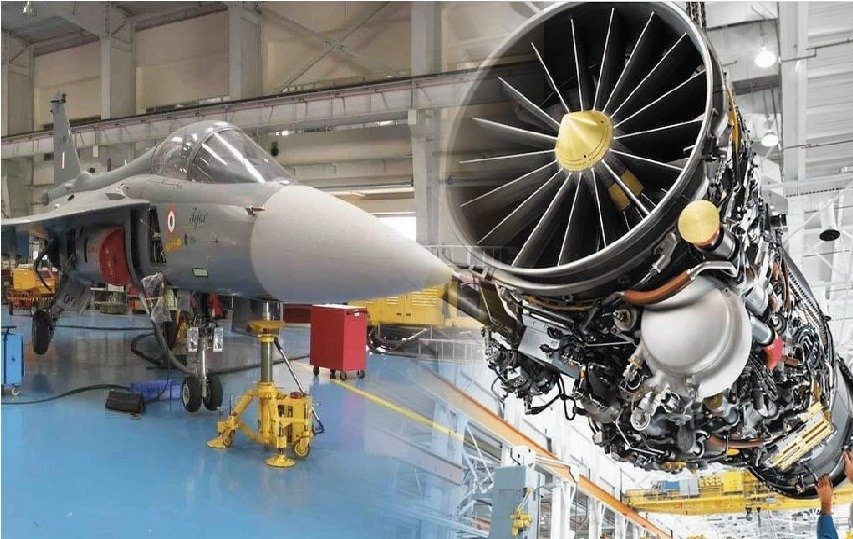
It is one of the most demanding engineering challenges in the world—and India’s long-running Kaveri engine programme provides an unusually revealing case study of just how difficult it is to move from designing an aircraft to mastering the machine that makes it fly.
The easy version of the story is: India tried, the Kaveri failed, and foreign engines had to be imported.
The real story is considerably more complicated—and much more interesting.
An engine is not simply a powerful motor
A modern fighter engine has to operate under extraordinary conditions.
It must compress enormous quantities of air, burn fuel at extremely high temperatures, withstand intense mechanical stresses, deliver enormous thrust, remain reliable through repeated acceleration and deceleration, and fit within very tight limits of weight and dimensions.
And it has to do all of this repeatedly, safely and predictably.
The difficult part is not merely designing the broad architecture.
It is mastering the hot section—the compressor, combustor and turbine systems where temperature, pressure, rotational speed and materials technology collide.
DRDO has itself described advanced materials and process technology, combustion technology and computational fluid dynamics as among the fundamental technological pillars of modern gas-turbine development.
That is why only a relatively small number of countries have independently mastered complete advanced fighter-engine development.
The Kaveri story began decades ago
The Kaveri engine programme was formally sanctioned in 1989, with the original objective of developing an indigenous powerplant for India’s Light Combat Aircraft programme.
The original schedule envisaged completion in the 1990s.
Reality had other plans.
The government has acknowledged that the programme encountered technological difficulties because developing a state-of-the-art gas turbine from scratch is extraordinarily complex. It also cited shortages of critical materials and components, inadequate infrastructure and testing facilities, and limited specialised manpower.
By 2012, the government acknowledged that Kaveri did not fully meet the approximately 90 kN thrust-class requirement of Tejas. The aircraft therefore moved ahead with imported powerplants.
That was the immediate problem.
But the deeper problem was technological maturity.

The metallurgy problem
Here is where the story becomes less visible—and far more important.
A fighter engine’s turbine operates in an environment where conventional engineering materials simply cannot survive indefinitely.
Advanced nickel-based superalloys, specialised coatings, precision casting, cooling passages and sophisticated manufacturing techniques become critical.
Single-crystal turbine blades are particularly demanding because they eliminate grain boundaries that can become weak points under extreme temperature and stress.
For years, India struggled with exactly these kinds of “hot-section” technologies.
DRDO material discussing the Kaveri experience has identified difficulties involving metallurgical tools, rotating components, single-crystal blade technology and the high-pressure engine core.
But there is an important 2025–26 development that changes the picture.
India is now building domestic capability in precisely these areas.
The Ministry of Defence announced that an Indian industry partner had received technical acceptance for indigenous development and manufacture of titanium castings for the Kaveri Derivative Engine and had received an order for single-crystal ready-to-fit turbine blades. The same announcement highlighted domestic production capability for aviation-grade titanium and superalloys.
So the correct conclusion is not:
“India cannot make advanced turbine blades.”
It is:
India spent decades building the specialised materials and manufacturing ecosystem needed to make them reliably at the required aerospace standard—and that capability is still developing.
That distinction is crucial.

The thrust problem
The other major obstacle was thrust.
The Kaveri did not achieve the performance required to power the Tejas in its intended configuration.
The Government of India stated that Tejas required a higher thrust level than the Kaveri could provide in its existing architecture. Consequently, an imported engine was selected.
And this is where internet discussions sometimes become misleading.
You will see precise claims such as “Kaveri produced 70–75 kN while 90–95 kN was required.”
Historical test configurations and variants make such single-number comparisons more complicated.
Government records show that the programme’s performance shortfall involved not merely maximum thrust but also thrust-to-weight ratio, reliability and thermal management.
In other words, producing more thrust is not like turning up the volume on a television.
More thrust means more heat.
More heat demands better materials.
More pressure requires stronger components.
More performance increases stresses throughout the engine.
The engineering problem therefore becomes circular: improving one parameter can expose a weakness somewhere else.
Testing is half the battle
There is another reason engine development takes so long.
You cannot safely discover every problem by attaching an experimental engine to a fighter and taking it for a casual afternoon flight.
Engine developers need sophisticated ground test facilities, altitude simulation, endurance testing, vibration testing, thermal testing and flight-test infrastructure.
India’s own government records have repeatedly identified inadequate domestic testing facilities as one reason Kaveri development required testing abroad.
The Kaveri nevertheless accumulated substantial experience.
By 2021, the government reported nine full prototype engines and four core engines, more than 3,217 hours of engine testing, completed altitude testing and Flying Test Bed trials.
So calling Kaveri “nothing but a failure” misses the technological knowledge accumulated along the way.
The engine did not become the Tejas powerplant.
But the programme helped build India’s knowledge base in gas-turbine engineering.
The foreign-engine dependence problem
The consequence is visible on India’s fighter-production lines.
Tejas Mk1 uses the American GE F404 engine, while the higher-thrust Tejas Mk2 programme has been associated with the GE F414. The government has explicitly acknowledged this dependence.
That dependence is not automatically a sign of technological weakness.
Almost every sophisticated aircraft programme involves international supply chains.
The strategic concern is different:
What happens if access to a critical component becomes restricted, delayed or disrupted?
An aircraft can be 80, 90 or even 95 percent indigenous by value and still face a production bottleneck if one crucial imported component is unavailable.
An engine is not just another spare part.
Without it, the aircraft does not fly.
The ecosystem problem
A fighter aircraft is itself a system of systems.
Its engine, radar, electronic warfare equipment, weapons, flight-control computers, materials, manufacturing processes and maintenance infrastructure must work together.
Engine development therefore requires a large ecosystem of universities, materials laboratories, precision manufacturers, testing organisations, designers, certification authorities and private companies.
India has historically had a fragmented defence-industrial structure, with major responsibilities distributed among organisations such as DRDO laboratories, HAL, the Aeronautical Development Agency, academic institutions and increasingly private industry.
That structure is changing.
The government says it is pursuing greater civil-military partnership and has sanctioned dedicated Kaveri dry-engine development and technology-demonstration projects.
In February 2026, Defence Minister Rajnath Singh visited GTRE in Bengaluru to review indigenous military gas-turbine programmes and witnessed a full afterburner test of the Kaveri engine. The government reiterated its commitment to indigenous aero-engine development.
That does not mean the problem has been solved.
It means the problem is being attacked with a broader technological and industrial base.

Kaveri is not dead—it changed jobs
One of the more interesting developments is that the Kaveri family has increasingly moved toward derivative applications rather than simply trying to become the original Tejas engine.
DRDO has been developing a dry Kaveri variant for unmanned applications.
A 2024–25 DRDO publication reported that the dry version produces roughly 49–51 kN, with an afterburner planned to raise thrust to approximately 73–75 kN for more demanding applications. It also reported that the engine had received clearance for inflight testing.
That is a very different mission from powering a frontline fighter.
But it could provide an important technological bridge.
Sometimes engineering progress does not look like the original project plan.
It looks like the project finding a second life.
The real question is not “Why can’t India build engines?”
The more useful question is:
Can India build the complete ecosystem required to develop engines continuously?
That means not merely designing one prototype.
It means developing materials.
Making turbine blades consistently.
Building precision manufacturing capacity.
Testing engines repeatedly.
Collecting enormous quantities of reliability data.
Training specialists.
Certifying components.
Scaling production.
And then doing it again for the next generation.
That last part is particularly important.
Aerospace engine technology cannot be treated as a one-time national examination in which everyone celebrates after receiving the certificate.
It is a continuous industrial capability.
DOONITED Editorial Perspective
India’s fighter-engine story should be neither a nationalist boast nor a national embarrassment.
It is a lesson in technological complexity.
The Kaveri programme unquestionably suffered major delays and failed to deliver the engine originally intended for Tejas. The government itself has documented technological, material, infrastructure, testing and manpower challenges.
But the programme also produced prototypes, thousands of hours of testing and valuable technological knowledge. And India’s current work on single-crystal turbine blades, superalloys, derivative engines and new industrial partnerships suggests that some of the weaknesses that once appeared almost insurmountable are now being addressed.
There is also a little irony here.
India spent decades trying to make the aircraft fly on an Indian engine.
Now the lesson may be that the engine cannot be developed separately from the industrial ecosystem around it.
The fighter jet gets the glamour.
The engine gets the heat.
And metallurgy gets almost none of the headlines.
Yet that unglamorous combination of materials science, manufacturing precision, testing discipline and patient engineering may ultimately determine whether India’s next generation of combat aircraft is genuinely self-reliant—or merely assembled domestically around a critical foreign component.
The real victory, therefore, will not be the day India announces one successful indigenous fighter engine.
It will be the day India can develop the next engine after that one.
That is when self-reliance becomes a capability rather than a slogan.

World Beyond the News
Birds Can Navigate Using Earth’s Magnetic Field
Several bird species can sense Earth’s magnetic field, helping them navigate during long-distance migration.
Fermentation Is a Global Food Tradition
People across continents have used fermentation for centuries to preserve food and create distinctive flavours.
Modern Batteries Store Energy Chemically
Rechargeable batteries repeatedly move ions between electrodes, allowing electrical energy to be stored and released.
Why Songs Become Global Hits
Streaming platforms, short-form video, playlists and international collaborations can rapidly carry music across borders.