
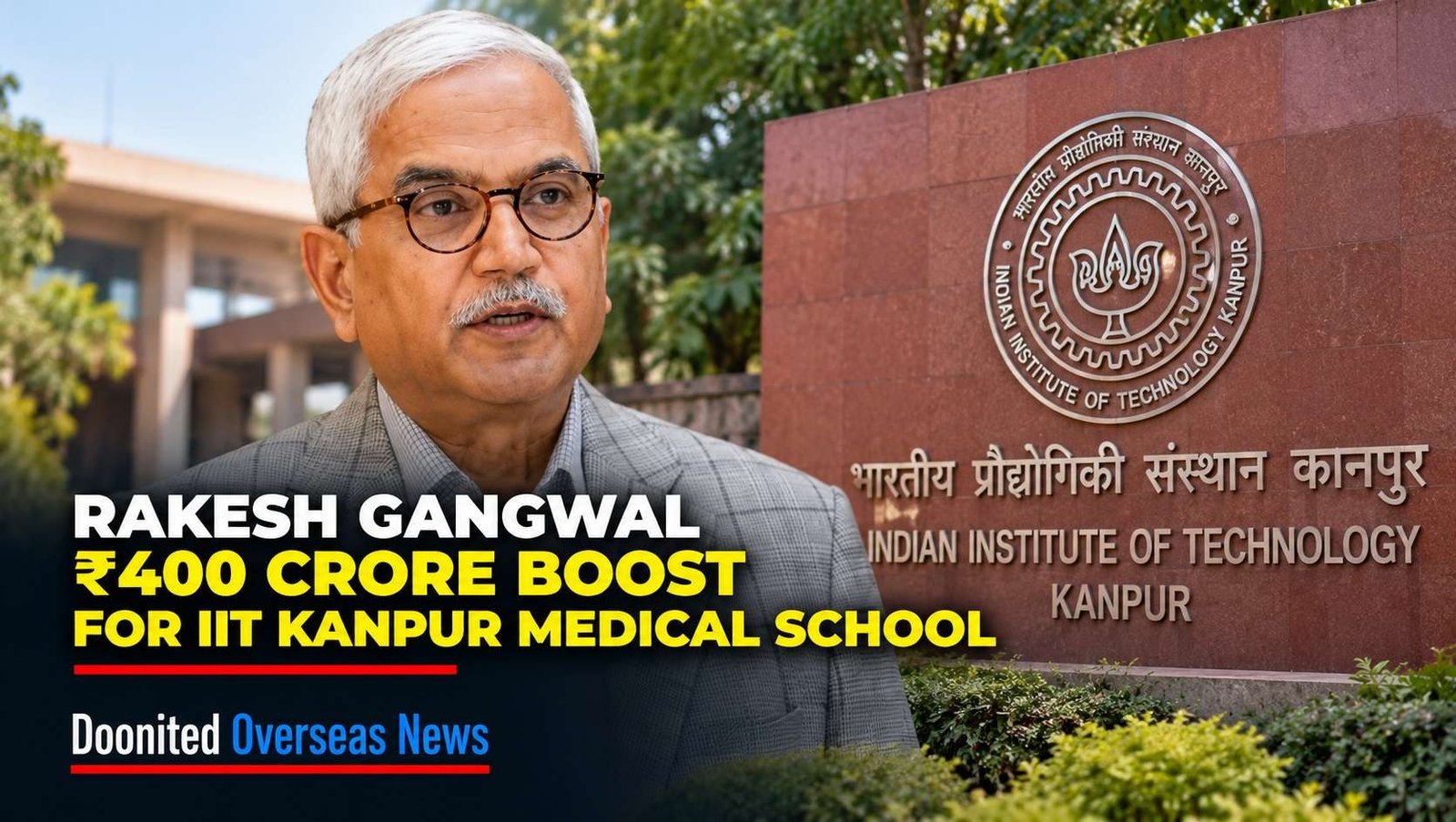
Rakesh Gangwal’s ₹400 Crore IIT Kanpur Commitment: How an Indian-American Entrepreneur Is Investing in India’s Next Generation of MedTech
IndiGo co-founder and IIT Kanpur alumnus Rakesh Gangwal has committed a total of ₹400 crore to his alma mater’s medical school, including a new ₹300-crore matching-grant pledge. The initiative offers a revealing example of how successful Indians who built careers abroad are helping create technology-driven institutions in India.
From an Indian engineering campus to global aviation
When Rakesh Gangwal graduated from IIT Kanpur with a degree in mechanical engineering in 1975, the institution was already establishing itself as one of India’s leading centres for science and engineering. Nearly five decades later, Gangwal is helping expand that engineering legacy into a completely different domain: medicine.
On August 24, 2026, IIT Kanpur announced that Gangwal had committed another ₹300 crore toward the development of the Gangwal School of Medical Sciences and Technology (GSMST). The new commitment comes on top of the ₹100 crore he donated in 2022, taking his contribution to the project to ₹400 crore. Indian Institute of Technology Kanpur
The latest commitment is particularly significant because it is structured as a matching grant. Gangwal will match contributions from other supporters up to ₹300 crore. In other words, the new pledge is not simply another large donation; it is an attempt to persuade other alumni, philanthropists and institutions to put additional money into the project. Indian Institute of Technology Kanpur
That makes the story relevant far beyond one philanthropist or one university.
For the Indian diaspora, it is an example of a broader question increasingly confronting successful overseas Indians: how can wealth and expertise accumulated through global careers be converted into long-term institutions in India?
An Indian-American career built largely through global aviation
Gangwal’s own career illustrates the international mobility of Indian professional talent.
IIT Kanpur identifies him as an Indian-American businessman. After completing his B.Tech in mechanical engineering, he earned an MBA from the Wharton School of the University of Pennsylvania in 1979. His career subsequently took him through major international aviation and technology organisations. Indian Institute of Technology Kanpur
He worked at Ford and Philips India before joining the aviation sector, eventually holding senior positions at United Airlines and Air France. He later became president and CEO of US Airways Group and chairman, president and CEO of Worldspan Technologies. In 2006, he co-founded InterGlobe Aviation, the company behind IndiGo. Indian Institute of Technology Kanpur
His international career has continued. Gangwal currently serves on the board of Southwest Airlines, where the company lists his experience in airline operations, strategy, mergers and acquisitions and corporate governance. Southwest Airlines Co.
That background matters to the philanthropy story because his contribution is not simply a nostalgic gift from a successful alumnus.
It represents a transfer of resources from a global career back into an institution designed to combine engineering, medicine, research and entrepreneurship.
Why IIT Kanpur wants a medical school
The Gangwal School is being designed around an unusual proposition for an engineering institute: medicine should not operate separately from technology.
IIT Kanpur’s vision includes a major super-speciality hospital, medical education and research facilities, along with centres focused on futuristic medicine and MedTech innovation. The institution says the objective is to bring engineers, doctors, scientists and technology specialists together to address unmet healthcare needs. GSMST
The planned clinical infrastructure includes the Yadupati Singhania Super Speciality Hospital, currently described by IIT Kanpur as a 500-bed next-generation facility. The August 2026 announcement also refers to a proposed 200-bed cancer-care and research centre. Indian Institute of Technology Kanpur
The school’s wider concept goes beyond conventional hospital construction.
IIT Kanpur envisages research centres where engineering and medical expertise can be combined to develop healthcare technologies, devices and new approaches to clinical problems. Students and researchers are also expected to have access to the institute’s incubation ecosystem so that research can potentially become products and startups. GSMST
That is an important distinction.
A large donation can build a building. The more difficult question is whether the resulting institution can create research, intellectual property, companies and clinical solutions that remain valuable for decades.
The diaspora connection is bigger than Gangwal
Gangwal’s contribution is also part of a wider pattern at IIT Kanpur.
The institute explicitly describes the medical school as a project supported by alumni, philanthropists, corporations and government funding. Its fundraising model is designed partly to cover fixed assets and the working-capital gap during the first several years. Indian Institute of Technology Kanpur
Other IIT Kanpur alumni with international careers have also contributed. The institute’s records include donors connected with businesses and professional careers in the United States and global markets. GSMST
IIT Kanpur has also been deliberately developing its global alumni network. Its alumni office says international events help graduates reconnect with their alma mater, while the institute is seeking substantial additional alumni contributions for new academic and research initiatives. Indian Institute of Technology Kanpur
This creates an increasingly important model for India’s diaspora relationship.
The overseas Indian community is often discussed through remittances, investment, entrepreneurship and family connections. Philanthropic capital adds another dimension: institution-building.
An alumnus living and working abroad can potentially contribute not only money, but also international networks, management experience, research partnerships and exposure to global standards.
Why the matching grant may matter more than the headline ₹400 crore
The most interesting part of Gangwal’s announcement may actually be the ₹300-crore matching mechanism.
Matching grants change the psychology of fundraising.
Instead of asking another donor simply to contribute to a large project, IIT Kanpur can now make a more concrete proposition: a qualifying contribution could effectively unlock additional philanthropic funding from Gangwal.
That could help broaden ownership of the medical school among the institute’s alumni and corporate partners.
It also reduces the risk of creating a project that is identified entirely with one donor.
For an institution intended to become a long-term centre for medicine and technology, a broad funding base may ultimately be healthier than dependence on a single benefactor.
The model could have implications for other Indian universities seeking to engage their diaspora. India’s premier educational institutions have alumni working across Silicon Valley, Wall Street, healthcare, aerospace, consulting, manufacturing and academia. The challenge is turning those global networks into sustained institutional partnerships rather than occasional donations.
But money alone will not create a global medical institution
There is also a necessary note of caution.
The announcement of ₹400 crore should not be interpreted as proof that the medical school has already become a major global medical-research centre. Construction, accreditation, faculty recruitment, clinical operations, research programmes and technology translation all require years of execution.
The institute’s own plans describe the project as a phased development. Earlier planning documents envisaged expansion from the initial hospital and research infrastructure toward a much larger medical ecosystem. Indian Institute of Technology Kanpur
The real test will therefore come later.
Can IIT Kanpur attract outstanding clinicians and biomedical scientists? Can engineers work effectively with doctors rather than in parallel silos? Can research produce clinically useful technologies? Can startups emerge from the campus? And can the hospital combine advanced care with meaningful accessibility for the surrounding population?
Those questions will determine whether the Gangwal School becomes merely a well-funded campus project or a genuinely important institution.
For the Indian diaspora, Gangwal’s story offers a broader lesson.
Successful overseas Indians do not have to choose between being globally integrated and remaining connected to India. The connection can take many forms: investing in companies, mentoring students, funding research, supporting hospitals, creating scholarships, building international collaborations or helping Indian institutions access global expertise.
The most consequential contributions may ultimately be those that outlive the donor.
A ₹400-crore commitment is certainly a substantial act of philanthropy. But its lasting value will be measured not by the size of the cheque, but by the doctors trained, technologies developed, patients treated, researchers supported and companies created years from now.
That is where Gangwal’s journey—from an IIT Kanpur engineering graduate to an Indian-American aviation executive and entrepreneur—comes full circle.
The most powerful form of diaspora philanthropy may not be giving back to the past.
It may be building institutions for the future.
Editorial perspective
Gangwal’s pledge is significant for Doonited Overseas not simply because it is a large Indian donation. Its stronger diaspora angle is the return of globally accumulated capital and experience into institution-building in India.
The matching-grant structure is especially noteworthy because it attempts to turn individual philanthropy into a collective alumni movement. If successful, the Gangwal School could become a useful case study in how India’s globally dispersed professional community can participate in building research and healthcare institutions at home.
The important benchmark, however, should remain outcomes rather than philanthropy headlines: research quality, clinical accessibility, MedTech innovation, faculty strength and measurable public benefit.

World Beyond the News
Octopuses Can Change Their Appearance
Octopuses can rapidly alter their skin colour and texture to communicate, camouflage themselves and respond to danger.
Some Cities Exist Across Two Continents
A small number of cities are geographically associated with two continents, creating unusual cultural and geographic identities.
Earth’s Climate Is Measured in Many Ways
Scientists track temperature, atmospheric gases, sea level, ice cover and other indicators rather than relying on a single climate number.
Streaming Changed How Audiences Discover Shows
Recommendation systems and global streaming releases allow audiences to discover programmes far beyond their original markets.