
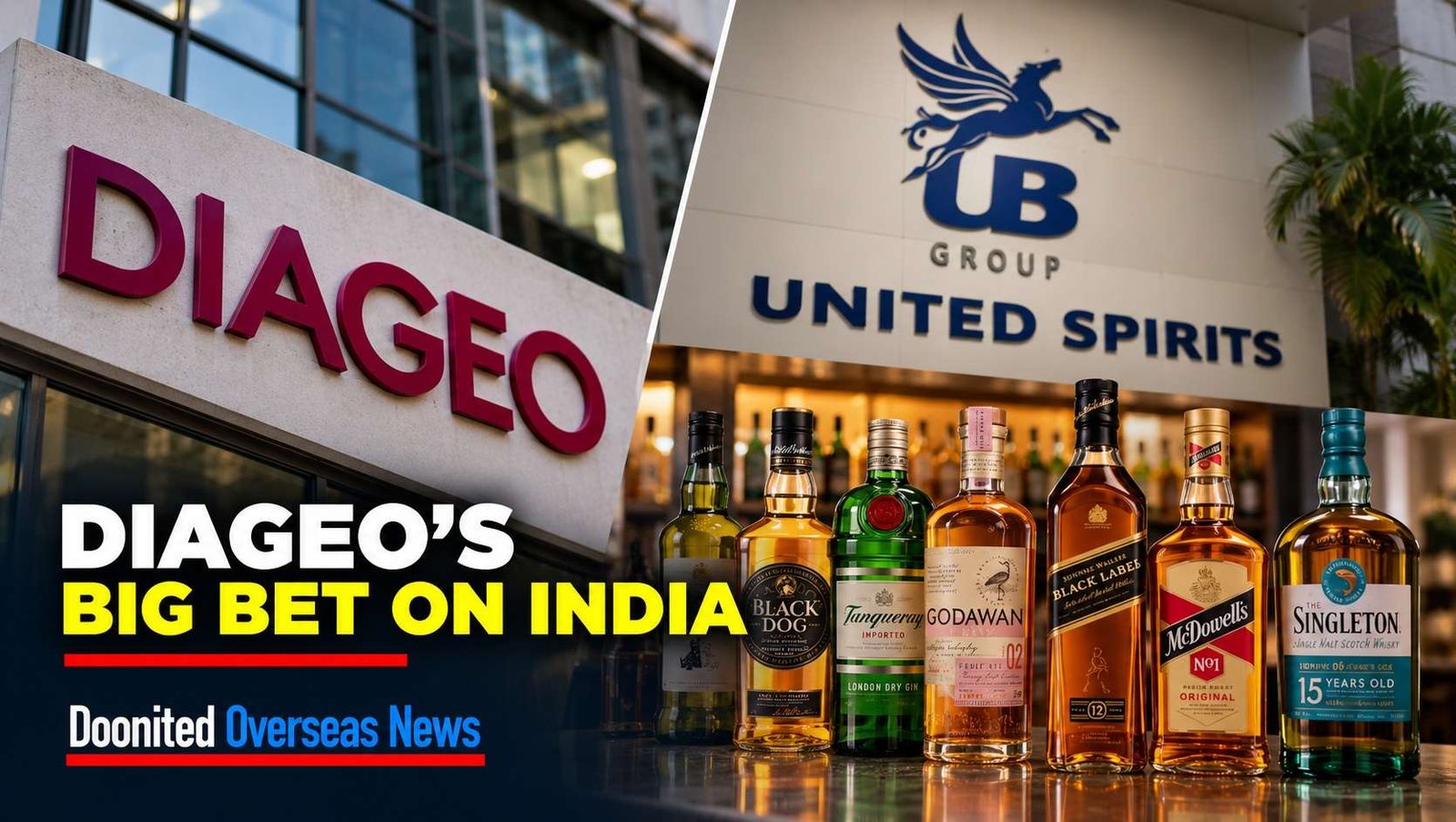
Diageo and United Spirits: How a Global Spirits Giant Rewired India’s Liquor Market
Diageo’s acquisition of control in United Spirits transformed the relationship between a British multinational and India’s largest spirits business. More than a decade later, the deal offers a revealing case study in globalisation, premiumisation and how an overseas corporation can reshape—and itself be reshaped by—the Indian market.
When Diageo began acquiring United Spirits Limited (USL) in the early 2010s, the transaction was about much more than buying an Indian liquor company.
It was a bet on India.
For Diageo, the world’s largest spirits companies, United Spirits offered access to a huge domestic market, established distribution, locally recognised brands and a consumer base whose tastes were gradually moving towards more premium products.
For India, the transaction represented another example of a global multinational taking a controlling position in a major Indian consumer business.
And for the Indian diaspora, it created a particularly interesting global-business story: Indian brands and consumer habits increasingly became part of the portfolio and strategy of a multinational whose products are sold across nearly 180 countries and territories.
Diageo completed the first stage of its United Spirits acquisition in 2013, becoming the major shareholder in India’s leading spirits company. Its own corporate history records the transaction as a significant milestone in its expansion into India. www.diageo.com
But the full story is more complicated than a simple foreign takeover.
The deal that unfolded in stages
Diageo’s initial agreement with the United Breweries Group was announced in November 2012.
Rather than immediately buying the entire company, Diageo entered through a staged transaction.
On 4 July 2013, Diageo increased its holding in USL from 10.04% to 25.02%, making USL an associate of Diageo. Diageo’s 2014 annual report records the additional investment and the resulting accounting change. Diageo Media
The decisive step came a year later.
On 2 July 2014, Diageo acquired another 26% of USL for approximately ₹114.5 billion, taking its aggregate investment to 54.78% and converting USL into a Diageo subsidiary.
That sequence is important because the often-repeated description that Diageo simply “bought United Spirits for £1.28 billion” obscures how the transaction actually worked.
The company accumulated control over time through a combination of negotiated purchases and tender/open-offer mechanisms.
The ultimate objective was clear: gain control of India’s largest spirits business while retaining its extensive domestic portfolio and distribution infrastructure.
Why United Spirits mattered so much
USL was not simply another Indian liquor company.
It had an unusually broad portfolio of Indian whisky and other spirits brands, along with manufacturing and distribution capabilities across the country.
Diageo’s later reporting continues to describe USL as one of India’s leading alcoholic beverage companies. In fiscal 2024, USL sold close to 61 million equivalent units of Indian-Made Foreign Liquor and imported liquor and operated 11 owned sites alongside leased and third-party manufacturing facilities. Its portfolio includes brands such as McDowell’s and other Indian labels.
This gave Diageo something that would have been extremely difficult to build from scratch.
Local scale.
India’s alcohol market is also unusually complex. Regulation, taxation, distribution and consumer preferences can vary significantly between states.
A multinational entering India therefore needs much more than global brands.
It needs local knowledge.
USL provided precisely that.
Why Diageo did not simply replace Indian brands with global ones
One of the most interesting aspects of the transaction is what did not happen.
Diageo did not turn United Spirits into a company selling only Johnnie Walker, Smirnoff and other international labels.
Instead, it retained a substantial Indian portfolio while using its international expertise to develop different segments of the market.
That strategy makes commercial sense.
Consumers do not necessarily move directly from mass-market products to imported luxury spirits. There is a progression through different price points, occasions and categories.
Diageo’s global strategy increasingly calls this premiumisation.
The company’s 2025 annual report noted that premium and above international spirits had grown from 26% of category value to almost 35% over the preceding decade.
In India, premiumisation has therefore become a central opportunity.
The company can use internationally recognised brands such as Johnnie Walker and Smirnoff while simultaneously developing Indian brands and premium expressions for local consumers.
That creates a two-way business model:
global brands enter India, while Indian brands and consumer insights strengthen a global portfolio.
The Whyte & Mackay complication
The United Spirits story also demonstrates why international acquisitions can become complicated.
Before Diageo completed control of USL, United Spirits had acquired Scotland-based Whyte & Mackay, giving the Indian company ownership of brands including whisky labels associated with the Scottish spirits industry.
The combination created a strange reversal in the globalisation story.
An Indian spirits company owned a historic Scottish whisky business, while a British-headquartered multinational was simultaneously becoming the controlling shareholder of that Indian company.
But competition concerns eventually became important.
In May 2014, United Spirits’ wholly owned UK subsidiary agreed to sell the entire issued share capital of Whyte & Mackay Group to Emperador UK Limited and Emperador Inc. for an enterprise value of £430 million. The transaction was completed in 2014.
The disposal was connected to competition concerns surrounding Diageo’s increased control of USL and its position in Scotch whisky.
The episode illustrates an important principle of international mergers:
Buying a company can create assets that regulators may later require the buyer to sell.
Global consolidation is therefore constrained not just by money, but by competition law.
From Vijay Mallya’s empire to professional management
The transaction also marked a major change in the history of United Spirits.
The company had been closely associated with entrepreneur Vijay Mallya and the United Breweries Group.
As Diageo increased its control, the management structure gradually moved toward the governance model of a global multinational.
That transition was commercially significant.
Diageo brought global systems for compliance, brand management, marketing, supply chains and portfolio management into a company operating in one of the world’s most complicated consumer markets.
But it would be simplistic to portray this as a one-way transfer of expertise.
Diageo also had to learn from India.
India’s consumers, regulatory structure, regional markets and price sensitivities are unlike those of Britain, the United States or Western Europe.
The company therefore had to adapt its global playbook rather than simply export it.
The real prize: India’s premium consumer
The deeper strategic logic behind the acquisition has become clearer over time.
India is not merely a large market by population.
It has a growing urban middle class, rising disposable incomes, expanding premium consumption and a large younger adult consumer base.
For a global spirits company, that creates opportunities across the price spectrum.
Diageo’s latest strategy acknowledges that premiumisation remains important but says it must now be approached more selectively, with attention to the full range of price points and changing consumer behaviour.
That is particularly relevant in India.
Premium whisky, Scotch, gin, tequila and cocktails increasingly compete not just on alcohol content but on brand identity, provenance, experience and social signalling.
The consumer is buying a story as much as a bottle.
India’s role in Diageo’s global strategy
The significance of USL becomes even clearer when viewed against Diageo’s global footprint.
Diageo’s fiscal 2025 business reported approximately $20.2 billion in revenue, more than 200 brands, over 29,000 employees and operations spanning approximately 180 countries and territories.
Within that global system, India is unusual because the local subsidiary itself possesses a large collection of nationally recognised brands.
This makes USL more than a distribution arm for Diageo’s international portfolio.
It is a brand-owning and market-building business in its own right.
That distinction is important for the Indian diaspora.
An Indian consumer in London, Dubai, Singapore or New York may encounter Johnnie Walker as a Diageo brand, but the wider Diageo-India relationship also reflects the growing importance of Indian consumer knowledge and Indian-origin brands within multinational business.
What it means for Overseas Indians
The diaspora connection here is subtle but important.
Alcohol brands travel particularly well across borders because they are tied to social occasions, hospitality, restaurants, duty-free retail and global travel.
For overseas Indians, the changing Indian spirits market can therefore influence what Indian-origin consumers encounter abroad—and vice versa.
Indian professionals and entrepreneurs working in global consumer-goods companies are also increasingly participating in a system where India is not simply an emerging market waiting to be served.
India can influence brand strategy, product development, consumer research and international portfolio decisions.
There is another dimension.
Diageo’s Indian business is operating in an environment where responsible consumption is increasingly important. The company itself maintains global programmes intended to promote informed choices about drinking and moderation. Its current corporate strategy also highlights moderation and low- and no-alcohol products as important consumer trends.
That matters because the commercial opportunity created by India’s growing spirits market comes with public-health and regulatory responsibilities.
A global acquisition that changed in both directions
More than a decade after Diageo began acquiring United Spirits, the transaction can be viewed as an example of a more mature form of globalisation.
Diageo gained access to India’s scale, brands and distribution.
USL gained access to international brands, global management systems, capital and portfolio expertise.
Neither side simply remained what it was before.
The acquisition also produced an unexpected corporate lesson through Whyte & Mackay: global consolidation has limits, and competition authorities can reshape even carefully constructed portfolios.
Today, Diageo’s India strategy is increasingly about premiumisation, brand segmentation and understanding local consumers rather than merely importing Western spirits.
That may ultimately be the most important legacy of the deal.
The world’s multinational companies are no longer simply exporting products into India.
They are learning from India, building in India and adapting global strategies around Indian consumers.
For the Indian diaspora, that is a significant shift.
The globalisation of Indian business is often measured by Indian companies buying foreign brands. The Diageo-USL story shows the reverse side of the equation: a global company can acquire an Indian champion and, in doing so, make India itself an increasingly important component of its worldwide strategy.
That is the real significance of United Spirits.
Not simply that a British spirits giant bought an Indian company—but that India became too strategically important to treat as just another market.
For Doonited Overseas, the strongest angle is India’s growing influence inside multinational consumer businesses, rather than the alcohol industry itself.
The Diageo-USL transaction is a useful case study in two-way globalisation. Diageo brought international brands, capital and systems into India, while USL brought local brands, distribution and consumer understanding into a global corporation.
The Whyte & Mackay disposal is equally important because it prevents the story from becoming a simple corporate success narrative. International acquisitions are constrained by competition law, market realities and portfolio discipline.
The larger lesson is that Indian consumer markets are increasingly important enough to influence how global corporations allocate capital and build brands.


World Beyond the News
Octopuses Can Change Their Appearance
Octopuses can rapidly alter their skin colour and texture to communicate, camouflage themselves and respond to danger.
Some Cities Exist Across Two Continents
A small number of cities are geographically associated with two continents, creating unusual cultural and geographic identities.
Earth’s Climate Is Measured in Many Ways
Scientists track temperature, atmospheric gases, sea level, ice cover and other indicators rather than relying on a single climate number.
Streaming Changed How Audiences Discover Shows
Recommendation systems and global streaming releases allow audiences to discover programmes far beyond their original markets.