
India’s S-400 Shield: Why India Still Wants a Desi Replacement
For a country that has to watch two very different strategic frontiers, air defence is not simply about owning a powerful missile system. It is about knowing what is coming, deciding what must be stopped, and having enough layers of protection to ensure that one missed target does not become a national crisis.
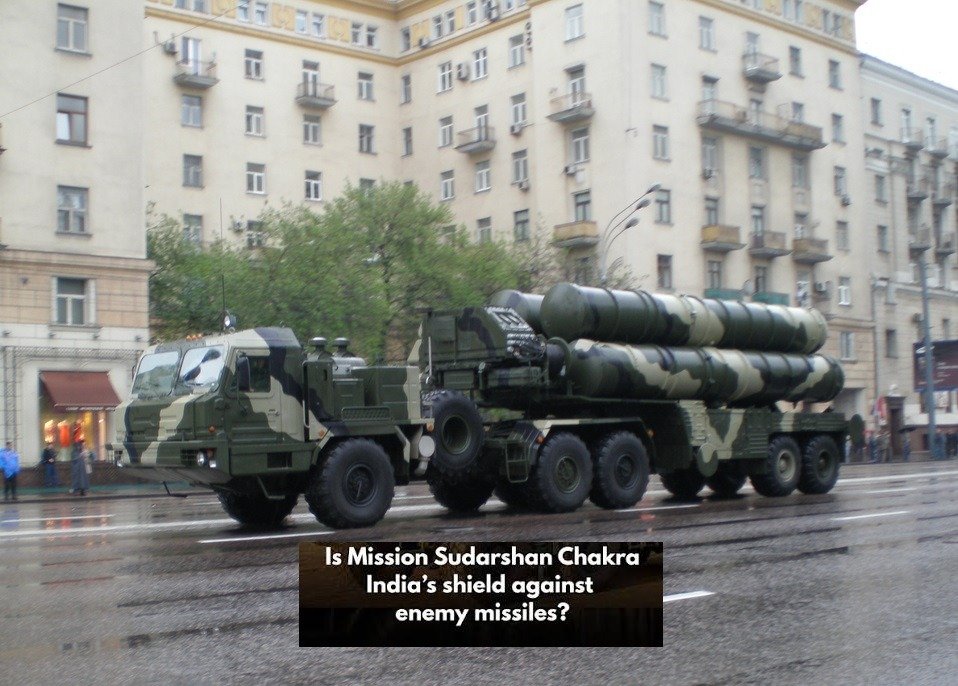
That is where Russia’s S-400 Triumf has become particularly important for India.
India received its fourth S-400 system in 2026, strengthening a long-range air-defence network that already includes three operational systems. The fifth and final system under the original 2018 contract is expected later this year.
In Indian discussions, the system is associated with the name Sudarshan Chakra. But behind the dramatic name is a very practical military idea: keep hostile aircraft, missiles and drones at a distance before they can get close enough to threaten important targets.
And that changes the question from “How powerful is the S-400?” to something much more interesting:
How does India build an air-defence shield in which the S-400 is only one part of a much larger system?
The 400-kilometre headline needs a little explanation
The S-400 is frequently described as a 400-kilometre air-defence system.
That is broadly correct—but there is an important footnote.
The 400-km figure relates to the system’s longest-range 40N6 interceptor. The S-400 can employ different interceptor missiles for different ranges and target profiles. DRDO material identifies the 40N6 as having a range of about 400 km.
So this is not a gigantic missile that simply sits there and shoots at everything 400 kilometres away.
Think of the S-400 more like a sophisticated air-defence toolbox.
Its radar and command elements detect and track airborne objects, while different interceptor missiles can be selected according to the threat. Publicly available technical material describes the system as capable of dealing with aircraft, cruise missiles, drones and certain ballistic-missile threats.
That combination is what makes it strategically valuable.
Why India wanted it in the first place
India signed the S-400 contract with Russia in October 2018 for five regiments, in a deal valued at roughly US$5.43 billion.
The decision was not made simply because the S-400 looked impressive at military exhibitions.
India needed a long-range ground-based air-defence capability that could complement its fighter aircraft and shorter- and medium-range missile systems.
The S-400 therefore occupies an important position in India’s broader layered air-defence architecture.
India’s air-defence philosophy increasingly resembles a carefully constructed security net: long-range systems provide the outer layer, while medium- and shorter-range systems deal with threats that penetrate further.
That is why the S-400 operates alongside systems such as MRSAM and Akash, rather than replacing them.
DRDO describes MRSAM as a mobile, medium-range, 360-degree air-defence system for protecting territory and ground forces, while Akash provides shorter-range protection and can engage multiple targets.
In other words, the S-400 is the heavyweight at the back of the defensive line. It still needs teammates.
Even the best goalkeeper cannot play the entire football match alone.
Operation Sindoor changed the conversation
The S-400’s reputation in India received another boost following Operation Sindoor in May 2025.
Indian officials and subsequent reporting credited India’s integrated air-defence network with intercepting hostile aerial threats during the conflict. The S-400 received particular attention because of its long-range capability.
There have also been reports of extremely long-range engagements involving the system. However, individual battlefield claims about exactly which aircraft were destroyed, the precise weapon used and the exact engagement distance should be treated carefully unless independently confirmed.
That distinction matters.
A serious defence story should not turn every military claim into a scoreboard.
The larger lesson is already clear: India now has operational experience using an advanced, networked ground-based air-defence architecture under real combat conditions.
That experience is arguably as important as the missile itself.
The fourth system is more than another launcher
The arrival of the fourth S-400 in 2026 expands India’s ability to distribute long-range air-defence coverage across strategically important sectors. The first three systems had already been deployed in key areas, including the northern and western theatres.
The fifth system is expected to complete the original five-system contract later in 2026.
There is also a newer development that makes the story considerably more interesting.
India is now considering five additional S-400 squadrons. Russia submitted a proposal estimated at more than ₹50,000 crore in August 2026. But this is still a proposal under consideration—not a completed purchase.
That distinction is important because defence procurement headlines sometimes make a proposal sound like a delivery truck is already on the highway.
It isn’t.
But India has another plan: build its own long-range shield
Here the story takes an important turn.
India does not want its long-term air-defence future to depend entirely on imported systems.
DRDO’s Project Kusha is being developed as an indigenous long-range surface-to-air missile system intended to provide capabilities comparable in class to systems such as the S-400.
In July 2026, DRDO successfully conducted the maiden flight test of Kusha from the APJ Abdul Kalam Island in Odisha. The test involved an electronic target representing a high-speed, high-altitude aerial threat.
The project is planned around multiple interceptor ranges, with the longest-range variant expected to reach roughly 350–400 kilometres.
That does not mean India suddenly has a fully operational indigenous S-400 replacement.
It doesn’t.
A successful test is a milestone, not the end of development, evaluation, production, deployment and operational integration.
But it is a significant milestone.
The real battle is not only about missiles
There is another lesson hidden inside India’s S-400 story.
Modern air defence is not simply a contest between missile ranges.
It is a contest between sensors, radars, communications, command networks, electronic warfare, interceptor technology, manufacturing capacity and trained personnel.
DRDO itself has described radars and sensors as the backbone of air-defence and ballistic-missile-defence networks.
A 400-km missile is of limited value if the network cannot reliably detect, identify and track the target early enough.
And a sophisticated imported system becomes a strategic vulnerability if spare parts, maintenance or specialist support cannot be secured during a prolonged crisis.
India has already been working to strengthen domestic maintenance capability for the S-400, with plans for an Indian maintenance facility aimed at improving operational readiness and reducing dependence on foreign support.
This is where Atmanirbharta becomes more than a slogan.
The real objective is not necessarily to stop buying foreign technology tomorrow morning.
It is to make sure that, eventually, India can design, manufacture, maintain and upgrade critical systems itself.
The intelligent question: should India buy more S-400s?
There is a reasonable argument on both sides.
More S-400 systems would strengthen India’s immediate long-range air-defence capacity. The technology is mature, already inducted and operational, and additional systems could expand geographic coverage.
But dependence on a foreign platform also creates questions about supply chains, maintenance, future upgrades and geopolitical circumstances.
That is precisely why Project Kusha matters.
The sensible Indian strategy may not be “S-400 or indigenous technology.” It may be “S-400 today, indigenous capability tomorrow—and increasingly both during the transition.”
That is strategic pragmatism rather than technological nationalism.
DOONITED Editorial Perspective
The S-400 deserves its reputation as one of the most important components of India’s modern air-defence architecture. But the bigger Indian achievement will not be owning five—or even ten—Russian systems.
It will be developing an ecosystem capable of producing the next generation of long-range air defence without waiting for someone else’s factory, supply chain or geopolitical permission.
The S-400 can provide the shield India needs today.
Project Kusha represents the possibility of building more of that shield at home tomorrow.
And perhaps that is the most interesting part of the story.
India’s air-defence journey is moving from “Can we buy the best system?” to a much harder question:
“Can we eventually build the entire ecosystem ourselves?”
That is where the real strategic competition lies.
And unlike a missile launch, there is no shortcut button for that one.

World Beyond the News
Birds Can Navigate Using Earth’s Magnetic Field
Several bird species can sense Earth’s magnetic field, helping them navigate during long-distance migration.
Fermentation Is a Global Food Tradition
People across continents have used fermentation for centuries to preserve food and create distinctive flavours.
Modern Batteries Store Energy Chemically
Rechargeable batteries repeatedly move ions between electrodes, allowing electrical energy to be stored and released.
Why Songs Become Global Hits
Streaming platforms, short-form video, playlists and international collaborations can rapidly carry music across borders.