
What the Number Really Means
India has entered another interesting chapter in its long military journey.
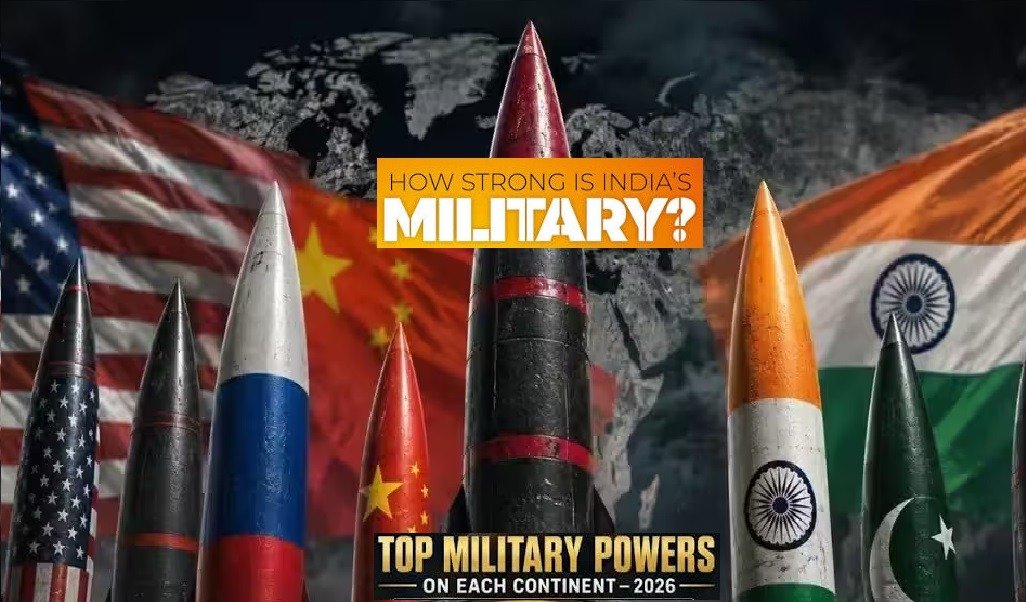
The 2026 Global Firepower Military Strength Ranking places India fourth among 145 countries, behind the United States, Russia and China, and ahead of South Korea. India’s Power Index, or PwrIndx, is 0.1346. In the GFP methodology, a lower score indicates greater conventional military strength.
At first glance, the headline is straightforward:
America No. 1. Russia No. 2. China No. 3. India No. 4.
But the more interesting story begins after the ranking.
Because military power is not a school examination in which the student with rank four necessarily loses to the student with rank three.
There is no question paper, no 100-mark total and, thankfully, no parent-teacher meeting afterwards.
Modern military strength is a complicated combination of manpower, aircraft, naval power, land forces, logistics, finances, geography, industrial capacity and the ability to sustain operations.
And that is where India’s position becomes particularly interesting.
What exactly does “No. 4” mean?
Global Firepower says its 2026 assessment uses more than 60 individual factors, ranging from military equipment and manpower to financial strength, logistics and geography. The organisation also makes clear that some figures are estimates where official data are unavailable.
Therefore, the ranking is best understood as an index of conventional military capability, not an absolute measurement of national power.
India’s 0.1346 score places it behind China at 0.0919 but ahead of South Korea at 0.1642. The United States leads with 0.0741, followed by Russia at 0.0791.
The difference between these numbers should also not be interpreted too literally.
A Power Index is an analytical model.
A battlefield is reality.
Those are two very different things.

India’s military manpower is enormous
India remains one of the world’s largest military manpower powers.
Global Firepower estimates 1.431 million active personnel, placing India second among the countries assessed in that category. It estimates another 1 million reserve personnel and 2.527 million paramilitary personnel.
That produces an estimated total military-personnel figure of approximately 4.96 million in the GFP methodology.
But there is an important distinction here.
The 4.96 million figure should not be interpreted as nearly five million soldiers waiting in uniform for the next parade.
GFP’s definition includes active, reserve and official paramilitary personnel.
The real strategic advantage of India’s manpower is therefore not simply its size.
It is the ability to recruit, train, equip, rotate and sustain forces across a country with enormous geographic and operational requirements.
That is much harder than counting uniforms.
India has enormous air and land strength
Global Firepower places India fourth in the world for total aircraft inventory and fourth for fighter aircraft in its 2026 assessment. It also ranks India fifth for tanks and second for military vehicles.
That reflects India’s long-established emphasis on land and air power.
The Indian Army must be prepared for radically different environments—from high-altitude Himalayan terrain to deserts and plains.
The Indian Air Force, meanwhile, has to operate across an enormous geographical area and support India’s requirements on both western and northern fronts while maintaining broader strategic reach.
But quantity alone is no longer enough.
Modern warfare increasingly depends on precision weapons, sensors, drones, electronic warfare, satellite support, secure communications, integrated command networks and real-time intelligence.
The military of the future will increasingly resemble a technology company that has been given tanks.
Except the customer support department is considerably less forgiving.
The sea is becoming increasingly important
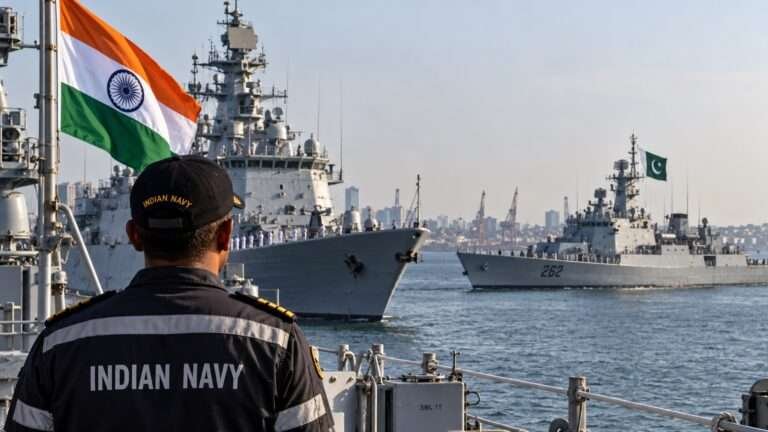
India’s fourth-place ranking also reflects its growing naval capabilities.
Global Firepower ranks India fourth for overall naval assets and third for aircraft carriers in its 2026 assessment.
India currently operates two aircraft carriers: INS Vikramaditya and indigenous INS Vikrant.
In 2023, the Indian Navy conducted combined operations involving both carriers and more than 35 aircraft in the Arabian Sea. The government described the exercise as a demonstration of India’s maritime capability and power projection in the Indian Ocean and beyond.
INS Vikrant is particularly significant because it represents more than another warship.
The indigenous carrier was commissioned in September 2022 and was built with substantial domestic content. The government says the project involved more than 550 original equipment manufacturers and 100 MSMEs.
That means the strategic value of Vikrant is not limited to the aircraft operating from its deck.
It is also a demonstration of India’s ability to design, manufacture and integrate extremely complex naval platforms.
And then comes the nuclear dimension
Global Firepower’s conventional ranking does not tell the entire story of India’s military capability.
India is also a nuclear-armed state with a nuclear triad—the ability to deliver nuclear weapons from land, air and sea-based platforms.
The Government of India stated in 2018 that INS Arihant’s first deterrence patrol completed India’s survivable nuclear triad.
In August 2024, the second Arihant-class ballistic-missile submarine, INS Arighaat, was commissioned. The Ministry of Defence said the submarine would further strengthen India’s nuclear triad and nuclear deterrence.
This is strategically important because nuclear deterrence changes the character of military power.
A country does not need to be able to defeat every adversary in every conventional category to possess a credible strategic deterrent.
The nuclear dimension therefore sits alongside—not inside—the simple “No. 4” headline.
The money behind the military matters
One of the most interesting corrections to the original figures concerns India’s defence spending.
Global Firepower estimates India’s 2026 defence budget at approximately $109 billion, placing India fifth in its financial category.
India’s actual Union Budget allocation for the Ministry of Defence in 2026–27 is ₹7.85 lakh crore, the highest-ever allocation, according to the Government of India. Of that, ₹2.19 lakh crore is allocated to capital expenditure.
The distinction between the GFP estimate and the Indian budget number is important because different databases use different definitions, currencies, accounting periods and methodologies.
For an ordinary reader, the broader point is simpler:
India is spending substantially more on modernisation, indigenous defence production and military capability than it did a decade ago.
The government says the defence budget has risen from ₹2.53 lakh crore in 2013–14 to ₹7.85 lakh crore in 2026–27.
But No. 4 does not mean “invincible”

This is where responsible reporting must resist the temptation of the headline.
Being fourth in a military ranking does not mean India is stronger than every country in every category.
Global Firepower’s own comparison shows China ahead of India in several conventional categories, including airpower, land power, naval power, natural resources, financials and logistics, while India has an advantage in manpower and geography in that model.
India also faces familiar challenges.
Some major weapons systems remain dependent on foreign suppliers.
The country continues to work toward greater domestic capability in fighter engines, advanced sensors, propulsion, semiconductors, drones and other critical technologies.
And military strength is not merely about buying platforms.
It is about maintaining them.
A fighter that cannot fly because a spare part is unavailable is technically an aircraft and operationally a very expensive sculpture.
That is why India’s push toward domestic defence manufacturing matters so much.
The real test is industrial strength
Perhaps the most important development behind India’s military rise is not the number of tanks or aircraft.
It is the attempt to build a domestic defence-industrial ecosystem.
The 2026 defence allocation includes ₹1.39 lakh crore for procurement from domestic defence industries, according to the Ministry of Defence.
That has implications far beyond defence.
Building a fighter aircraft creates demand for metallurgy, electronics, software, composites, precision manufacturing, artificial intelligence, radar technology and specialised engineering.
Building a warship requires shipyards, propulsion systems, sensors, weapons, communications and thousands of suppliers.
The military therefore increasingly becomes an industrial and technological ecosystem.
That is where India’s next major advantage—or weakness—will be determined.
What the ranking tells us about India’s future
The fourth-place ranking is encouraging, but it should be treated as a starting point rather than a finish line.
India has enormous manpower.
It has nuclear deterrence.
It has a large air force, a major army and a growing blue-water navy.
It operates two aircraft carriers.
It is developing indigenous weapons and platforms.
Its defence budget has expanded substantially.
And its defence-industrial base is becoming more ambitious.
But the next generation of military competition will increasingly be decided by things that are less visible in military parades.
Who controls the semiconductor supply chain?
Who can produce advanced engines?
Who can manufacture sophisticated sensors at scale?
Who has resilient satellite and communications networks?
Who can defend against cyberattacks?
Who can manufacture drones faster than an opponent can destroy them?
Who can replace battlefield losses without depending on a foreign supplier?
Those questions may ultimately matter more than whether a country is ranked fourth or fifth.
DOONITED Editorial Perspective
India’s fourth-place position in the 2026 Global Firepower ranking is certainly a significant indicator of the country’s conventional military weight.
But the smarter way to read the number is not:
“India is No. 4, therefore India can defeat anyone below No. 4.”
That would turn a complex analytical index into a school report card.
The more meaningful interpretation is this:
India has accumulated the scale and strategic capability to be recognised among the world’s major military powers—but its next challenge is to convert that scale into technological depth, industrial independence and long-term operational readiness.
The country’s military future will therefore depend increasingly on what happens inside laboratories, factories, shipyards, semiconductor facilities and engineering centres—not only on parade grounds.
A powerful military needs soldiers.
A modern military needs technology.
A sustainable military needs an industrial ecosystem capable of replacing, repairing and upgrading that technology when the pressure is highest.
India has travelled a considerable distance.
The fourth-place ranking tells us that.
The harder question—and perhaps the more important one—is how high India can climb when more of the technology behind its military power is designed and built at home.

World Beyond the News
Why Elephants Stay Close to Their Herd
Elephants live in highly social family groups and use calls, touch and body movements to maintain strong bonds.
Most of the Deep Ocean Remains Difficult to Explore
Extreme pressure, darkness and distance make deep-ocean exploration one of Earth’s greatest scientific challenges.
Spacecraft Can Travel Without Traditional Roads
Spacecraft use carefully calculated trajectories and gravity assists to travel enormous distances through space.
Why Movie Trailers Are Released in Stages
Major films often use teaser trailers, full trailers and final promotional spots to build awareness over time.