
From Sriharikota to 36,000 Km Above Earth
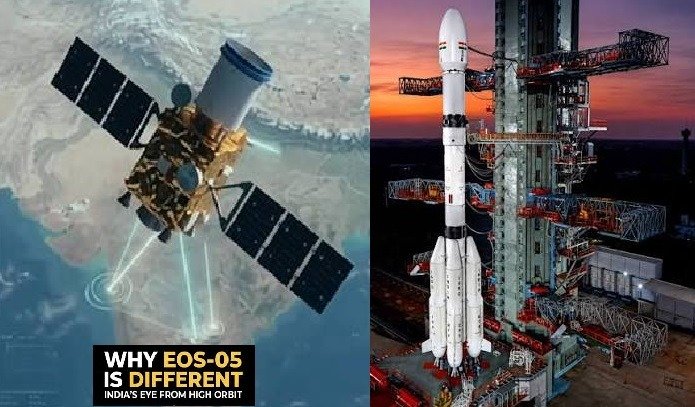
At 2:55 in the morning on September 4, 2026, while most of India was either asleep or negotiating with the snooze button, a 51.7-metre rocket rose from Sriharikota.
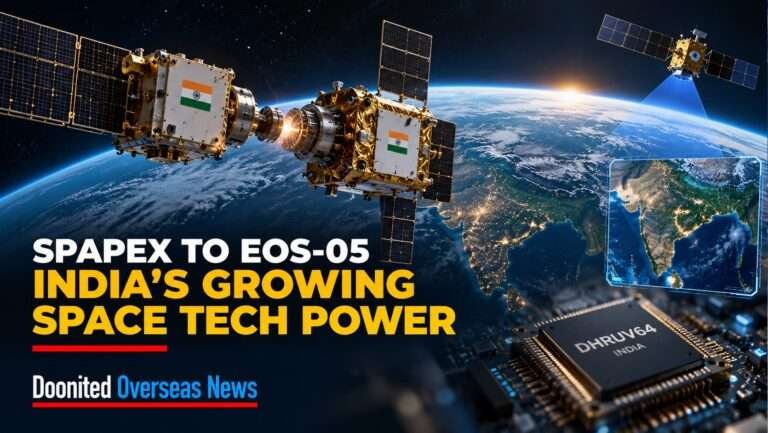
The rocket was GSLV-F17, and its passenger was EOS-05, an Earth-observation satellite that represents a significant new capability for India’s space programme.
But the most interesting part of this story is not simply that India launched another satellite.
It is where EOS-05 is designed to operate and what that means for the way India can watch its own territory.
The mission has also arrived at an interesting moment for India’s space programme. On one side, ISRO is demonstrating increasingly sophisticated space capabilities. On the other, India is deliberately bringing private companies deeper into the space economy.
And suddenly, a question that sounds almost philosophical becomes very practical:
Can India expand its space industry without making ISRO smaller?
The answer, at least according to ISRO, is yes.
The morning India put a new eye in the sky
ISRO’s GSLV-F17 mission was the 19th flight of India’s Geosynchronous Satellite Launch Vehicle. The rocket successfully injected the approximately 2,367-kg EOS-05 into a Sub-Geosynchronous Transfer Orbit after launch from the Second Launch Pad at Satish Dhawan Space Centre, Sriharikota.
That distinction matters.
It would be technically inaccurate to say EOS-05 was already in its final geosynchronous orbit immediately after liftoff.
The satellite had more work to do.
On September 5, ISRO carried out the first orbit-raising manoeuvre. A second manoeuvre followed on September 6. Then, on September 7, the third and final manoeuvre was completed successfully at 8:57 pm. ISRO reported the resulting orbit at approximately 34,903 km × 35,884 km, with the satellite’s health normal.
In other words, the rocket delivered EOS-05 where it needed to go initially, and the spacecraft itself then climbed into its operational orbit.
Spaceflight, it turns out, is rather like Indian railway travel: reaching the destination involves several stages, and the first arrival is not always the final one.
So what makes EOS-05 special?
ISRO describes EOS-05 as India’s first-ever imaging satellite from geosynchronous orbit.
That is important because satellites in different orbits provide very different kinds of information.
Many Earth-observation satellites operate in low Earth or polar orbits. They move rapidly around the planet and periodically pass over particular locations.
EOS-05 is designed for a very different perspective.
Operating roughly 36,000 kilometres above Earth, its geosynchronous orbit allows it to remain associated with the same broad region of the planet as Earth rotates.
The practical advantage is persistent regional observation.
Instead of waiting for a low-orbit satellite to make another pass, a geosynchronous imaging platform can repeatedly observe a large area.
That can become particularly valuable when conditions are changing quickly.
A cyclone develops.
A flood spreads.
A forest fire moves.
Agricultural conditions change.
A major infrastructure project expands.
A strategically important region requires repeated observation.
The value of satellite imaging is not simply the photograph. It is the frequency, continuity and usefulness of the information.
Recent reporting indicates that EOS-05 is designed to provide repeated imaging of large areas, with applications including disaster monitoring, agriculture, forestry and other Earth-observation requirements.
Civilian benefits—and a strategic dimension
Earth observation has never been exclusively about pretty pictures of the planet.
Satellite imagery can support disaster management, agriculture, environmental monitoring, water-resource assessment, urban planning and infrastructure development.
It can also have strategic applications.
Because EOS-05 provides a persistent view of a broad region, its data can potentially contribute to national security and strategic awareness. Several reports have highlighted this dimension, including possible applications for maritime and defence-related monitoring.
But it is important not to turn every Earth-observation satellite into a cinematic spy satellite.
The publicly available information supports saying that EOS-05 has strategic applications. It does not justify inventing specific classified missions or claiming that the satellite is exclusively watching a particular foreign country.
That distinction is journalism 101—and increasingly important in the age of social media headlines.
The comeback of GSLV
The mission is also significant for the rocket itself.
GSLV-F17 was the 19th GSLV flight. The GSLV programme has had both successes and setbacks, including the unsuccessful GSLV-F10/EOS-03 mission in 2021.
The successful F17 mission therefore represents more than a successful satellite deployment.
It demonstrates continued operational confidence in India’s indigenous geosynchronous launch capability.
That matters because heavier satellites and missions requiring higher-energy orbits demand increasingly capable launch systems.
The rocket may only appear on television for a few minutes.
The engineering required to make those few minutes reliable takes years.
And then came an entirely different story: Is ISRO being privatised?
Just as India was celebrating the EOS-05 achievement, another space story was gaining attention.
Reports and speculation suggested that increasing private-sector participation could reduce ISRO’s role or eventually amount to privatisation.
On September 6, ISRO issued an unusually direct clarification.
It said the assertions that ISRO would be privatised or that its importance would be reduced were “baseless and incorrect.”
ISRO stated that it would remain India’s principal institution for advanced space research and technology development, national and strategic missions, space science and exploration, and critical and frontier capabilities.
The agency’s explanation is straightforward.
Private industry is supposed to scale mature technologies and commercial activities, while ISRO concentrates more heavily on advanced technologies and complex missions.
That is not the same thing as selling ISRO.
It is an attempt to change the division of labour.
Why bring private companies into space?
Because building a serious space economy requires more than a brilliant government laboratory.
It requires factories.
Suppliers.
Electronics manufacturers.
Satellite companies.
Launch companies.
Data businesses.
Insurance.
Financing.
Software.
Skilled engineers.
And customers.
The Indian Space Policy 2023 opened the door for private entities to undertake end-to-end space activities, including launches, satellite development and operations, data acquisition and dissemination, and ground infrastructure. IN-SPACe was established as the mechanism for promoting, authorising and overseeing private-sector space activities.
The transformation is already measurable.
Government figures reported in August 2026 said around 440 space-technology startups were registered in India, while IN-SPACe had granted 113 authorisations to 52 non-government entities.
The government has also established a ₹1,000-crore Venture Capital Fund and a ₹500-crore Technology Adoption Fund to support the sector.
This is the bigger story behind the headlines.
India is trying to move from having a successful space agency to having a successful space ecosystem.
The $44-billion ambition
India’s space economy was estimated at around $8.4 billion in 2023, equivalent to about 2% of the global space economy at that time.
The government’s Decadal Vision and Strategy projects India’s space economy could reach approximately $44 billion by 2033, with about an 8% share of the global space economy. The longer-term projection is approximately $100 billion by 2040.
Those are ambitions, not guaranteed outcomes.
And this is where a little healthy scepticism is useful.
A projection on paper does not automatically become revenue in a bank account.
India will have to build global customers, commercially competitive companies, reliable supply chains, intellectual property, deep-tech financing and international market access.
The difficult part of the space economy is not announcing that it will grow.
The difficult part is making someone in another country pay for an Indian space product because it is the best or most competitive option available.
ISRO’s next chapter may actually be bigger
There is an apparent paradox here.
If private companies manufacture more satellites, operate more launches and commercialise more technologies, some traditional ISRO responsibilities may indeed move outside the organisation.
But that does not necessarily make ISRO less important.
It could make ISRO more important in a different way.
Imagine a national automobile industry in which the government laboratory stops manufacturing every component itself and instead concentrates on next-generation engines, materials, autonomous systems and difficult research.
The laboratory has not disappeared.
Its job has changed.
That appears to be the direction ISRO is describing.
The agency says mature and scalable activities can increasingly be undertaken by Indian industry, freeing its scientific and technical manpower to focus on advanced research, next-generation technologies and complex national missions.
DOONITED Editorial Perspective: Don’t privatise the ambition—multiply it
There is a sensible middle ground between two extremes.
One extreme says everything connected to space must remain inside government institutions.
The other says private participation automatically makes everything better.
Neither proposition is convincing.
India needs both.
ISRO should remain capable of doing things that Indian industry cannot yet do.
Indian industry should be encouraged to do things that industry can manufacture, commercialise and scale more efficiently.
And the country needs transparent regulation so that private participation does not become a fancy phrase for weak oversight.
The real measure of the reform should therefore not be:
“How much work has moved out of ISRO?”
It should be:
“How much additional capability has India gained?”
That is the more intelligent test.
If EOS-05 represents India’s growing technological capability in space, the expanding private ecosystem represents India’s attempt to turn that capability into an industry.
One launches satellites.
The other helps build an economy around them.
The bigger lesson from EOS-05
The most fascinating thing about EOS-05 may ultimately be what happens after the launch photographs disappear from television screens.
A satellite becomes truly valuable when its data improves decisions on Earth.
A space programme becomes economically powerful when its technologies create industries.
And a country becomes a serious space power when it can simultaneously conduct advanced scientific missions, protect strategic interests, build commercial capability and create knowledge that others want to buy.
That is a much bigger challenge than putting a rocket into the sky.
India has already shown that it can reach orbit.
The next question is whether India can build an entire economy around what it learns there.
And that, perhaps, is the real mission now.

World Beyond the News
Bees Communicate Where Food Is
Honeybees use movement patterns known as waggle dances to communicate information about food locations.
Street Food Reflects Local History
Many famous street foods developed from migration, trade, local ingredients and the everyday needs of working communities.
A Day on Venus Is Extremely Long
Venus rotates so slowly that one rotation relative to distant stars takes longer than its trip around the Sun.
Human Achievement Continues to Push Limits
Athletes, engineers, scientists and explorers regularly establish new benchmarks in speed, endurance, scale and precision.