
How Indian Shipyards Are Changing the Navy’s Future
There was a time when an Indian Navy warship usually came with an interesting footnote: “Built with foreign assistance.”
Today, an increasingly common description is rather different:
Designed in India. Built in India. Armed increasingly with Indian systems.
That change is one of the most consequential developments in India’s defence-industrial story.
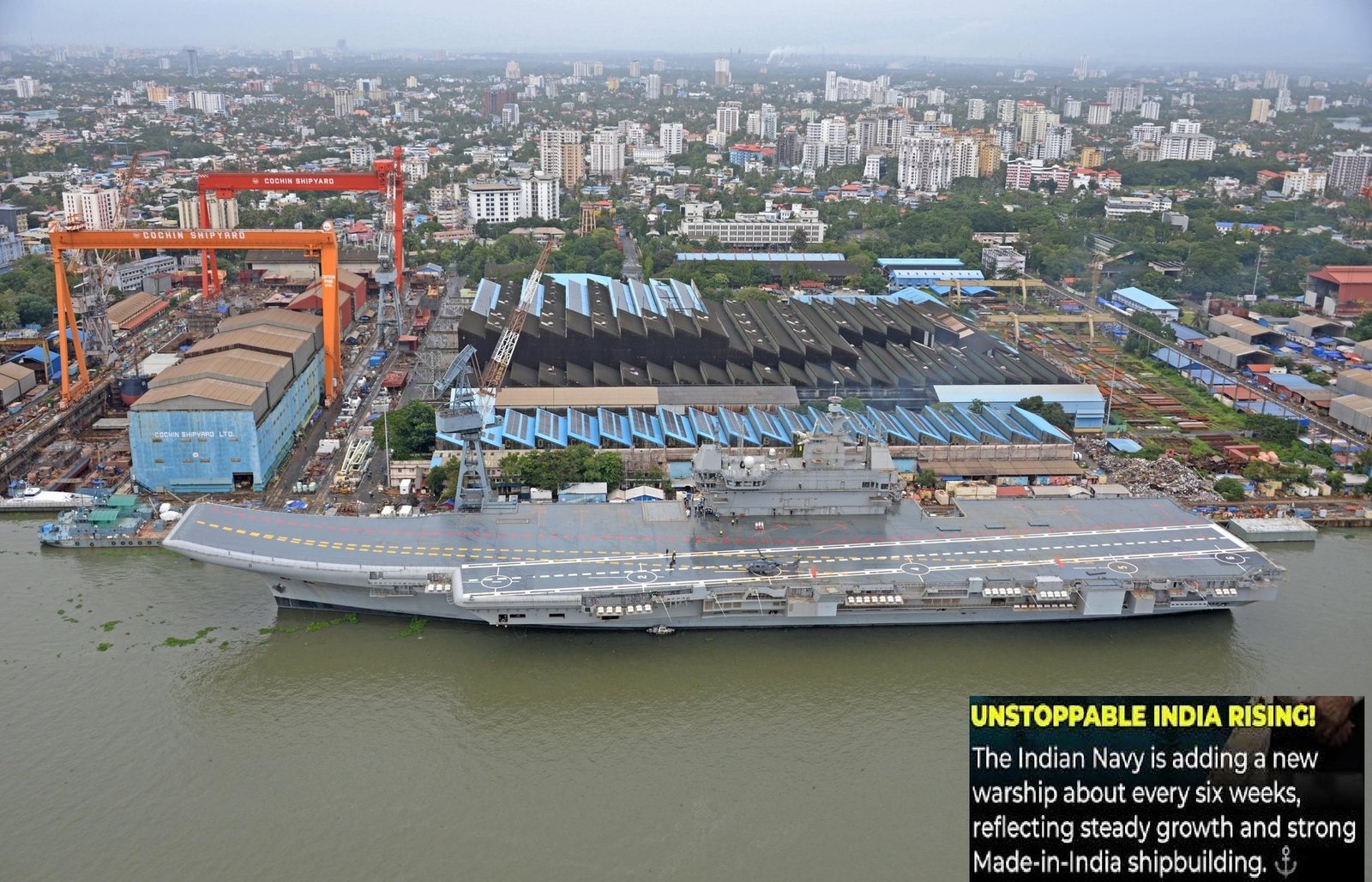
India’s naval modernisation is no longer just about buying more ships. It is increasingly about creating the industrial capacity to design, build, maintain and eventually export sophisticated warships.
And the shipyards are getting very busy.
Project 17A: the frigate programme becoming a manufacturing lesson
The clearest example is Project 17A, India’s Nilgiri-class stealth frigate programme.
The programme comprises seven advanced multi-mission frigates, being built by Mazagon Dock Shipbuilders Limited (MDL) in Mumbai and Garden Reach Shipbuilders & Engineers (GRSE) in Kolkata.
By 2026, the programme had moved substantially from construction into induction.
INS Nilgiri, INS Himgiri, INS Udaygiri and INS Taragiri had already entered service, followed by INS Dunagiri in June 2026 and INS Mahendragiri in July 2026. INS Vindhyagiri remains the final ship of the seven and is still under construction.
These are not merely larger floating pieces of steel.
The P17A frigates incorporate stealth features, advanced sensors, BrahMos missiles, medium-range air defence systems, anti-submarine warfare equipment and integrated platform-management systems.
The more remarkable figure, however, may be hidden below the headline.
Indigenous content is around 75%.
The programme has also involved more than 200 Indian MSMEs, with official figures citing approximately 4,000 direct and more than 10,000 indirect jobs associated with the project.
That means a frigate is not just a shipyard product.
It is an industrial ecosystem floating on water.
The real story is what happens outside the shipyard
When people see a warship, they see the hull.
An engineer sees hundreds of suppliers.
Steel producers, electronics manufacturers, cable suppliers, radar companies, propulsion specialists, software developers, precision-machining companies and countless smaller vendors all become part of the process.
This is why naval construction has an unusual economic multiplier.
A ₹1,000-crore ship does not create value only inside the shipyard.
It creates demand throughout the supply chain.
India’s use of indigenous special-grade steel for ships such as INS Taragiri is one example. SAIL supplied approximately 4,000 tonnes of specialised steel for the frigate, demonstrating that self-reliance in shipbuilding starts much earlier than the welding bay.
The shipyard may get the photograph.
The supplier network quietly gets the experience.
And experience is one of the hardest things for a country to import.
Project 17B: the next chapter is already being planned
If Project 17A represents the present generation, Project 17B represents the next step.
But there is an important distinction.
Project 17B should currently be described as a planned next-generation frigate programme, rather than a fleet already under construction.
The Defence Acquisition Council granted Acceptance of Necessity for seven stealth frigates in September 2024. By 2026, however, the programme was still progressing through acquisition and planning stages, with the Request for Proposal yet to become the decisive construction milestone.
Recent reporting indicates that the Navy is considering a new batch of advanced frigates to follow the Nilgiri-class, with MDL and GRSE expected to play important roles.
This is strategically significant.
A successful shipbuilding programme should not end when the last ship leaves the yard.
The industrial learning must continue into the next class.
Otherwise, the workforce builds seven excellent ships and then starts wondering what happened to the eighth.
Goa and the Talwar-class connection
Another interesting strand is the Project 1135.6/Talwar-class frigates being constructed at Goa Shipyard Limited.
India contracted for two additional frigates to be built at GSL with Russian design assistance and material support. The two Indian-built vessels were launched as INS Triput and Tavasya.
This is not the same story as Project 17A.
The Talwar design has Russian roots, and the programme therefore represents a different stage of India’s shipbuilding journey: building an established foreign-derived design domestically while increasing the Indian industrial contribution.
That is also part of technological learning.
Not every step toward self-reliance has to begin with designing a completely new ship from a blank sheet of paper.
Sometimes the sensible route is:
Build → learn → modify → indigenise → design independently.
Industrial development rarely follows the Hollywood version where the hero wakes up one morning knowing everything.
Submarines: the underwater factory matters too
India’s submarine story has its own chapter.
The original Project 75 programme involved six Kalvari-class Scorpène submarines built at MDL with French collaboration.
The sixth and final submarine, INS Vagsheer, was commissioned in January 2025.
But the story did not end there.
In 2023, the Defence Acquisition Council granted Acceptance of Necessity for three additional Scorpène submarines, also to be constructed at MDL with higher indigenous content.
That follow-on programme is important because submarine construction is among the most demanding industrial capabilities a country can develop.
It requires precision engineering, specialised materials, acoustic management, complex systems integration and rigorous testing.
Building one submarine teaches lessons.
Building a series of submarines creates an industrial capability.
That distinction is enormous.
Arnala-class: smaller ships, important mission
Not every important naval vessel needs to be enormous.
The Arnala-class Anti-Submarine Warfare Shallow Water Crafts are designed for operations in coastal and shallow-water environments, including underwater surveillance, search and rescue and low-intensity maritime operations.
The first vessel, INS Arnala, was delivered in May 2025 and commissioned the following month. It was designed by GRSE and constructed through a public-private partnership involving GRSE and Larsen & Toubro Shipbuilding.
By June 2026, the Navy had commissioned multiple vessels from the class, including INS Agray, the fourth vessel, which was equipped with shallow-water sonar, lightweight torpedoes and indigenous rocket launchers.
These vessels demonstrate another important principle.
India needs high-end frigates for blue-water operations.
It also needs specialised platforms to protect its coastline and hunt submarines in difficult littoral waters.
A navy is a system, not a collection of impressive photographs.
The bigger transformation: 64 of 66 ships and submarines
One of the most striking recent government figures concerns the location of construction.
A Ministry of Defence document stated that 64 of 66 ships and submarines on order were being built in Indian shipyards.
That is potentially more significant than any individual ship.
Because once a country develops the capacity to repeatedly build complex naval platforms domestically, it gains more than ships.
It gains sovereignty over production schedules, maintenance, upgrades and industrial knowledge.
There can still be foreign-origin engines, weapons, sensors or components in individual platforms. Indigenous construction therefore should not automatically be confused with complete technological independence.
That is where the honest assessment belongs.
India’s shipbuilding capability has advanced considerably, but some critical technologies remain dependent on international collaboration or foreign-origin systems.
The objective should be to progressively reduce those dependencies where strategically important.
And then comes the economic opportunity
Warship construction can also become an export story.
India has already moved from being predominantly a defence importer toward becoming a defence exporter, and Indian shipyards are increasingly involved in international naval cooperation.
That creates a potentially powerful cycle:
Domestic orders → industrial learning → better products → lower production risk → export opportunities → larger production runs.
For Indian shipbuilders, the dream is not merely to build India’s Navy.
It is eventually to have foreign navies asking:
“Can you build ours too?”
That would be a much stronger measure of industrial maturity.
DOONITED Editorial Perspective: The ship is only the visible part
India’s naval expansion is sometimes discussed as if the objective were simply to increase the number of ships.
That is too narrow.
The deeper objective should be to build an Indian maritime industrial ecosystem capable of continuously producing sophisticated platforms.
The difference is important.
If India builds 100 ships but remains dependent on overseas suppliers for critical technologies, its self-reliance will remain incomplete.
If India develops the ability to design the next generation of ships, manufacture increasingly sophisticated components, integrate sensors and weapons, maintain vessels through their entire life cycle and export selected platforms, then the strategic gain becomes much larger.
The Navy gets ships.
The country gets industrial capability.
And the economy gets skilled jobs, technology and supply-chain depth.
That is why the most important thing happening in Indian naval shipyards may not actually be the launch of the next frigate.
It may be the learning taking place between the launches.
The lesson for India
India’s warship-building programme is moving from individual projects toward something more valuable: continuity.
Project 17A has demonstrated that Indian shipyards can construct sophisticated stealth frigates at scale.
Project 17B points toward the next generation.
The Talwar-class construction at Goa demonstrates domestic production of a foreign-derived design.
The additional Scorpène programme extends India’s submarine-building experience.
The Arnala-class demonstrates the importance of specialised coastal platforms and public-private industrial partnerships.
Together, these programmes show that India’s maritime future is being built not only at sea.
It is being built inside Indian factories, design offices, steel plants, laboratories and MSME workshops.
And perhaps that is the real warship India is building:
not just a fleet, but the industrial ability to build the fleet that comes after it.

World Beyond the News
Birds Can Navigate Using Earth’s Magnetic Field
Several bird species can sense Earth’s magnetic field, helping them navigate during long-distance migration.
Fermentation Is a Global Food Tradition
People across continents have used fermentation for centuries to preserve food and create distinctive flavours.
Modern Batteries Store Energy Chemically
Rechargeable batteries repeatedly move ions between electrodes, allowing electrical energy to be stored and released.
Why Songs Become Global Hits
Streaming platforms, short-form video, playlists and international collaborations can rapidly carry music across borders.