
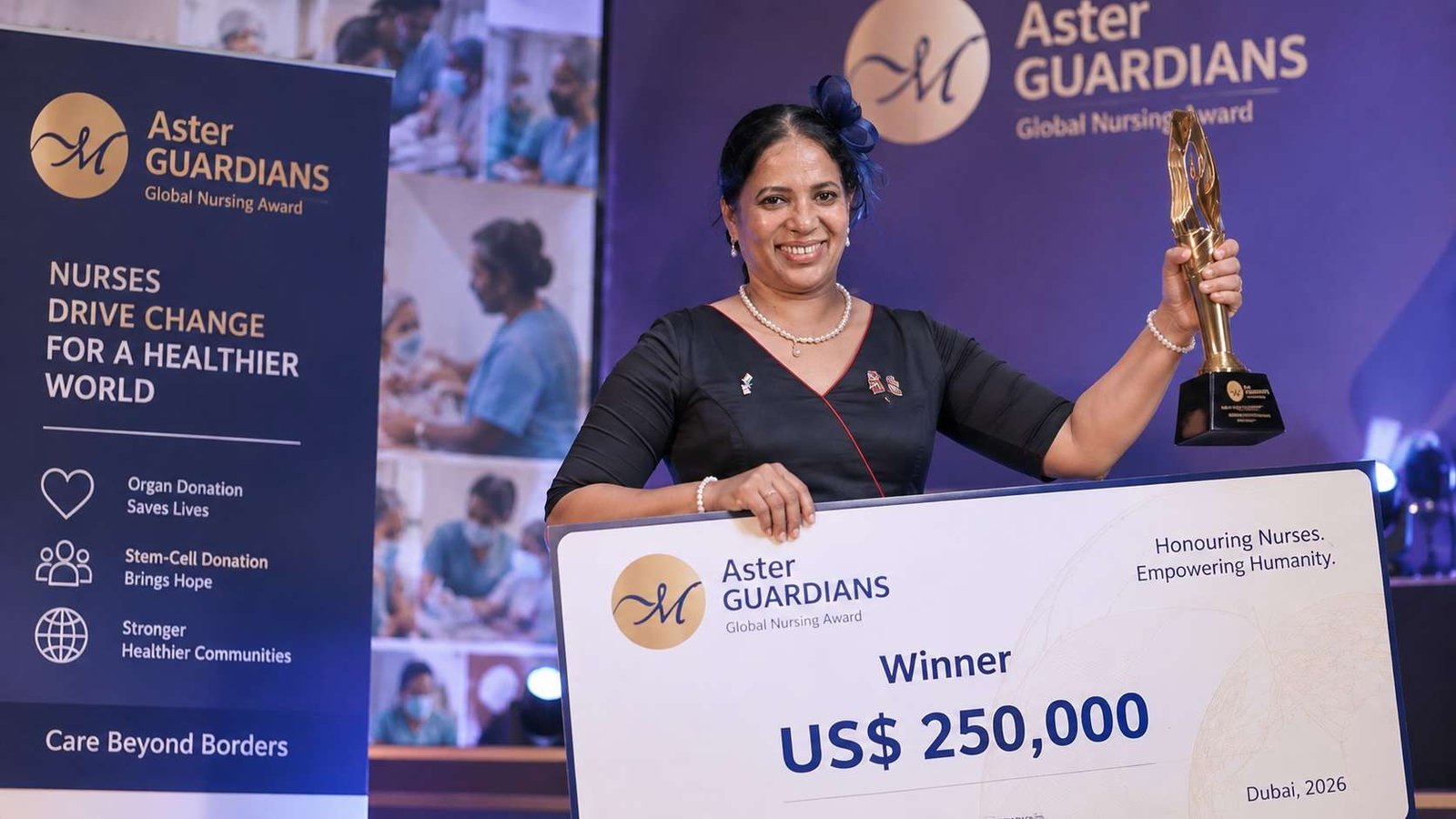
From Kerala to King’s College: How Dr. Agimol Pradeep Turned Nursing Into a Global Mission
There are awards that recognise a successful career.
And then there are awards that recognise what a person has done with that career.
For Dr. Agimol Pradeep, the distinction is important.
On September 12, 2026, the UK-based Indian nurse was named the winner of the Aster Guardians Global Nursing Award 2026 at a ceremony in Kochi, receiving a prize of US$250,000. She was selected from more than 134,000 registrations spanning 214 countries and economies.
Dr. Pradeep works as a Senior Transplant Coordinator at King’s College Hospital in London and is also an Honorary Senior Lecturer at the University of Salford. Her recognition, however, is not simply for working inside a major British hospital.
It is for taking a difficult healthcare problem outside the hospital walls—and trying to change it at community level.
Her particular focus has been the shortage of suitable organ and stem-cell donors among South Asian communities in the UK.
And that is where the story becomes considerably bigger than one nursing award.
The problem she decided not to ignore
Organ transplantation depends on a deceptively simple word:
Match.
A patient may need a transplant urgently. Doctors may be ready. The medical infrastructure may exist.
But finding a compatible donor can still be difficult.
For some ethnic-minority patients, the probability of finding a suitable donor can be lower because donor registries do not always reflect the diversity of the population requiring treatment.
Dr. Pradeep saw this problem through her professional work and turned her attention towards community awareness.
Rather than simply asking why patients were waiting, she began asking another question:
Why aren’t more potential donors from underrepresented communities registering?
That question eventually led to Upahaar, a UK-based charity focused on blood stem-cell and organ donation, with particular attention to the South Asian community. The organisation conducts awareness campaigns, registration drives and volunteer programmes.
According to the organisation and reporting around the award, more than 10,000 stem-cell donors have registered through the initiative.
That is not merely an awareness statistic.
Every registration represents a potential future donor.
And somewhere, potentially, a patient waiting for a match.

Why the South Asian connection matters
The UK’s South Asian community is large and diverse, but cultural familiarity with organ and stem-cell donation cannot simply be assumed.
Questions about religion, family attitudes, medical terminology, misconceptions and trust can all influence people’s willingness to register.
This is where community-led healthcare advocacy can make a difference.
A government poster saying “Become a donor” is one thing.
A trusted healthcare professional explaining the process in a community setting, answering uncomfortable questions and allowing families to discuss the issue is another.
Dr. Pradeep’s work illustrates that difference.
Her approach has been to take the conversation into communities rather than waiting for communities to come into hospitals.
That is an important lesson in public health.
Upahaar: the idea behind the name
Upahaar’s message is beautifully simple:
“Live Life, Give Life.”
The organisation describes itself as a UK-based charity dedicated to saving lives through blood stem-cell and organ donation. It works with partner organisations and volunteers to encourage people to register and understand the potential impact of donation.
The organisation also has a substantial volunteer network.
The University of Salford has previously reported that Dr. Pradeep works with more than 70 volunteers across the UK to spread awareness of organ and stem-cell donation among South Asian communities.
This is where the story becomes particularly interesting.
The award may have gone to one nurse.
But the work itself depends on many people.
That is often how meaningful public-health campaigns operate: one person becomes the visible face, but hundreds of conversations happen elsewhere.
A nurse who became an advocate
Dr. Pradeep’s work also extends beyond donation.
University of Salford material records her advocacy for internationally educated nurses in the UK, including efforts relating to their professional and academic progression.
That gives her career another dimension.
She is not only working within the healthcare system.
She is also examining some of the barriers affecting the people who keep that system functioning.
This is particularly relevant to countries such as the UK, where internationally trained healthcare professionals play a significant role in the workforce.
The lesson is worth noting:
A healthcare system needs both patients and professionals to be supported.
Improving one while ignoring the other creates a rather expensive half-solution.

Why $250,000 matters—but isn’t the biggest story
The prize is substantial.
At US$250,000, it is one of the world’s most significant financial awards specifically associated with nursing recognition.
But Dr. Pradeep has indicated that the money will be used to extend the work rather than simply celebrate the achievement.
According to reporting around the award, half of the prize money is intended to support Upahaar’s expansion and related efforts in organ and stem-cell donation, while she also intends to support nursing development and training.
That decision changes the meaning of the prize.
A cash award can end up being a personal reward.
Or it can become seed funding for the next phase of an idea.
In this case, the intention is clearly the latter.
The DOONITED Editorial View
The most valuable part of Dr. Pradeep’s story is not that an Indian-origin nurse working in Britain won an international award.
That is certainly worth celebrating.
But the deeper lesson is about how healthcare problems are solved.
Hospitals can provide extraordinary medical treatment. Technology can improve diagnosis. Governments can create national programmes.
Yet none of those systems can manufacture trust inside a community.
That has to be built.
And sometimes a nurse who understands both the medical problem and the community’s concerns can accomplish something that a large institutional campaign cannot.
There is also a useful warning here.
India and other countries with large diaspora populations frequently celebrate overseas achievements as symbols of national success. That celebration is understandable.
But the real value of the diaspora story should not stop at “an Indian won an award abroad.”
The better question is:
What can India learn from the work behind the award?
In this case, the answer is substantial.
India itself faces enormous challenges in organ donation, donor awareness, transplant infrastructure and equitable access to transplantation.
A campaign that makes donation culturally understandable, scientifically clear and community-driven has relevance far beyond Britain.
The human side of transplantation
Behind every transplant statistic is a patient.
A mother waiting for a kidney.
A child needing a stem-cell match.
A family hoping for more time.
And somewhere else, potentially, a person who can help but has never considered becoming a donor.
That gap between need and awareness is precisely where advocacy becomes powerful.
Dr. Pradeep’s work attempts to close that gap.
It is not glamorous work.
There are no red carpets at most donor-registration drives.
No dramatic hospital soundtrack.
Usually there is just someone explaining what donation means, answering questions and asking another person to consider helping someone they may never meet.
Yet that ordinary conversation can eventually become extraordinarily important.
From Kerala to London—and back to Kerala
There is a particularly fitting geographical circle in this story.
Dr. Pradeep’s professional life has taken her to the UK, where she works at one of London’s major transplant centres.
Her award, however, brought her back to Kochi, where she received the global recognition.
The Aster Guardians award itself was launched in 2021 and has developed into an international platform recognising nurses working across different healthcare settings and communities.
This year’s competition attracted registrations from 214 countries and economies.
So although the ceremony took place in Kerala, the achievement was global in scale.
What readers can learn from her story
There is a practical message here that goes well beyond nursing.
First: healthcare advocacy can begin with identifying a gap that others have become accustomed to.
Second: community engagement is not an optional extra in public health. It can be essential.
Third: professional expertise becomes more powerful when it is combined with communication.
Fourth: diaspora professionals can create meaningful links between the healthcare knowledge of their adopted countries and the communities from which they come.
And finally:
One person’s professional job can become another person’s life-saving opportunity.
That may be the most powerful definition of nursing in this entire story.
The Bigger Story
Dr. Agimol Pradeep’s US$250,000 Aster Guardians Global Nursing Award is undoubtedly an extraordinary personal achievement.
But the award is ultimately recognising something larger than a CV.
It recognises a model of healthcare in which a professional does not stop at treating the patient in front of her.
She asks why other patients are still waiting.
She looks for the barrier.
She goes into the community.
She recruits volunteers.
She builds awareness.
And then she tries to change the system.
More than 134,000 registrations competed for this year’s award.
One nurse emerged as the winner.
But if the prize money helps create thousands more donor conversations, more registrations and a stronger nursing workforce, the real winner will not be Dr. Pradeep alone.
It will be the patient who eventually receives the call:
A suitable match has been found.
That is when an award becomes more than an award.
It becomes a possibility of life.

World Beyond the News
Birds Can Navigate Using Earth’s Magnetic Field
Several bird species can sense Earth’s magnetic field, helping them navigate during long-distance migration.
Fermentation Is a Global Food Tradition
People across continents have used fermentation for centuries to preserve food and create distinctive flavours.
Modern Batteries Store Energy Chemically
Rechargeable batteries repeatedly move ions between electrodes, allowing electrical energy to be stored and released.
Why Songs Become Global Hits
Streaming platforms, short-form video, playlists and international collaborations can rapidly carry music across borders.