
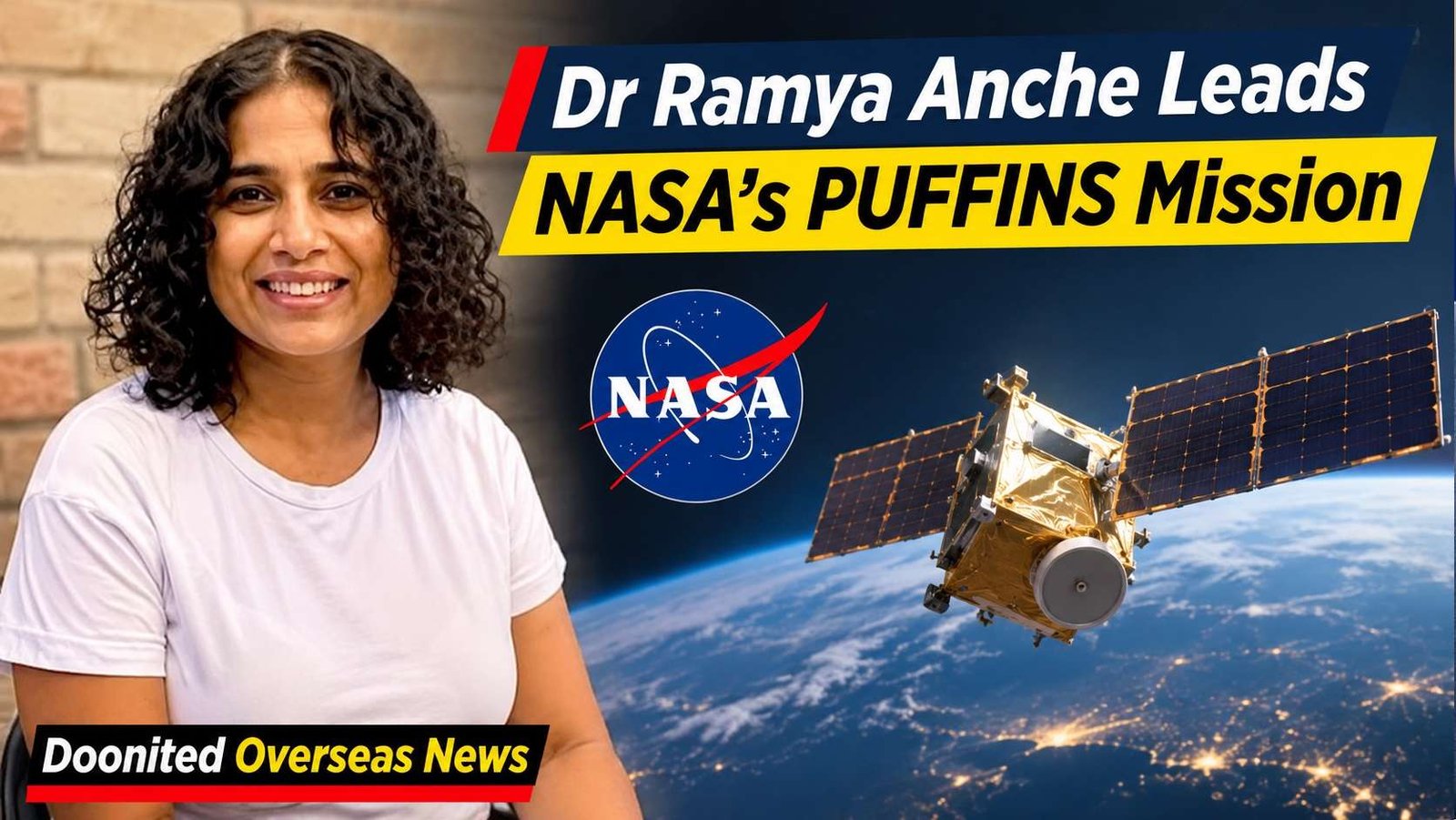
From Devanahalli to NASA: Indian-Born Astrophysicist Ramya Anche to Lead $20 Million Mission Exploring the Dust Between Stars
Trained at leading Indian research institutions and now an assistant research professor at the University of Arizona, Dr Ramya Manjunath Anche is principal investigator of PUFFINS, a NASA-funded SmallSat mission. Its findings could help scientists understand how interstellar dust influences the formation of stars and planets.
From Bengaluru to the forefront of space research
A scientist who began her academic journey in Devanahalli, near Bengaluru, is now leading an international NASA-funded mission to investigate some of the smallest and least-understood particles in the universe.
Dr Ramya Manjunath Anche, an assistant research professor at the University of Arizona’s Steward Observatory, is the principal investigator of PUFFINS — Polarimetry in the Ultraviolet to Find Features in INterStellar dust. NASA has awarded the University of Arizona team $20 million for the project under its Astrophysics Pioneers programme. The mission is being developed for a planned launch around 2030.
The achievement is significant not only because of the scale of the scientific project, but also because of the international research journey behind it. Anche completed her doctoral training at the Indian Institute of Astrophysics (IIA) in Bengaluru before moving into research roles in India and the United States. Her career illustrates how scientific education and research experience gained in India can contribute to major international space missions.
A small telescope investigating a big cosmic mystery
PUFFINS will use a compact satellite carrying a specialised ultraviolet telescope with a primary mirror approximately 25 centimetres, or 10 inches, across. Despite its modest dimensions, the instrument is designed to observe ultraviolet light from approximately 70 stars and measure how that light has been altered while travelling through interstellar space.
The target is interstellar dust: tiny solid particles dispersed between stars. These grains may appear insignificant, but they influence how light travels through galaxies and play an important role in the environments where stars and planets form.
The mission will use a technique known as ultraviolet spectropolarimetry. In simple terms, polarimetry measures the orientation and alignment of light waves, while spectroscopy examines light across different wavelengths. Combining the two allows researchers to investigate how dust grains interact with ultraviolet radiation and how their properties vary.
The mission is particularly interested in grains smaller than approximately 50 nanometres. These particles are difficult to study using conventional optical and infrared observations. By examining their effects on starlight, scientists hope to learn more about their composition, alignment and relationship with magnetic fields in the interstellar medium.
The research could also improve understanding of the material that eventually becomes part of new stars and planetary systems. It will not directly discover planets or establish whether life exists elsewhere; its contribution is more fundamental, addressing the physical processes that shape the environments in which planetary systems develop.
The Indian academic journey behind the mission
According to reporting by The Indian Express, Anche studied at Oxford English School in Devanahalli and MES Vidyasagar Prof. MPL Sastry PU College before earning a Bachelor of Engineering degree in electrical and electronics engineering from Sir M. Visvesvaraya Institute of Technology, Bengaluru.
In 2012, she joined the Indian Institute of Astrophysics for an integrated M.Tech–Ph.D. programme in astronomical instrumentation. She subsequently undertook postdoctoral research at the Inter-University Centre for Astronomy and Astrophysics (IUCAA) in Pune during 2020–21 before moving to the University of Arizona in 2021.
Her transition from electrical engineering to astrophysics is an important part of the story. Rather than following a conventional engineering-industry career, she pursued specialised research in optical instrumentation and astronomical polarimetry.
At Steward Observatory, her work has included the development of instrumentation and polarimetric research connected with NASA’s Nancy Grace Roman Space Telescope. Her institutional profile confirms that she is the principal investigator of PUFFINS and holds a Ph.D. from the Indian Institute of Astrophysics, awarded in 2020.
An international research partnership, with Indian institutions involved
PUFFINS is not an isolated American research project. Its scientific collaboration extends across four continents, bringing together researchers and institutions in the United States, Europe, Asia and Africa.
The mission’s published team list includes India’s Indian Institute of Astrophysics and IUCAA, Pune, alongside institutions such as the University of Arizona, McDonald Observatory at the University of Texas at Austin, Leiden University, the Austrian Academy of Sciences and the Korea Astronomy and Space Science Institute.
This international structure gives the project a direct connection to India’s scientific community. Indian institutions are represented in the collaboration, creating opportunities for researchers and students to contribute to a mission led from the United States.
For Indian students and early-career scientists considering research careers overseas, the project also offers a valuable example of how advanced scientific work increasingly depends on international teams rather than isolated national programmes.
Why PUFFINS matters beyond its launch
The mission is expected to contribute to the scientific groundwork for NASA’s proposed Habitable Worlds Observatory, a future flagship telescope being developed for the 2040s. Better knowledge of interstellar dust could help scientists interpret astronomical observations more accurately, including measurements involving stars and planetary environments.
There is, however, a distinction between a funded mission and a completed scientific achievement. PUFFINS is still in its early design phase. Its telescope must be developed, tested and prepared for flight before it can begin collecting observations. Its eventual scientific value will depend on successful development, launch and analysis of the data.
There is also a small difference in published launch schedules: NASA’s Astrophysics Pioneers page lists 2029, while the University of Arizona’s mission announcement and the PUFFINS project timeline identify 2030. The latter is the more recent project-specific target reported by the university, but the schedule should be treated as provisional.
For India and its overseas scientific community, Anche’s leadership represents a meaningful connection between Indian academic training and global scientific discovery. Her work demonstrates that the contribution of Indian researchers abroad is not limited to technology companies, medicine or business. It also reaches the frontier of fundamental research — into the particles between stars and the processes that help shape the universe.

World Beyond the News
Bees Communicate Where Food Is
Honeybees use movement patterns known as waggle dances to communicate information about food locations.
Street Food Reflects Local History
Many famous street foods developed from migration, trade, local ingredients and the everyday needs of working communities.
A Day on Venus Is Extremely Long
Venus rotates so slowly that one rotation relative to distant stars takes longer than its trip around the Sun.
Human Achievement Continues to Push Limits
Athletes, engineers, scientists and explorers regularly establish new benchmarks in speed, endurance, scale and precision.