
Why Europe’s Biggest Market Opportunity Could Change the Way India Does Business
There are trade agreements, and then there are trade agreements that make exporters start checking their calculators twice.
The India–European Union Free Trade Agreement (FTA) belongs to the second category.
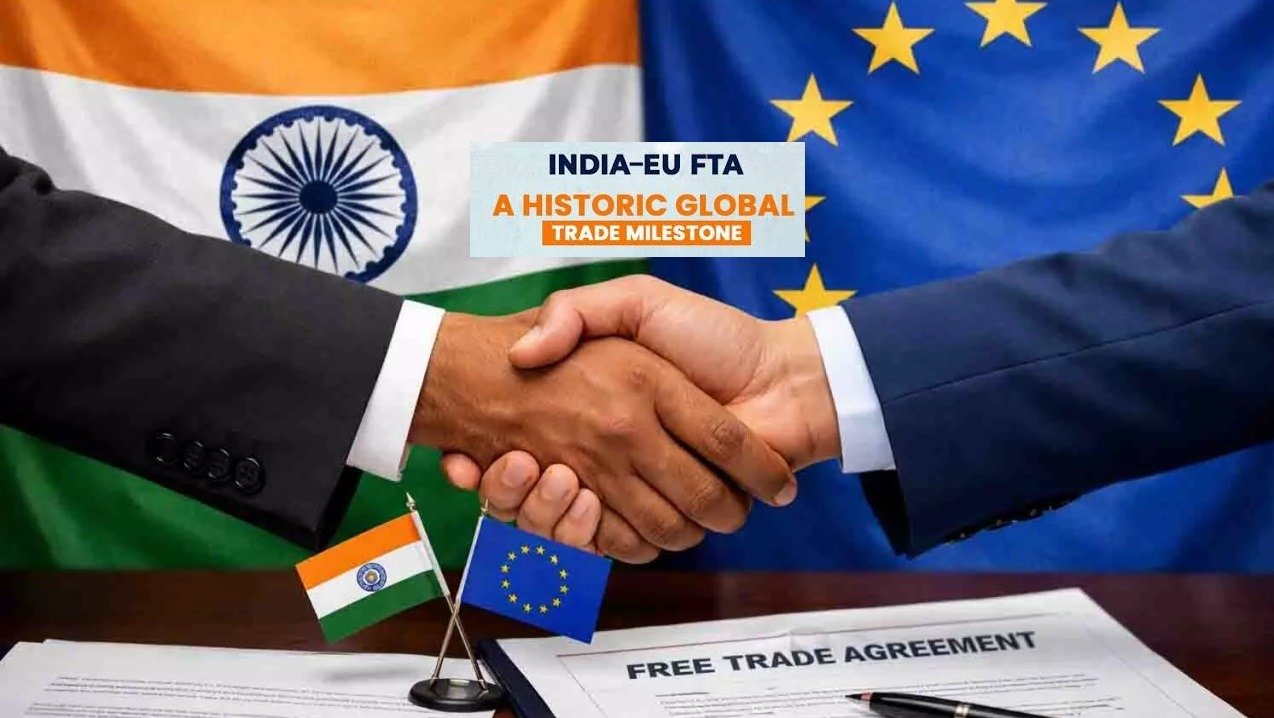
On January 27, 2026, India and the European Union announced the conclusion of negotiations for their long-awaited FTA at the 16th India–EU Summit in New Delhi. It followed years of negotiations and the formal relaunch of talks in 2022.
But there is an important distinction: the negotiations have been concluded; the agreement has not yet entered into force. Legal revision, approvals, signing and the respective internal procedures still have to be completed. The Indian government says the FTA will enter into force after India and the EU exchange written notifications confirming completion of their internal legal procedures, unless they mutually agree another date.
That distinction may sound like legal paperwork.
For Indian exporters, however, it is the difference between “opportunity coming” and “opportunity available.”
A market of roughly 2 billion people
The scale is difficult to ignore.
India and the EU together represent a market of around 2 billion people, approximately one-quarter of global GDP, and around one-third of global trade, according to the Indian government. The government estimates the combined market at about $24 trillion.
The existing relationship is already substantial.
In 2024–25, India’s merchandise trade with the EU was about $136.54 billion, including Indian exports of approximately $75.85 billion. India–EU services trade was about $83.10 billion in 2024.
So this is not India opening a new shop in Europe.
It is more like taking an existing shop and suddenly giving it a much larger storefront.
The question is whether Indian businesses are ready to fill the shelves.
What Indian exporters stand to gain
The agreement provides preferential access covering more than 99% of India’s exports to the EU by trade value, according to the Indian government’s factsheet. The EU, using a different measurement, says tariffs will be eliminated or reduced on more than 96% of bilateral trade.
Among the sectors expected to benefit are:
- textiles and apparel
- leather and footwear
- gems and jewellery
- marine products
- handicrafts
- engineering goods
- pharmaceuticals
- automobiles and components
- agricultural and processed food products
The Indian government says tariff reductions of up to 10 percentage points will bring almost $33 billion of labour-intensive exports to zero tariffs when the agreement enters into force.
That could be particularly important for industries that employ large numbers of workers.
A textile exporter in Tiruppur, a leather manufacturer in Kanpur, a jewellery company in Surat or an engineering supplier in Pune does not necessarily think about international diplomacy every morning.
They think about orders, margins, compliance and delivery deadlines.
That is where an FTA becomes real.
The farmer is part of the story too
It would be easy to describe this as an agreement for factories and multinational companies.
That would miss part of the picture.
The agreement provides improved market access for selected Indian agricultural and processed-food products, including tea, coffee, spices, fruits, vegetables and processed foods. At the same time, India has retained protection for sensitive sectors including dairy, cereals, poultry, soymeal and certain other agricultural products.
That balancing act is important.
Free trade does not mean that every tariff disappears overnight.
Every country has products it considers strategically or socially sensitive.
In trade negotiations, “free” has always been a slightly optimistic word.
There is usually a footnote nearby.
Europe gets access too
The agreement is not a one-way Indian export ticket.
India has also offered substantial market access to European goods, including machinery, chemicals, medical equipment, automobiles and selected agricultural and food products.
The automobile sector is particularly interesting.
The Indian government describes the arrangement as calibrated and quota-based auto liberalisation, designed to permit greater access for European manufacturers while also creating possibilities for Indian-made automobiles to become more competitive and eventually access European markets.
For Indian consumers, greater competition can mean more choice and potentially access to advanced products.
For Indian manufacturers, however, it also means something uncomfortable:
the competition is coming home too.
An FTA is not a medal ceremony. Both sides get opportunities, and both sides get competitors.
The less visible revolution: services
Perhaps the most strategically important part of the agreement is not something that arrives in a shipping container.
It is something that arrives through a laptop.
The FTA contains significant commitments covering Indian services, including IT and IT-enabled services, professional services, education, financial services, tourism, construction and other business services.
India has secured predictable access to 144 EU subsectors, while India has offered access across 102 subsectors.
There is also a mobility framework covering categories such as business visitors, intra-corporate transferees, contractual service suppliers and independent professionals.
The EU has offered commitments in 37 sectors/sub-sectors for contractual service suppliers and 17 for independent professionals. The agreement also establishes a framework for discussions on social-security agreements and provides provisions concerning student mobility and post-study work opportunities.
This does not mean that every Indian professional suddenly receives an unrestricted European work permit.
That would be a rather spectacular interpretation of a trade agreement.
The commitments apply to specified categories and conditions.
But they do make the movement of qualified Indian professionals for legitimate business and service activities more predictable.
For India’s services economy, that could become extremely valuable.
Digital trade, AI and the new economy
The agreement also looks beyond traditional merchandise.
Its digital-trade provisions support electronic contracts, e-invoicing, e-authentication and paperless trade, while addressing areas such as consumer protection, cybersecurity and electronic transactions.
The agreement also identifies areas for future cooperation including artificial intelligence, clean technologies and semiconductors.
That matters because India’s next export story cannot depend forever on shirts, shoes and traditional manufacturing alone.
The global economy is increasingly built around software, data, technology, specialised engineering and high-value services.
India has considerable strengths in several of these areas.
Europe has technology, capital, advanced industrial capacity and one of the world’s largest affluent consumer markets.
There is obvious room for complementarity.
But Europe is not an easy market
Here comes the less glamorous part.
Tariffs are only one barrier to international trade.
European businesses operate under demanding standards involving product safety, environmental rules, documentation, traceability, data, packaging and technical compliance.
The FTA itself includes mechanisms concerning regulatory cooperation, sanitary and phytosanitary measures, technical barriers to trade and customs procedures.
Then there is the Carbon Border Adjustment Mechanism (CBAM).
The agreement includes provisions for cooperation and support concerning carbon pricing, verification and compliance with emerging carbon requirements.
For Indian manufacturers, this means the future European customer may ask not only:
“How much does your product cost?”
but increasingly:
“How much carbon was emitted while making it?”
The second question may be annoying.
It is also becoming commercially important.
The real test begins after the signing
As of September 2026, the agreement is still moving through the legal and procedural stage. India has said it wants the necessary processes completed quickly, while the EU’s own description confirms that negotiations concluded on January 27 but implementation still depends on subsequent procedures.
That means Indian businesses should not wait for the ceremonial signing to begin preparing.
Exporters need to understand rules of origin, European standards, certification, packaging, logistics, intellectual-property requirements and environmental compliance.
An FTA can reduce a tariff.
It cannot improve a bad product.
It cannot repair unreliable delivery.
And it certainly cannot make a European customer forgive poor quality simply because the customs duty has fallen.
DOONITED Editorial Perspective: The opportunity is bigger than the tariff
The most important part of the India–EU FTA may ultimately have little to do with tariffs.
It is about forcing Indian companies to think globally.
If Indian exporters use the agreement merely to sell existing products slightly more cheaply, the benefit will be limited.
But if companies use European market access to improve quality, automation, design, certification, logistics and technological capability, the impact could spread far beyond Europe.
A product that satisfies demanding European customers can potentially become more competitive in other developed markets as well.
That is where the agreement becomes a strategic opportunity rather than merely a customs arrangement.
India has spent years talking about becoming a manufacturing and services powerhouse.
Europe now offers one of the world’s largest testing grounds for that ambition.
The opportunity is enormous.
So is the homework.
And unlike a school examination, this one has 27 sets of customers watching the answer sheet.
What readers should remember
The India–EU FTA negotiations were concluded on January 27, 2026, but the agreement still requires completion of legal and internal procedures before it can enter into force. Once operational, it could substantially improve market access for Indian goods and services while increasing competitive pressure inside India.
The real question is therefore not simply:
“How much tariff will India save?”
It is:
“How much more competitive can India become because Europe is now a bigger part of the market?”
That is the opportunity worth watching.

World Beyond the News
Birds Can Navigate Using Earth’s Magnetic Field
Several bird species can sense Earth’s magnetic field, helping them navigate during long-distance migration.
Fermentation Is a Global Food Tradition
People across continents have used fermentation for centuries to preserve food and create distinctive flavours.
Modern Batteries Store Energy Chemically
Rechargeable batteries repeatedly move ions between electrodes, allowing electrical energy to be stored and released.
Why Songs Become Global Hits
Streaming platforms, short-form video, playlists and international collaborations can rapidly carry music across borders.