
Global South Ambition and Practical Cooperation
On September 12 and 13, New Delhi will become one of the most closely watched diplomatic addresses in the world.
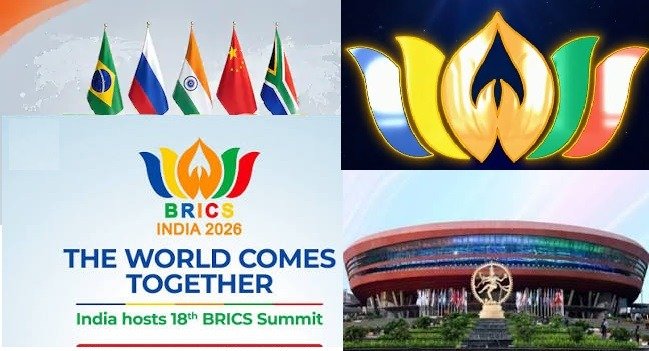
The occasion is the 18th BRICS Summit, hosted by India at Bharat Mandapam during its 2026 BRICS chairship.
But this is not simply another diplomatic gathering where leaders arrive, pose for photographs, shake hands and return home with a folder full of declarations.
The timing makes this summit particularly important.
BRICS is now a much larger grouping than the original Brazil-Russia-India-China configuration. It has 11 members, including South Africa, Egypt, Ethiopia, Iran, Saudi Arabia, the United Arab Emirates and Indonesia. Together, the members account for nearly half of the world’s population and around 40% of global GDP, according to Indian government figures.
And 2026 marks another milestone:
BRICS is 20 years old.
For India, therefore, this summit is both a diplomatic responsibility and a test.
Can New Delhi turn an increasingly diverse group into a more useful instrument of economic and technological cooperation?
Or will BRICS remain a fascinating collection of countries that agree on some things, disagree on others—and occasionally manage to agree on the punctuation?
India’s four-word BRICS message
India’s presidency has chosen the theme:
Building for Resilience, Innovation, Cooperation and Sustainability.
It is not merely a slogan.
Throughout the year, India has organised BRICS meetings covering trade, finance, science and technology, urbanisation, disaster management, communications, energy, culture and other areas. The government says more than 350 meetings and high-level engagements have been held in more than 25 Indian cities under the chairship.
The idea is to make BRICS cooperation more practical.
Resilience means stronger supply chains, disaster preparedness, health security and the ability to withstand external shocks.
Innovation includes digital technologies, artificial intelligence, science, fintech and digital public infrastructure.
Cooperation means making a larger group work together despite very different national interests.
And sustainability brings climate, energy, green finance and long-term development into the conversation.
India has already demonstrated this approach through initiatives such as the BRICS ICT track, where discussions have included Digital Public Infrastructure, cybersecurity, future networks and inclusive digital transformation.
The BRICS challenge: everyone wants cooperation, but everyone has interests
This is where the story becomes considerably more complicated.
BRICS is not a political alliance like NATO.
It has no constitutive treaty, no permanent secretariat and decisions are based on consensus. Its members have different political systems, economic structures and foreign-policy priorities.
That diversity can be its strength.
It can also be its headache.
India has close relationships with the United States, Europe, Russia, Japan and countries across the Global South.
China is India’s neighbour and major trading partner, but the two countries continue to have unresolved strategic and border concerns.
Russia remains an important defence and energy partner for India while maintaining its own geopolitical confrontation with the West.
Iran and the Gulf countries have their own regional calculations.
In other words, BRICS is not a family dinner where everybody agrees on the menu.
It is more like a very large diplomatic buffet where eleven guests have arrived with eleven different appetites.
India’s job is to find enough food that everybody can actually eat.
China will be one of the biggest stories in Delhi
The presence of Chinese President Xi Jinping is expected to give the summit an additional dimension.
His visit would be his first to India since 2019 and comes after years of tension following the 2020 border crisis.
Recent diplomatic developments have indicated a cautious effort by India and China to stabilise their relationship.
Chatham House has described the India-China reset as likely to continue around the BRICS summit, while recent reporting has pointed to renewed diplomatic and economic engagement.
But BRICS cannot erase the India-China relationship’s unresolved problems.
Nor should it.
A summit is not a magic eraser.
The more realistic objective is to create enough political space for competition and cooperation to coexist.
For India, that is classic strategic autonomy: engage where interests overlap, protect national interests where they diverge, and avoid becoming permanently trapped inside somebody else’s geopolitical camp.
The financial question is bigger than “de-dollarisation”
One of the most discussed BRICS issues is the future of international payments.
There is considerable interest within BRICS in increasing the use of national currencies and making cross-border transactions more resilient.
Ahead of the summit, finance ministers and central bank officials are discussing these issues, including greater use of local currencies and the role of the New Development Bank (NDB).
But here again, headlines can oversimplify.
Russia’s Kremlin spokesperson Dmitry Peskov said on September 8 that Russia does not seek “de-dollarisation” and remains open to acceptable payment methods.
That is revealing.
BRICS financial cooperation does not necessarily mean creating one new currency tomorrow morning and announcing that the dollar has retired.
The practical question is more interesting:
Can BRICS countries make cross-border trade and investment easier by giving businesses more payment and financing options?
That is achievable in stages.
And India has something useful to bring to that conversation.
India’s digital advantage
India’s Unified Payments Interface, or UPI, has become one of the country’s most visible examples of Digital Public Infrastructure.
India has already begun taking UPI beyond its borders, and Prime Minister Narendra Modi has recently argued for deeper integration with payment systems in other countries. Reuters reported that UPI was operating in 11 countries as of September 2026.
This gives India an interesting proposition inside BRICS.
Instead of merely discussing digital transformation in theoretical terms, India can demonstrate a system that operates at enormous scale.
That does not mean other countries will simply copy UPI.
Different countries have different banking regulations, currencies, privacy laws and financial architectures.
But India can offer an important lesson:
digital infrastructure can become a public utility rather than remaining exclusively a proprietary corporate platform.
That is potentially relevant across much of the Global South.
The New Development Bank needs to deliver more
The New Development Bank, headquartered in Shanghai, is another important piece of the BRICS architecture.
Created in 2015, the bank was designed to finance infrastructure and sustainable-development projects in BRICS countries and other emerging-market and developing economies.
Its challenge now is scale.
In August, India hosted a major NDB seminar on mobilising private capital.
According to the NDB, by June 30, 2026, it had approved 141 projects worth a cumulative $44 billion, with $25 billion disbursed.
The next question is whether the bank can mobilise significantly more private investment.
Governments alone cannot finance the infrastructure requirements of emerging economies.
Roads, ports, renewable energy, digital infrastructure, water systems, urban transport and healthcare require enormous pools of capital.
If the NDB can help reduce investment risks and make projects more bankable, it could become one of BRICS’ most useful institutions.
That is considerably more valuable than producing another beautifully worded communiqué.
Global South: India wants influence, not just applause
India has increasingly positioned itself as a voice for developing and emerging economies.
That ambition has gained visibility through initiatives such as the Voice of Global South Summit and India’s emphasis on reforming international institutions.
BRICS fits naturally into that approach.
The group seeks greater representation for emerging economies in institutions such as the United Nations, IMF and World Bank.
But India should be careful with the phrase “leader of the Global South.”
The Global South is not a single political constituency.
African countries have their own priorities.
Latin American countries have their own interests.
Asian countries do not necessarily agree with each other.
Even within BRICS, economic and geopolitical priorities vary enormously.
India’s stronger proposition may therefore be bridge-builder rather than bloc leader.
That is actually more compatible with India’s foreign-policy tradition.
The real test is what ordinary people get from BRICS
Diplomacy can sometimes become an exercise in impressive nouns.
Resilience.
Sustainability.
Multilateralism.
Strategic autonomy.
Connectivity.
Innovation.
All important words.
But eventually someone should ask a very simple question:
What changes for an ordinary citizen?
If BRICS cooperation makes medicines cheaper, infrastructure easier to finance, digital payments simpler, energy supplies more secure, food systems more resilient or trade easier for small businesses, then it has real value.
If it produces only declarations, photographs and another acronym for the diplomatic dictionary, its impact will be considerably smaller.
India’s 2026 chairship appears to understand this challenge.
Its programme has deliberately spread BRICS activity across technology, finance, disaster management, cities, energy, trade and people-to-people cooperation.
The hard part is turning meetings into measurable outcomes.
DOONITED Editorial Perspective: India’s biggest opportunity is not to create another bloc
There is a temptation to interpret BRICS as an emerging replacement for the Western-led international system.
That would be too simplistic.
The world is not necessarily moving from one bloc to another.
It is becoming more fragmented, competitive and interconnected at the same time.
India’s opportunity is therefore not to choose one camp and declare victory.
It is to increase its bargaining power by maintaining relationships across camps.
That requires capability.
Strategic autonomy without economic strength is merely a slogan.
Strategic autonomy without technological capacity is fragile.
Strategic autonomy without military credibility has limits.
And strategic autonomy without diplomatic flexibility becomes isolation wearing a very expensive suit.
India’s BRICS chairship should therefore be judged not by how loudly it challenges existing powers, but by how effectively it creates additional choices for India and other developing countries.
Delhi’s moment
When leaders arrive in New Delhi on September 12, they will be meeting at a moment of geopolitical uncertainty.
Wars and conflicts continue to affect energy and food security.
Trade tensions are disrupting supply chains.
Technology is becoming a strategic asset.
Artificial intelligence is changing economies.
Climate risks are becoming harder to ignore.
And developing countries continue to seek greater influence over the institutions that shape global finance and governance.
BRICS cannot solve all of these problems.
Nor should anyone expect it to.
But it can become a useful platform for countries that want more cooperation and more options.
India’s task is to prove that a larger BRICS can also be a more practical BRICS.
The success of the Delhi summit will therefore not ultimately be measured by the grandeur of Bharat Mandapam or the number of leaders standing together for the traditional group photograph.
It will be measured by what happens afterwards.
If India can turn resilience into stronger supply chains, innovation into usable technology, cooperation into trade and finance, and sustainability into real investment, BRICS 2026 could become more than a summit.
It could become a demonstration of how diplomacy works when the objective is not simply to make history—but to make international cooperation useful.

World Beyond the News
Birds Can Navigate Using Earth’s Magnetic Field
Several bird species can sense Earth’s magnetic field, helping them navigate during long-distance migration.
Fermentation Is a Global Food Tradition
People across continents have used fermentation for centuries to preserve food and create distinctive flavours.
Modern Batteries Store Energy Chemically
Rechargeable batteries repeatedly move ions between electrodes, allowing electrical energy to be stored and released.
Why Songs Become Global Hits
Streaming platforms, short-form video, playlists and international collaborations can rapidly carry music across borders.