
India’s ₹151 Crore YETI Drone Project: Could It Open New Global Logistics Markets?
Government-backed funding for Mumbai-based ideaForge aims to advance a heavy-lift autonomous aircraft capable of carrying up to 200 kg over a targeted 200 km range. For Overseas Indians, the wider story is about India’s ambitions in deep technology, future export opportunities and the challenge of turning an engineering programme into a trusted global product.
The announcement: ₹151 crore for a difficult engineering challenge
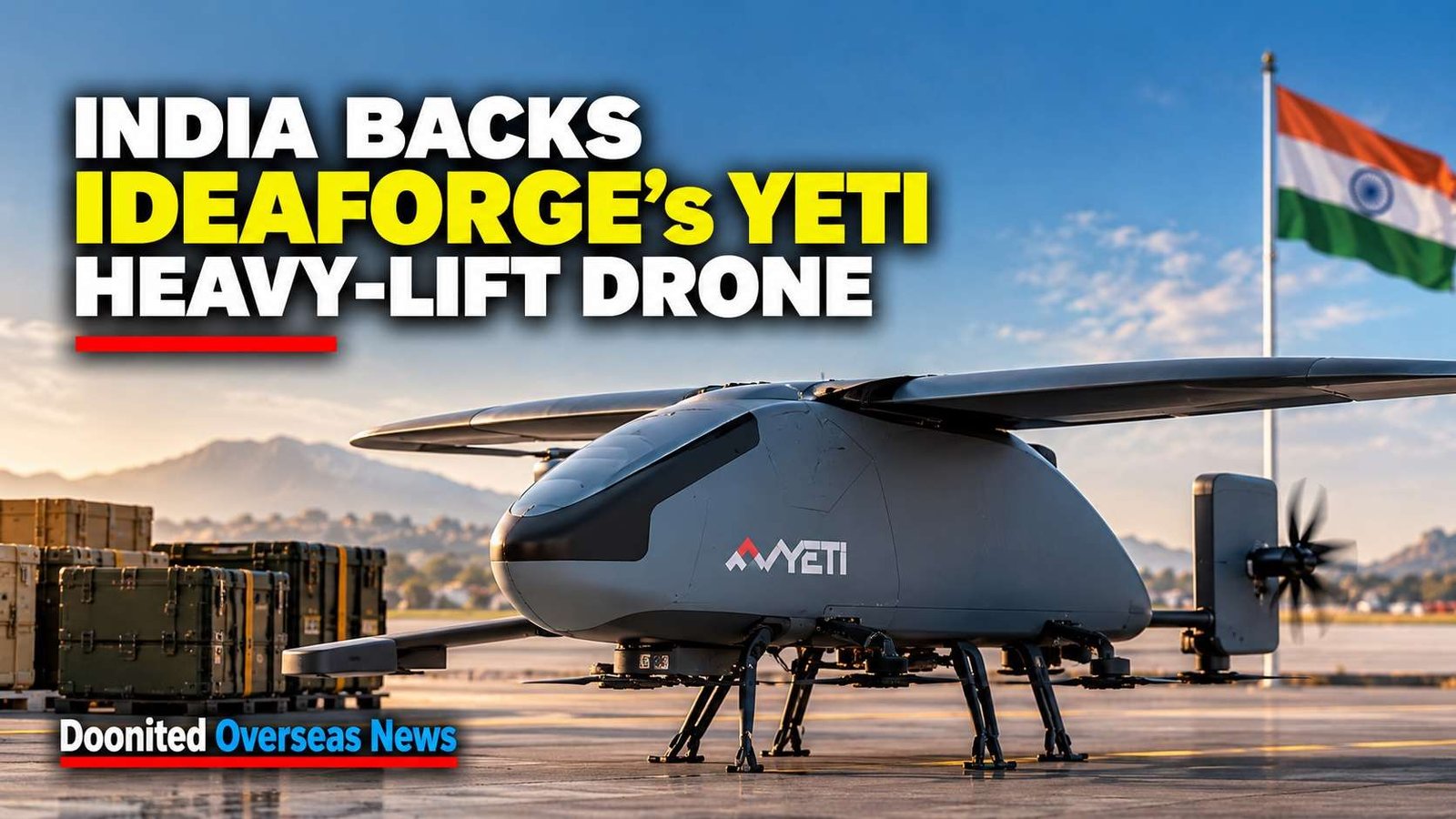
India’s effort to build advanced autonomous aircraft has received a significant financial boost. On 14 October 2026, the Technology Development Board (TDB), under the Department of Science and Technology, signed an agreement with Mumbai-based ideaForge Technology Limited for ₹151 crore in financial support to develop YETI, a heavy-lift autonomous aerial logistics vehicle. The programme has a stated total project cost of ₹302 crore, with the government support structured as debt financing.
YETI is being developed as a hybrid aircraft combining vertical take-off and landing (VTOL) with a fixed-wing configuration. This design is intended to allow the vehicle to operate from relatively small landing areas while retaining the potential for longer-range flights.
According to the government announcement, the planned specifications include a payload capacity of up to 200 kilograms, a targeted range of up to 200 kilometres and an operating altitude of up to 6,500 metres above mean sea level. The design also envisages containerised transportation, redundant propulsion and power systems, and navigation capabilities intended for environments where satellite navigation signals may be unavailable.
These are development targets, not confirmation that every capability has been demonstrated in routine commercial operations. The funded programme is intended to take the technology from Technology Readiness Level 4 to Level 9, involving further engineering, integration, testing and validation.
That distinction matters. A promising prototype can demonstrate that a technical concept works under controlled conditions. A dependable logistics aircraft must also prove that it can operate safely, repeatedly and economically in real-world environments.
Why heavy-lift drones could matter beyond India
The global case for autonomous cargo aircraft is strongest where moving essential goods by road is slow, expensive or difficult. Mountainous terrain, isolated communities, disaster-hit areas and locations with limited transport infrastructure can all create logistics problems that conventional vehicles struggle to solve.
A heavy-lift aircraft could, in principle, transport medical supplies, equipment, spare parts or other essential cargo between accessible distribution points and harder-to-reach destinations. In emergency situations, it could potentially help restore supply routes when roads are damaged or blocked.
YETI’s proposed combination of vertical take-off and landing and longer-range flight is designed to address some of these challenges. Its targeted payload capacity is also materially different from that of small delivery drones designed to carry lightweight packages.
But capacity alone does not establish commercial value. Actual performance will depend on payload and range trade-offs, weather limits, battery or fuel endurance, maintenance requirements, landing-site availability, operating costs and the reliability of communications and navigation systems.
For overseas markets, these practical factors will matter more than headline specifications. Logistics operators need evidence that a system can complete missions consistently, protect cargo, meet safety requirements and deliver a competitive cost per shipment.
What this could mean for Overseas Indians
The direct connection to the Indian diaspora is not an immediate change to immigration, citizenship, OCI rules or consular services. The agreement does not announce a new visa route or a specific overseas employment programme.
Its potential relevance is economic and technological.
1. Opportunities for Indian-origin entrepreneurs
Indian-origin entrepreneurs working in aerospace, robotics, medical logistics, supply-chain technology and climate-resilient infrastructure may find future opportunities if Indian-built autonomous aircraft become commercially viable.
Potential areas of participation could include software integration, fleet management, maintenance, communications, logistics planning and partnerships with local operators. These are prospective opportunities, not confirmed contracts arising from the YETI announcement.
Diaspora entrepreneurs could eventually help connect Indian technology developers with customers and partners in markets where they have commercial experience. However, that would require demonstrated product performance, credible pricing, regulatory compliance and appropriate local partnerships.
2. Export potential—and the barriers to it
An indigenous heavy-lift platform could contribute to India’s ambition to develop more sophisticated aerospace and autonomous-systems products. If YETI progresses successfully, overseas sales could create opportunities across manufacturing, engineering, servicing and associated technology.
Yet an Indian development agreement does not automatically mean that foreign regulators will approve the aircraft or that overseas customers will buy it.
A cargo drone intended for use abroad may face requirements covering airworthiness, operational permissions, radio equipment, data security, insurance, import controls and the movement of particular goods. Rules will differ by jurisdiction and by the aircraft’s intended use.
Potential deployments involving border regions, sensitive infrastructure or security-related applications could also attract additional scrutiny. Any export strategy will need to account for these realities rather than assuming that domestic development guarantees international market access.
3. Skills and high-value employment
The project sits at the intersection of aerospace engineering, autonomous control, propulsion, navigation, communications and systems integration. Advancing a complex aircraft from development towards operational readiness can require multidisciplinary teams.
If the programme leads to sustained production and commercial deployment, it could support demand for specialised engineering and technical roles. Overseas Indians with relevant expertise may be able to contribute through research collaboration, supplier relationships, investment or professional partnerships.
However, the funding announcement does not specify a job-creation figure, overseas recruitment plan or diaspora participation target. It would be premature to present these as established benefits.
The regulatory hurdle: building a drone is only half the job
For YETI to become an operational logistics product, the developer must establish not only technical capability but also compliance with applicable aviation rules.
India’s Directorate General of Civil Aviation (DGCA) provides requirements and guidance for drone operations, including certification, registration, airspace restrictions and operational permissions. Its public guidance tells operators to use appropriately certified and registered drones, check airspace before flight, and obtain specific authorisation for beyond-visual-line-of-sight operations where required.
International deployment would add another layer. Countries have their own rules governing unmanned aircraft, commercial cargo operations, aviation safety and the use of radio frequencies. A manufacturer seeking overseas customers would need to determine the relevant requirements market by market.
Export controls also deserve attention. India’s Directorate General of Foreign Trade maintains a SCOMET framework for specified sensitive goods, software and technologies, including certain unmanned aerial vehicle systems. Its applicability depends on the product’s classification and characteristics; exporters should not assume that every drone is treated identically or that every shipment requires the same authorisation.
What the ₹302 crore project must prove
The project’s total stated cost is ₹302 crore, of which ₹151 crore is supported through the TDB agreement as debt financing. This is not the same as a ₹151 crore grant with no repayment obligation. The public announcement does not set out all the financing terms, so the repayment conditions should not be inferred from the headline figure.
Engineering validation: Can the aircraft reliably meet its payload, range and altitude targets under realistic operating conditions?
Safety and reliability: Do its propulsion, power, communications and navigation systems perform predictably when conditions deteriorate or components fail?
Operational approval: What certification and permissions will be needed for the intended missions?
Commercial economics: Can the system compete with road, conventional air freight and smaller drone networks on total delivery cost?
Customer adoption: Will logistics providers, public agencies or other potential customers commit to using it at a sustainable scale?
The transition from TRL-4 to TRL-9 is ambitious precisely because it involves more than producing a working prototype. It requires a technology to progress towards a level of maturity associated with validation in its intended operational environment. The funding is intended to support that journey; it does not establish that the journey has already been completed.
The bigger picture for India’s global technology ambitions
YETI offers a useful lens through which to assess India’s developing deep-technology sector. The question is not merely whether an Indian company can design a large autonomous aircraft. It is whether the company can build a product that is reliable, maintainable, commercially competitive and acceptable to regulators and customers in multiple markets.
That distinction matters for the diaspora. Overseas Indians can be important connectors between Indian engineering capabilities and international customers, investors, research institutions and distribution networks. But the most durable partnerships will be built on tested performance, transparent financing, credible safety evidence and compliance—not national branding alone.
There is also a wider public-interest question. If heavy-lift drones eventually improve access to essential supplies, their value could extend beyond commercial deliveries. Remote communities and disaster-response organisations may benefit from faster transport of critical goods. Those benefits, however, will depend on affordability, infrastructure, operating permissions and the ability to use the technology safely in difficult conditions.
For now, the agreement is best understood as a substantial development commitment rather than proof of a finished logistics revolution.
What readers should watch next
Overseas Indian entrepreneurs, investors and technology professionals following the project should look for independently verifiable milestones: successful flight and payload trials, progress towards the stated technology-readiness target, applicable certification, disclosed customer deployments and any confirmed export agreements.
Those developments would provide a stronger basis for assessing whether YETI can move from an Indian engineering programme to an international logistics platform.
The central takeaway: India’s ₹151 crore commitment to ideaForge’s YETI programme signals an effort to develop more advanced domestic aerospace capabilities. Its significance for Overseas Indians will depend on whether that investment eventually produces a safe, commercially viable aircraft—and whether Indian companies can turn that capability into credible international partnerships and exports.

World Beyond the News
Dolphins Use Individual Signature Whistles
Bottlenose dolphins develop distinctive whistles that function somewhat like individual acoustic identifiers.
The Pacific Is Earth’s Largest Ocean
The Pacific Ocean covers more area than any other ocean basin and stretches between Asia, Australia and the Americas.
Artificial Intelligence Learns Statistical Patterns
Modern machine-learning systems identify patterns in large datasets and use those patterns to generate predictions or outputs.
Why Some Stories Spread So Quickly
Emotion, novelty, visual appeal and easy sharing can make a story travel rapidly across social platforms.