
INS Samarthak: How India’s New Multi-Purpose Naval Ship Advances Indigenous Defence Technology
Commissioned at Karwar on 16 October, INS Samarthak is designed to support maritime surveillance, weapons trials, autonomous systems and disaster relief. Its significance extends beyond a new naval vessel: it highlights how India’s private shipbuilding industry is contributing to the development and testing of future defence technology.
A different kind of addition to the Indian Navy
A naval ship does not always need to be designed around a single mission. Some vessels are built to carry out a particular combat role; others provide the platforms, equipment and operational flexibility that allow a navy to develop and test new capabilities.
INS Samarthak belongs to the second category.
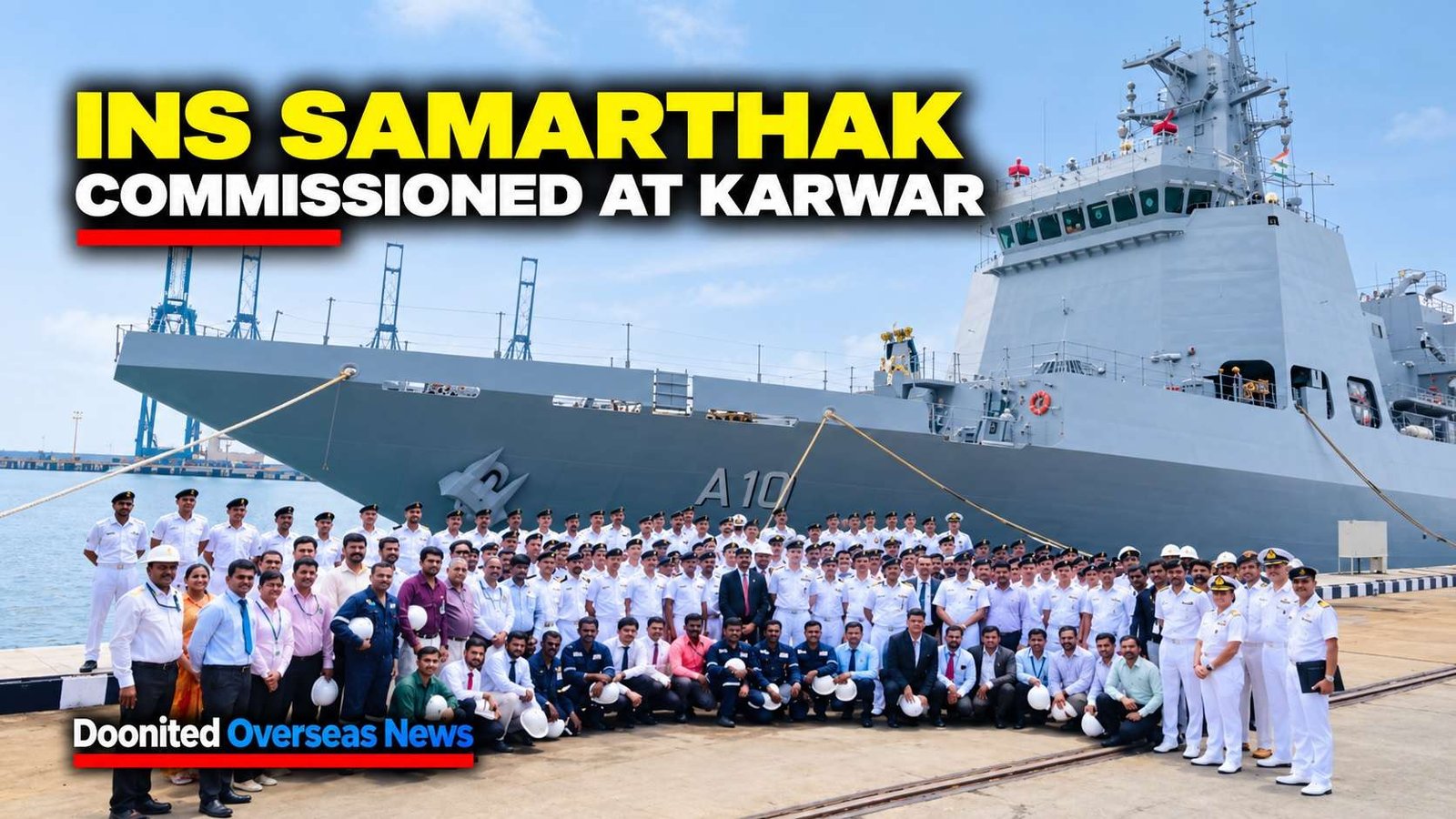
The Indian Navy commissioned the indigenous multi-purpose vessel at Naval Base Karwar in Karnataka on 16 October 2026. Built by Larsen & Toubro (L&T) at its Kattupalli shipyard near Chennai, the vessel has more than 75% indigenous content, according to the Ministry of Defence. It is intended to support a wide range of activities, from maritime surveillance and patrol to weapons trials, unmanned-system operations and humanitarian assistance.
For India, which is seeking to strengthen domestic defence manufacturing, that combination matters. A navy’s capabilities depend not only on frontline ships and weapons, but also on the platforms used to test, evaluate and integrate the next generation of systems.
What makes INS Samarthak different?
The vessel was conceived as a multi-purpose platform rather than a ship limited to one narrowly defined task.
The Ministry of Defence identifies several intended roles:
-
Maritime surveillance and patrol.
-
Low-intensity maritime operations.
-
Target deployment and recovery, and trials of equipment.
-
Support for unmanned and autonomous systems.
-
Humanitarian assistance and disaster relief.
-
Conversion for limited hospital-ship functions.
-
Salvage-related operations.
Its integrated combat suite combines indigenous sensors, weapons and electronic systems. These capabilities are intended to support operations in challenging maritime environments.
The ship is also designed to serve as a mothership for unmanned surface and aerial vehicles. In practical terms, a mothership can provide a larger vessel from which smaller uncrewed systems are deployed, recovered or supported.
Such systems can potentially extend a navy’s ability to observe maritime areas, conduct trials and perform tasks without placing personnel directly in every operating environment. Their effectiveness, however, depends on the systems being carried, communications, mission planning and successful integration with the wider fleet.
The public announcement describes Samarthak’s intended roles; it does not establish that every possible autonomous capability has already been deployed operationally.
Why a dedicated trials platform matters
Naval technology must be tested in demanding conditions. Sensors, weapons, communications equipment and autonomous systems need to be evaluated before their performance can be relied upon in operational settings.
A dedicated multi-purpose platform can provide a means of conducting such trials while supporting other maritime tasks. This is particularly relevant as naval forces worldwide explore combinations of crewed ships and uncrewed systems.
For India, the ability to test indigenous equipment is an important part of building domestic technological capability. Developing a system locally is one achievement; proving that it works reliably at sea, integrates with other equipment and can be maintained over time is another.
A platform like Samarthak can contribute to that process. Its value will ultimately depend on how effectively the Navy uses it for trials, evaluation and operational support.
This is a less visible aspect of defence modernisation than the announcement of a new missile or fighter aircraft, but it is an important one. Sophisticated equipment requires a testing and integration process before it can become a dependable operational capability.
Private shipbuilding and India’s defence ambitions
Samarthak was designed and constructed by L&T at its Kattupalli shipyard. The Ministry of Defence describes it as the first major warship built by an Indian private shipyard to be commissioned into the Navy, highlighting the expanding role of private industry in naval construction.
The wider significance is that defence self-reliance is an industrial process, not merely a procurement target. It requires skilled workers, experienced designers, quality-control systems and sustained demand for complex products.
For India’s private shipbuilding sector, naval programmes can help build these capabilities. Whether that expertise leads to wider export opportunities will depend on future customer demand, product competitiveness, export approvals and the ability to meet international requirements.
A maritime connection beyond India
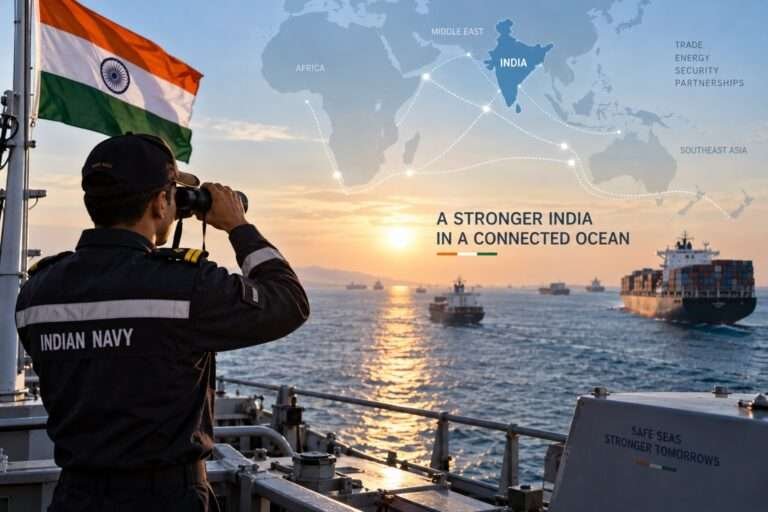
India’s maritime interests extend across busy commercial sea routes, coastal waters and the wider Indian Ocean region. Safe and reliable maritime activity matters to international trade, energy supplies, fisheries, disaster response and the movement of people and goods.
A vessel capable of supporting surveillance, trials and humanitarian assistance can contribute to several of these responsibilities. Its stated disaster-relief role is especially relevant in a region where coastal communities can face cyclones, flooding and other emergencies.
That does not mean Samarthak alone changes the regional balance of power or guarantees improved maritime security. Its contribution will depend on deployment, training, the systems it operates and coordination with other naval and civilian agencies.
For international observers, the ship is best understood as one component of a broader effort to develop India’s naval and industrial capabilities.
For overseas Indians, the connection is indirect but meaningful. Maritime stability and the security of sea routes matter to a country whose economy and global relationships are closely linked to international trade. Indian-origin professionals and businesses working in engineering, shipping, advanced manufacturing and technology may also follow developments in India’s defence-industrial ecosystem.
There is, however, no announcement associated with Samarthak of a new visa programme, overseas recruitment initiative or specific employment entitlement for the diaspora.
What comes next?
The commissioning of INS Samarthak marks the transition from ship construction and delivery to service in the Indian Navy. The next important indicators will be how the vessel is used for trials, how successfully it supports unmanned systems and how its multi-purpose design contributes to operational requirements.
The government has described Samarthak as the first of four multi-purpose vessels being inducted into the Navy. Earlier official material also records a contract with L&T for two vessels under the project, so the status of any additional ships should be assessed from subsequent official announcements rather than assumed from the commissioning of the first vessel.
The wider lesson is that naval modernisation involves more than acquiring finished combat systems. It also requires the infrastructure to develop, test, maintain and integrate those systems over time.
INS Samarthak’s significance lies in that supporting role. By combining multi-purpose maritime operations with a platform for trials and autonomous systems, it gives the Indian Navy another tool for developing its capabilities while demonstrating the growing contribution of India’s domestic shipbuilding industry.

World Beyond the News
Bees Communicate Where Food Is
Honeybees use movement patterns known as waggle dances to communicate information about food locations.
Street Food Reflects Local History
Many famous street foods developed from migration, trade, local ingredients and the everyday needs of working communities.
A Day on Venus Is Extremely Long
Venus rotates so slowly that one rotation relative to distant stars takes longer than its trip around the Sun.
Human Achievement Continues to Push Limits
Athletes, engineers, scientists and explorers regularly establish new benchmarks in speed, endurance, scale and precision.