

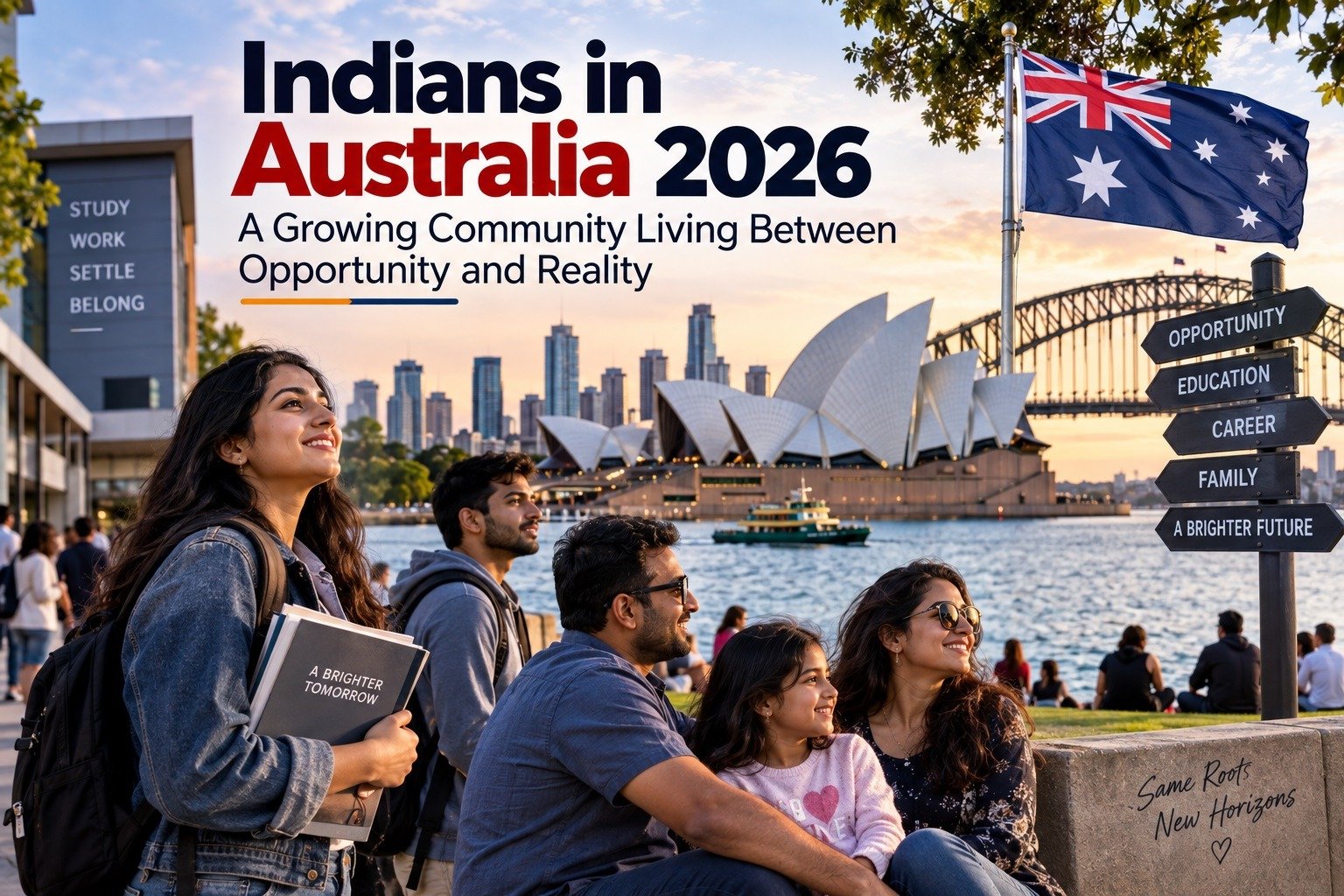
Indians in Australia 2026: A Growing Community Living Between Opportunity and Reality
Good universities.
A strong economy.
Professional opportunities.
A multicultural society.
A large Indian community.
And, for many migrants, the possibility of building a long-term life in a country very different from India.
But the Australia of 2026 is not the Australia of five or ten years ago.
Migration is becoming more selective.
Housing is expensive.
Competition for desirable jobs is real.
Student visas are being scrutinised more closely.
And the Indian community itself has become so large that newcomers increasingly arrive not in an unfamiliar country, but in a place where someone is probably already selling samosas within walking distance.
That combination of opportunity and pressure defines much of the Indian experience in Australia today.
India has become Australia’s largest overseas birthplace
The scale of the community is remarkable.
According to the Australian Bureau of Statistics, at 30 June 2025 there were 971,020 people born in India living in Australia.
India narrowly overtook England to become Australia’s largest overseas country of birth for the first time. England had 970,950 residents, while China was third with 732,000. (abs.gov.au)
The figure is particularly striking because India’s Australia-born population has grown rapidly.
In 2015, the number of India-born residents was about 449,000.
By 2025, it had more than doubled.
The Indian-born community is therefore approaching the symbolic one-million mark—but the latest official figure is still just below it.
And this number does not include Australian-born people of Indian ancestry.
So the broader Indian-Australian community is considerably larger.
Australia no longer feels culturally distant to many Indians
For a newcomer, one of the biggest psychological differences between migration destinations is whether everyday life feels completely foreign.
Australia increasingly does not.
Indian restaurants, grocery stores, temples, cultural organisations, cricket clubs and community associations have become established parts of urban life.
Areas such as Harris Park in Sydney have developed strong South Asian commercial identities, while Melbourne’s Indian communities have similarly created their own cultural and business networks.
This matters.
Migration is easier when you can find familiar food, language, festivals and people who understand why your mother is calling you three times a day to ask whether you have eaten.
Community networks can help newcomers understand everything from rental markets to employment practices.
But there is another side.
A strong ethnic community can make the transition easier, but building friendships and professional networks outside one’s own community can still take effort.
Integration is not automatic simply because there is an Indian grocery store downstairs.
The cost of living is the uncomfortable part
This is where the migration dream meets arithmetic.
Sydney and Melbourne remain expensive places to live, particularly when housing costs are considered.
For students, the financial requirement is especially important.
Australia’s Department of Home Affairs currently requires student-visa applicants to demonstrate financial capacity for living costs, with the annual benchmark for the primary student at AUD 29,710, in addition to tuition and other applicable expenses. (homeaffairs.gov.au)
That is not a complete estimate of what a student will necessarily spend.
Actual living costs vary substantially by city, accommodation, lifestyle and transport.
But the figure makes one point very clear:
Australia is not a destination where arriving with minimal savings and hoping a part-time job will solve everything is a sensible financial strategy.
Part-time work can help.
It should not be mistaken for a complete financial plan.
Housing changes the migration calculation
Housing is perhaps the biggest pressure on daily life.
Renting in Australia’s major cities can consume a large share of household income, particularly for newcomers without established careers.
This creates an interesting contradiction.
Australia may offer excellent professional and educational opportunities, but the financial cost of accessing those opportunities can be substantial.
A high salary sounds impressive until rent, transport, insurance, groceries, childcare and taxes all request their share.
The Australian dream, it turns out, also comes with an Excel spreadsheet.
The immigration system is becoming more selective
Australia has been reforming its migration system.
The federal government’s Migration Strategy says the system should focus more strongly on higher-skilled migration and use migration in lower-paid sectors where there is a demonstrated labour-market need. It also aims to regulate international education more effectively and ensure student visas are primarily used for study rather than work. (homeaffairs.gov.au)
This represents an important change in tone.
Australia is not closing the door to migrants.
It is becoming more selective about who enters, why they enter and what skills they bring.
For Indian applicants, that means the old assumption that an Australian education automatically leads to permanent residency is increasingly unsafe.
Visa pathways change.
Occupation lists change.
Points thresholds change.
State nomination priorities change.
And policy changes can occur faster than a student can finish a degree.
Anyone considering migration therefore needs to evaluate the current rules rather than rely on advice from a cousin who arrived seven years ago.
The job market is competitive too
An Australian qualification or overseas experience does not automatically guarantee a high-paying job.
Indian professionals may encounter a familiar challenge in a new form:
experience does not always transfer perfectly across borders.
Employers may expect Australian workplace experience, local professional accreditation or familiarity with Australian regulations.
This is particularly relevant in regulated fields such as healthcare and engineering.
Technology professionals can also face intense competition, especially when employers become more selective about specialised skills.
The most useful strategy is therefore not simply to ask:
“Is there a job in Australia?”
The better question is:
“Is there demand for my particular skill at the salary and career level I need?”
That is a much more serious migration question.
Healthcare, engineering and technology remain important
Australia’s skilled-migration system continues to value occupations where labour shortages exist.
Indian professionals are strongly represented in sectors such as healthcare, information technology, engineering, finance and professional services.
This gives the Indian community an important advantage.
But the advantage belongs to people whose qualifications and experience actually match Australia’s labour-market needs.
Migration is becoming increasingly skills-driven.
That means the value of a qualification depends not only on how impressive it sounds in India, but also on whether it translates into employment in Australia.
The student story needs a reality check
Australia remains a major destination for Indian students.
But international education is undergoing tighter regulation.
The government’s Migration Strategy explicitly says the primary purpose of a student visa is study, not work. (homeaffairs.gov.au)
That is an important distinction.
A student who chooses a course primarily because it appears to provide an immigration pathway may face a very different experience from someone choosing a qualification with genuine career value.
The smartest applicants therefore need to examine:
course quality → employment outcomes → total cost → skills demand → visa pathway → long-term career prospects.
The order matters.
Choosing the visa pathway first and the education second is a risky strategy.
Why many Indians still choose Australia
Despite all these difficulties, Australia retains significant advantages.
The country has a large and established Indian community.
India is now its largest overseas country-of-birth group.
Australian universities have global reputations.
The country has strong institutions and a relatively high standard of living.
For skilled professionals who find the right occupation and establish themselves financially, Australia can offer attractive long-term opportunities.
And for families, the combination of safety, education and lifestyle remains an important consideration.
The fact that migration has become harder does not mean it has become unattractive.
It means the cost of making a bad migration decision has increased.
And some people eventually return to India
This is an increasingly interesting part of the migration story.
Not every successful migrant stays overseas permanently.
Some Indians return after years in Australia because of family responsibilities, career opportunities in India, lifestyle preferences or the rising cost of living.
Others discover that they prefer India’s social and professional environment after experiencing life abroad.
That should not automatically be described as migration failure.
Migration is a life decision, not a one-way exam.
A person can leave India, build skills and experience in Australia, and eventually return with capital, international exposure and a new perspective.
That can benefit both countries.
The Indian community is becoming part of Australia’s mainstream
Perhaps the biggest change is generational.
India-born Australians are not simply temporary visitors anymore.
They are becoming doctors, engineers, business owners, academics, technology professionals, community leaders and parents raising Australian-born children.
Their children will grow up with an identity that may be simultaneously Indian and Australian.
That is how migration changes a country.
Not in one dramatic moment.
But through schools, workplaces, neighbourhoods, businesses and families.
DOONITED Editorial Perspective
The most useful question about Indians in Australia in 2026 is not:
“Is Australia worth it?”
There is no universal answer.
For one person, it may be an excellent decision.
For another, the same move could produce debt, career frustration and years of financial pressure.
The better question is:
“Does Australia make sense for my particular skills, finances, career goals and family circumstances?”
That is less romantic.
It is also much more useful.
India’s growing community in Australia is evidence that the two countries have developed deep people-to-people ties.
But migration should not be sold as a guaranteed upgrade from one life to another.
Australia has opportunities.
It also has expensive housing, selective immigration, competitive employment and significant financial requirements.
India has its own problems.
It also has a rapidly growing economy, expanding technology ecosystem and increasingly global career opportunities.
For the Indian migrant of 2026, the smartest approach may therefore be neither blind optimism nor pessimism.
Go where the opportunity is—but calculate the cost before you pack the suitcase.
Because the best migration decision is not the one that looks impressive on Instagram.
It is the one that still looks sensible five years later.

World Beyond the News
Dolphins Use Individual Signature Whistles
Bottlenose dolphins develop distinctive whistles that function somewhat like individual acoustic identifiers.
The Pacific Is Earth’s Largest Ocean
The Pacific Ocean covers more area than any other ocean basin and stretches between Asia, Australia and the Americas.
Artificial Intelligence Learns Statistical Patterns
Modern machine-learning systems identify patterns in large datasets and use those patterns to generate predictions or outputs.
Why Some Stories Spread So Quickly
Emotion, novelty, visual appeal and easy sharing can make a story travel rapidly across social platforms.