
India’s Semiconductor Moment: From Chip Design Powerhouse to Global Manufacturing Hub
For decades, India was exceptionally good at designing technology — but much of the physical hardware powering that technology was manufactured somewhere else.
That equation is beginning to change.
India’s semiconductor strategy is moving from design and engineering capability toward fabrication, assembly, testing, packaging and eventually a more complete domestic supply chain. The transition is being driven by government incentives, multinational investment, Indian companies, a large engineering talent base and a global effort to diversify semiconductor manufacturing.
The timing is significant.
Artificial intelligence, electric vehicles, smartphones, defence systems, data centres, telecom networks and industrial automation are all increasing demand for chips. At the same time, geopolitical tensions have exposed how vulnerable the world can be when critical components are concentrated in a relatively small number of manufacturing locations.
India wants to become one of the places the world can turn to.
But becoming a semiconductor power is considerably harder than announcing one.

From consumer to creator
A May 2026 NITI Aayog roadmap describes semiconductors as strategically important not only for economic growth but also for national security and technological autonomy.
The report estimates that India’s semiconductor market could reach about $200 billion by 2035, while noting that roughly 90–95% of current semiconductor demand is met through imports.
That gap explains both India’s vulnerability and its opportunity.
India already has a major advantage: engineers.
According to the Ministry of Electronics and Information Technology, India employs nearly 20% of the world’s semiconductor chip-design workforce and hosts about 7% of semiconductor-domain Global Capability Centres. Indian engineers are involved in chip design, verification and development, including work on advanced-node products.
In other words, India does not have to start its semiconductor journey from zero.
It is starting with a large design ecosystem.
The bigger challenge is connecting that intellectual capability to factories, equipment, materials, packaging facilities, testing infrastructure and global customers.
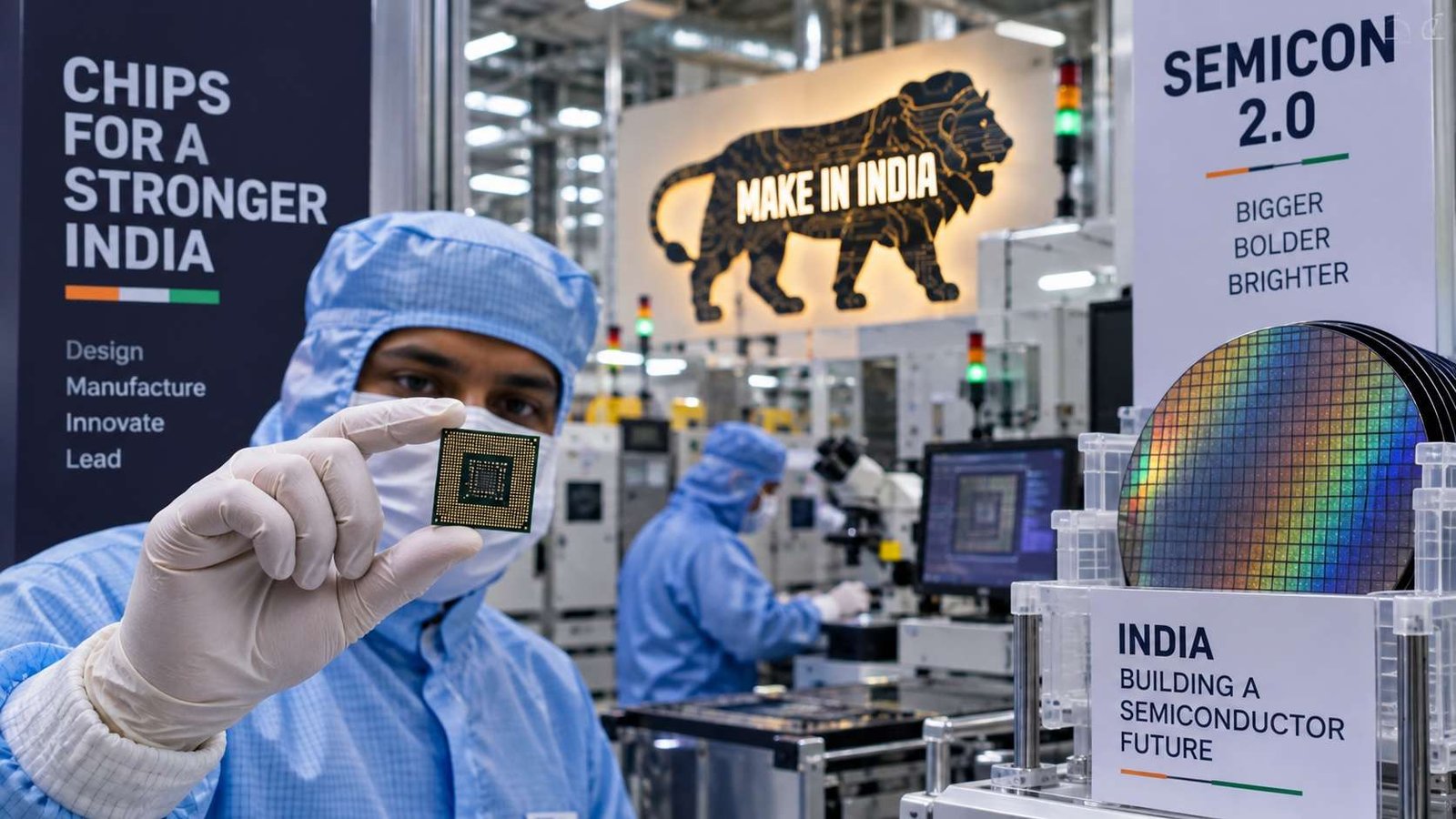
Semicon 2.0 changes the scale
The government’s original Semicon India Programme was approved with an outlay of ₹76,000 crore.
In July 2026, Semicon 2.0 was approved with a total budget outlay of ₹1,27,500 crore. The second phase expands the focus beyond fabs and assembly/testing to include equipment and materials, semiconductor design, Indian intellectual property, applied research and talent.
The distinction is important.
A semiconductor ecosystem cannot be built simply by constructing a factory.
A modern chip supply chain requires:
- specialised equipment;
- ultra-pure materials and chemicals;
- industrial gases;
- wafer manufacturing;
- chip design;
- electronic design automation tools;
- intellectual property;
- assembly and testing;
- advanced packaging;
- research laboratories;
- skilled engineers and technicians;
- reliable power and water;
- logistics; and
- customers capable of absorbing the output.
India is therefore trying to build an ecosystem rather than a single factory.

The country is already producing chips
Perhaps the biggest change in India’s semiconductor story in 2026 is that it is no longer entirely about future announcements.
At SEMICON India 2026 in New Delhi, the government said five commercial semiconductor ATMP units were operational.
Commercial production has begun at facilities involving Micron, Kaynes Semicon and CG Semi, while commercial production lines at CDIL Semiconductor in Mohali and Suchi Semicon in Surat were virtually inaugurated on September 17.
Micron’s Sanand facility is also producing DRAM and NAND products commercially, according to Micron’s CEO at SEMICON India 2026.
That is an important psychological shift.
India’s semiconductor conversation is moving from:
“When will India make chips?”
to:
“How quickly can India’s semiconductor ecosystem scale?”
The second question is much more useful.
Gujarat is emerging as a major semiconductor cluster
Gujarat has become one of the most important locations in India’s semiconductor programme.
Micron is developing its Sanand facility for assembly and testing of memory products. CG Power’s semiconductor operation is also in Sanand.
Meanwhile, Tata Electronics is developing a 300mm semiconductor fab at Dholera in partnership with Taiwan’s Powerchip Semiconductor Manufacturing Corporation.
The Dholera project has an estimated investment of more than ₹91,000 crore and planned capacity of approximately 50,000 wafer starts per month.
That is a fundamentally different capability from simply importing finished chips.
And Gujarat is not alone.
Tata’s semiconductor assembly and testing facility in Morigaon, Assam, is planned with a capacity of around 48 million units per day, while semiconductor projects are also being developed in Uttar Pradesh, Odisha, Punjab and Andhra Pradesh.
The emerging geography therefore extends beyond one industrial corridor.
India’s real advantage may be talent
Factories attract headlines.
People determine whether the factories succeed.
India has recognised this by expanding semiconductor education and training.
A July 2026 government update said more than 100,000 engineers had been trained, while 68,000 people had been skilled in chip design and 175 chip designs had been taped out under semiconductor talent-development initiatives.
Government programmes have also expanded access to advanced electronic design automation tools across hundreds of institutions.
This matters because semiconductor manufacturing is not simply a construction project.
A cleanroom can be built with capital.
A mature semiconductor workforce takes years to develop.
Why the world is looking at India
The global semiconductor industry is undergoing a structural rethink.
The pandemic exposed supply-chain weaknesses. Geopolitical competition has added another layer of uncertainty. Governments in the United States, Europe, Japan and elsewhere are supporting domestic or allied semiconductor capabilities.
Companies therefore have an incentive to diversify.
India’s proposition is straightforward:
large domestic demand + engineering talent + government support + expanding manufacturing capability + an established technology-services ecosystem.
That combination gives India an opportunity to become an important node in the global semiconductor network.
But “important node” is different from “replacement for Taiwan” or another existing semiconductor powerhouse.
India does not yet possess the entire depth of the world’s most advanced semiconductor manufacturing ecosystem.
And that distinction should remain clear.
The difficult part begins now
Government support can attract investment.
It cannot automatically guarantee competitiveness.
Semiconductor manufacturing requires extremely high yields, dependable infrastructure, precision engineering, specialised suppliers and continuous technological upgrades.
India will also have to compete with established semiconductor ecosystems that have spent decades developing supplier networks and manufacturing expertise.
There is another challenge: cost.
Producing chips domestically can improve resilience, but resilience and lowest-cost production are not always the same thing.
India’s semiconductor strategy will therefore have to balance national security, supply-chain resilience and commercial competitiveness.
That is where execution becomes more important than slogans.
The international opportunity
The opportunity extends beyond supplying India’s own electronics industry.
If Indian facilities can consistently produce high-quality chips, packages and components at globally competitive standards, India can become part of international semiconductor supply chains.
That could create opportunities for Indian companies in areas ranging from automotive electronics and power management to telecommunications, industrial equipment, consumer electronics and defence.
It could also deepen India’s role in the global technology economy.
The country’s existing semiconductor design workforce provides a useful bridge between software engineering and hardware manufacturing.
That combination could become one of India’s distinctive strengths.

Doonited Editorial Perspective
India’s semiconductor ambition should neither be dismissed as government hype nor treated as an inevitable success story.
The evidence shows that something substantial is happening.
There is large-scale public funding. Major international and Indian companies are investing. Commercial production has begun. Design talent is already significant. New fabs and packaging facilities are progressing.
But semiconductor leadership is measured in years of reliable production, technology depth, yields, intellectual property, supplier ecosystems and global customer confidence — not the number of foundation stones or investment announcements.
The next decade will therefore be less about announcing India’s semiconductor ambition and more about executing it.
India does not need to manufacture every chip used in the world.
It needs to become too capable, too connected and too strategically useful to be left out of the global semiconductor supply chain.
That is a more realistic — and potentially more durable — ambition.
The Doonited Insight
The most important development in India’s semiconductor story may not be the size of a single investment.
It is the transition from designing chips for the world to increasingly making, packaging and testing them in India.
For a country that imports most of the chips it consumes, that is a meaningful structural change.
And if India can connect its engineers, factories, research institutions, suppliers and global customers into one functioning ecosystem, the country’s semiconductor story could become much larger than the chip itself.
It could become an industrial story about who builds the infrastructure of the next digital economy.

World Beyond the News
Bees Communicate Where Food Is
Honeybees use movement patterns known as waggle dances to communicate information about food locations.
Street Food Reflects Local History
Many famous street foods developed from migration, trade, local ingredients and the everyday needs of working communities.
A Day on Venus Is Extremely Long
Venus rotates so slowly that one rotation relative to distant stars takes longer than its trip around the Sun.
Human Achievement Continues to Push Limits
Athletes, engineers, scientists and explorers regularly establish new benchmarks in speed, endurance, scale and precision.