
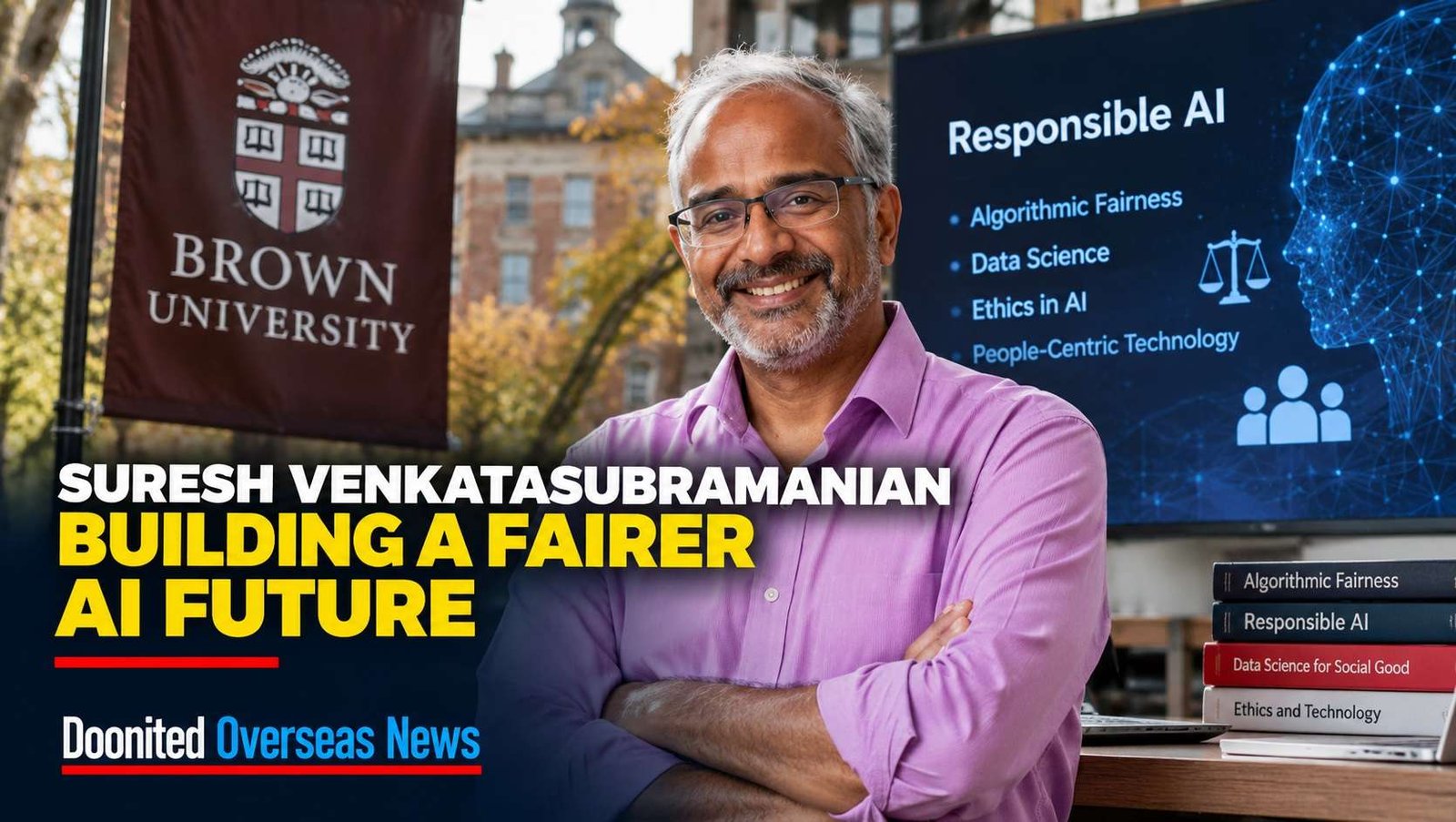
Suresh Venkatasubramanian: The Indian-American Computer Scientist Asking Who AI Really Works For
From IIT Kanpur and Stanford to the White House and Brown University, Suresh Venkatasubramanian has spent his career examining what happens when algorithms make decisions about real people. His work on algorithmic fairness is becoming increasingly relevant to Indians and diaspora communities living in a world where AI is entering hiring, lending, policing, healthcare and public services.
Artificial intelligence is often presented as a technical achievement: larger models, better chips, faster computation and increasingly capable machines.
But there is another question that becomes harder to ignore as AI moves into everyday decision-making:
What happens when an algorithm is wrong — and who bears the consequences?
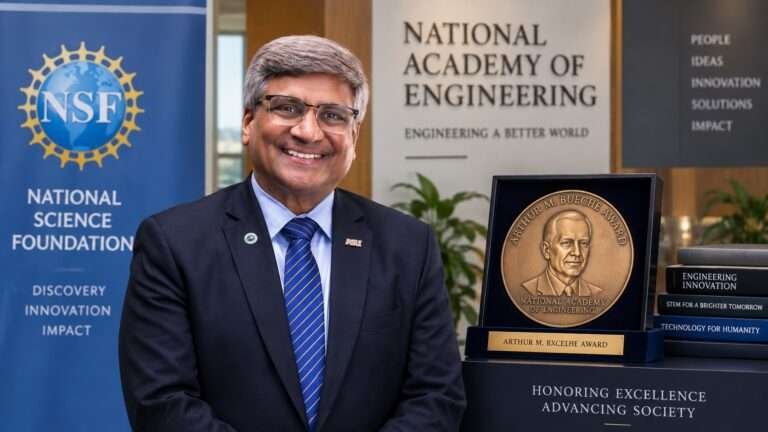
That question has been central to the career of Suresh Venkatasubramanian, an Indian-American computer scientist and professor at Brown University whose work sits at the intersection of algorithms, machine learning, law, public policy and social justice.
Venkatasubramanian is currently Brown University’s Dean’s Professor of Data Science and Computer Science, Professor of Humanities, Deputy Director of the Data Science Institute and Director of the Center for Technological Responsibility, Reimagination, and Redesign (CNTR). His research focuses particularly on algorithmic fairness and the impact of automated decision-making systems on society.
His story is particularly relevant to Doonited Overseas because it represents a different kind of Indian global achievement. He is not building an AI company or leading a technology giant. He is helping examine the rules, assumptions and social consequences behind the technology.
From New Delhi to IIT Kanpur and Stanford
Venkatasubramanian’s route into American technology and academia began in India.
In an autobiographical profile, he says he did most of his schooling in New Delhi at Mount St. Mary’s before studying computer science at the Indian Institute of Technology Kanpur. He subsequently earned his PhD at Stanford University in 1999. Users CS Utah
His early academic work was rooted in theoretical computer science, particularly algorithms and computational geometry. He later worked at AT&T Labs before moving into academia, first at the University of Pennsylvania and then the University of Utah.
Over time, his interests expanded from the mathematics of algorithms to a much larger question: how do automated systems affect people?
Brown describes his research today as focusing on algorithmic fairness and the societal impact of automated decision-making. His work has also included privacy, data mining, machine learning and auditing of black-box models. Data Science Institute
That transition is important.
Algorithms were once largely invisible infrastructure operating behind search engines and software applications. Today, algorithmic systems can influence whether somebody receives a loan, gets selected for an interview, qualifies for a public benefit or is subjected to additional scrutiny.
The consequences are therefore no longer purely computational.
The White House and the AI Bill of Rights
Venkatasubramanian’s academic work eventually took him into the US government.
During the 2021–2022 academic year, he served as Assistant Director for Science and Justice at the White House Office of Science and Technology Policy. Brown says he helped co-author the Blueprint for an AI Bill of Rights, released in 2022.
The Blueprint was not a federal law and did not itself create enforceable rights. Instead, it established a set of principles for designing and deploying automated systems in ways intended to protect the public.
Its central ideas included protections against unsafe or ineffective automated systems, safeguards against discrimination, privacy protections, notice and explanation, and the ability to opt out of automated systems in certain contexts.
For Venkatasubramanian, the issue was not that algorithms were inherently bad.
It was that automated decision-making can reproduce or amplify existing problems if systems are poorly designed, inadequately tested or deployed without meaningful accountability.
Taking the AI debate to Congress
After leaving the White House, Venkatasubramanian continued to make the case for stronger safeguards.
In March 2023, he testified before the US Senate Committee on Homeland Security and Governmental Affairs about AI’s risks and opportunities. His testimony focused on the need for proactive regulation and protections around AI-based systems.
His underlying argument was straightforward: AI should be treated as technology rather than something mysterious or inherently trustworthy.
That sounds obvious, but it has significant policy implications.
A sophisticated AI system can produce convincing answers while still making errors. A predictive model can appear statistically successful while producing unequal outcomes for particular populations. A system can be technically accurate while being inappropriate for the decision it has been asked to make.
The question therefore becomes not only “Does the model work?” but also “Does it work fairly, for whom and in what circumstances?”
Brown’s new laboratory for technological responsibility
At Brown University, Venkatasubramanian now directs CNTR, an interdisciplinary centre dedicated to examining how technology can better serve society.
The centre was founded in April 2024. Brown says its mission is to rethink computer science education, research and technology around the needs and aspirations of people who have historically been left behind by technology.
Its research extends beyond conventional AI ethics.
Projects have included legislative mapping, sociotechnical evaluation of large language models and genetic-data governance. The centre also developed a Socially Responsible Computing Curriculum Handbook, bringing questions of social impact into computer science education. Brown Tech Responsibility
That educational dimension may ultimately be just as important as regulation.
If future software engineers are taught only how to make systems more powerful, but not how those systems affect people, technological progress can outpace social responsibility.
Venkatasubramanian’s approach attempts to put those questions into the training of the people who will build tomorrow’s technology.
Why algorithmic fairness matters to Indians overseas
For the Indian diaspora, algorithmic fairness is not an abstract American policy debate.
Indians and Indian-origin communities are deeply embedded in technology-driven economies across the United States, United Kingdom, Canada, Australia, Europe, the Gulf and Asia.
Many work in sectors where automated systems are already becoming influential.
Recruitment platforms increasingly use automated screening. Banks use algorithms in credit and fraud decisions. Insurance companies use data-driven risk assessments. Governments use automated systems in welfare, immigration and public administration. Healthcare increasingly relies on predictive models.
A system that treats different groups unequally can therefore affect immigrants and diaspora communities in very practical ways.
There is also a cultural and linguistic dimension.
AI systems trained predominantly on particular datasets or linguistic patterns may perform differently across languages, accents and cultural contexts. India’s enormous linguistic diversity makes this especially relevant to Indian users and Indian-origin communities operating across multilingual societies.
The diaspora therefore has a stake in whether AI systems become more inclusive — not simply whether they become more powerful.
The problem with assuming that “neutral” means fair
One of the most difficult ideas in algorithmic fairness is that removing an explicitly discriminatory variable does not necessarily remove discrimination.
An automated system may use apparently neutral information that indirectly reflects socioeconomic or demographic differences.
Historical data can also encode historical inequalities.
If an algorithm is trained on past decisions that were themselves biased, a model may learn patterns from those decisions and reproduce them at scale.
This is why fairness cannot be solved simply by telling developers to “remove bias.”
It requires examining the data, the objective being optimised, the context in which the system is used, the people affected and the mechanisms available to challenge an outcome.
Venkatasubramanian’s research sits squarely in this technical-and-social intersection. Brown identifies algorithmic fairness as his primary research area, alongside algorithms, machine learning and related areas.
The global Indian dimension
Venkatasubramanian’s career also illustrates how Indian educational institutions have become part of the global pipeline for technology policy leadership.
His path from Delhi and IIT Kanpur to Stanford, American research institutions, the White House and Brown University spans several of the major institutions shaping the modern technology ecosystem.
But his significance for the Indian diaspora should not be reduced to the familiar “Indian succeeds in America” narrative.
The more interesting story is about knowledge moving across borders.
Indian institutions helped train the computer scientist. American universities and technology companies became platforms for his research. US government service placed him inside the policymaking process. His work at Brown now contributes to a global conversation about responsible computing.
That is a two-way relationship between India and the world rather than a simple story of migration.
AI governance is entering its difficult phase
The first stage of the AI debate was largely about capability: what can these systems do?
The next stage is increasingly about deployment.
Who should be allowed to use AI for high-stakes decisions? What evidence should companies provide before deploying a system? Who audits an algorithm? What happens when an automated decision is wrong? Can a person appeal? What responsibilities should developers, governments and users have?
There are no universally accepted answers.
There is also a legitimate counterargument: excessive regulation could slow innovation, raise costs and make it harder for smaller companies or researchers to compete with large technology firms.
That tension cannot simply be wished away.
The challenge is to create safeguards that are proportionate to the risks while allowing useful technologies to develop.
Doonited Overseas Editorial View
Suresh Venkatasubramanian’s importance lies in the fact that he occupies a space between computer science and public accountability.
The Indian diaspora has produced CEOs, entrepreneurs, engineers, doctors and researchers who have helped build the digital economy. Venkatasubramanian represents another increasingly important role: the technologist who asks whether the systems being built deserve to be trusted — and what society should do when they do not.
That question will become more important as AI moves beyond chatbots and search engines into decisions affecting employment, education, healthcare, finance, immigration and public services.
For overseas Indians, the lesson is particularly relevant.
The future of AI will not be determined only by who builds the most powerful model. It will also depend on whether those systems can operate fairly across different communities, languages, countries and social circumstances.
That is where the work of Indian-origin researchers such as Venkatasubramanian becomes part of a much larger global story.

World Beyond the News
Why Elephants Stay Close to Their Herd
Elephants live in highly social family groups and use calls, touch and body movements to maintain strong bonds.
Most of the Deep Ocean Remains Difficult to Explore
Extreme pressure, darkness and distance make deep-ocean exploration one of Earth’s greatest scientific challenges.
Spacecraft Can Travel Without Traditional Roads
Spacecraft use carefully calculated trajectories and gravity assists to travel enormous distances through space.
Why Movie Trailers Are Released in Stages
Major films often use teaser trailers, full trailers and final promotional spots to build awareness over time.