
Gopal Vittal Re-Elected GSMA Chair Until 2028: An Indian Leader at the Centre of the Global Connectivity Debate
An Indian telecom executive will continue to help shape the global mobile industry’s agenda as it faces the next wave of artificial intelligence, digital platforms and security challenges.
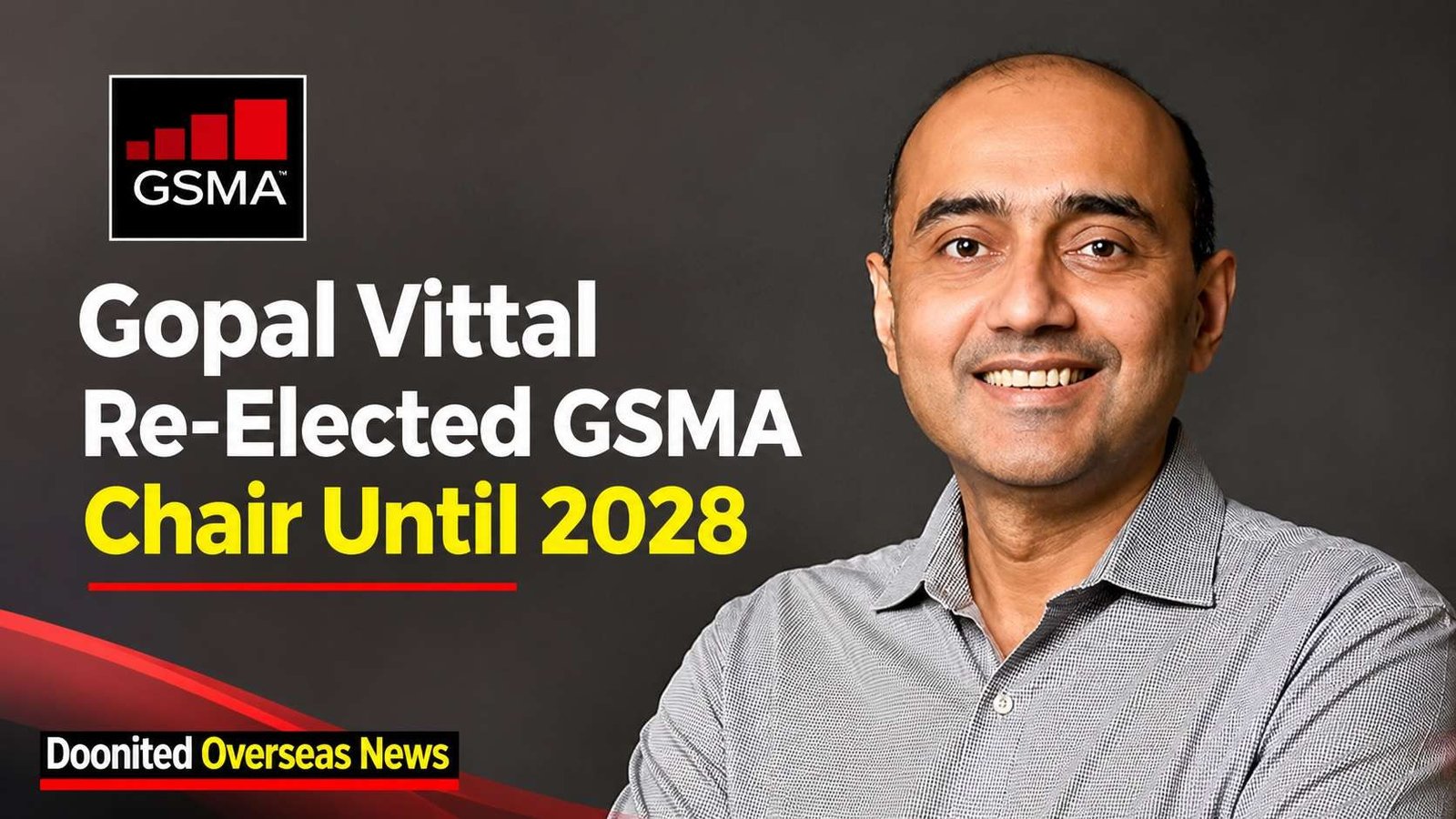
An Indian executive has secured another important leadership role in the global technology industry. The GSMA Board of Directors has re-elected Gopal Vittal, Executive Vice Chairman of Bharti Airtel, as its Chair for the 2027–2028 term, extending his tenure until December 2028.
The decision, announced on November 2, 2026, gives Vittal a second term as Chair after he first took the position in 2025. He has served on the GSMA Board for around a decade. The Board has also elected Vodafone Group CEO Margherita Della Valle as co-Deputy Chair, alongside Ralph Mupita, President and CEO of MTN Group, who has been re-elected.
The appointment is significant for India’s standing in the international telecommunications industry. But its relevance extends beyond corporate recognition: mobile connectivity has become essential infrastructure for people living across borders, including millions of Indians who depend on digital networks to maintain family relationships, work, study and operate businesses internationally.
What is the GSMA, and why does its leadership matter?
The GSMA is an international association representing mobile network operators and organisations across the wider mobile ecosystem. Its membership includes companies involved in telecommunications, devices, software, equipment and related services.
Its Board sets the organisation’s strategic direction and identifies areas where coordinated industry action can achieve more than individual companies working independently. The Chair therefore has an influential industry leadership role, but the GSMA is not a government regulator. It does not independently decide national spectrum policy, telecom tariffs, immigration rules or consumer regulations.
The distinction matters. Vittal’s re-election does not automatically mean cheaper international roaming or new benefits for overseas Indians. Its importance lies in the influence the GSMA can exercise over industry-wide priorities, technical cooperation and shared approaches to emerging challenges.
From 5G expansion to AI: the industry’s next test
Vittal’s comments following the re-election point to three connected priorities: advanced networks, artificial intelligence and open digital platforms. He also identified security as the industry’s leading concern, referring to threats against nations, scams targeting customers and the need for a sustainable mobile industry capable of continuing investment.
These priorities reflect a sector undergoing a major transition. Mobile operators are no longer competing only on call quality, coverage and data prices. They are investing in 5G, cloud infrastructure, enterprise connectivity, cybersecurity and digital services, while exploring how AI can improve network operations and create new commercial opportunities.
The scale is substantial. According to the GSMA’s Mobile Economy 2026 report, mobile technologies and services generated an estimated $7.6 trillion in economic value in 2025, equivalent to 6.4 per cent of global GDP. The organisation projects that the contribution could reach $11.3 trillion by 2030.
That economic footprint makes decisions about connectivity relevant to businesses, governments and consumers across continents.
Why overseas Indians should pay attention
For overseas Indians, a mobile connection is often much more than a communication service. It is the link between a family in India and relatives living in the Gulf, Europe, North America, Africa, Southeast Asia or Australia. It supports video calls, digital payments, remote work, international business coordination and access to online services.
Three areas of the GSMA’s agenda deserve particular attention.
First, digital security. Scams, identity theft, fraudulent messages and social-engineering attacks increasingly exploit the same communication channels people rely on every day. Overseas Indians managing finances in more than one country, sending money to relatives or handling sensitive work communications can be exposed to risks on both sides of a border. Better industry cooperation on network-level security and fraud prevention could help, although actual consumer protection will also depend on national regulators, banks, platforms and law-enforcement agencies.
Second, cross-border connectivity. International roaming, reliable networks and seamless access to digital services remain practical concerns for frequent travellers, students, migrant workers and business owners. Industry coordination can influence technical standards and the way services develop, but roaming prices and consumer entitlements are still shaped by operators, commercial agreements and national rules. Vittal’s appointment should not be interpreted as a promise of immediate price reductions.
Third, digital inclusion. Connectivity is not meaningful if people cannot afford a suitable device, understand how to use online services or access networks reliably. The GSMA has repeatedly highlighted the gap between mobile broadband coverage and actual usage. Its 2025 connectivity research found that a large share of people who remain offline live in areas where mobile broadband is already available. Affordability, digital skills and safety remain important barriers.
For diaspora communities, inclusion also means making digital services accessible to people with different languages, levels of digital literacy and financial circumstances.
An Indian executive in a global industry role
Vittal’s career gives him experience across several major markets and business functions. Before joining Airtel, he spent close to two decades at Hindustan Unilever, working in sales, marketing and general management across markets including India, Thailand, Indonesia and China. At Airtel, he led the company as Managing Director and CEO for 12 years before moving into the Executive Vice Chairman role in January 2026.
He also serves as Non-Executive Chair of Airtel Africa and Airtel Payments Bank, and as a Non-Executive Director on the BT Group Board. His experience therefore spans telecom operations, consumer businesses, digital services and international corporate governance.
His re-election also places two senior executives from major African and European telecom groups alongside him in the GSMA leadership: Ralph Mupita of MTN and Margherita Della Valle of Vodafone. That combination reflects the global nature of the mobile industry and the need to consider different markets rather than treating connectivity as a single-country issue.
The real measure will be what changes for users
Leadership appointments are important markers of professional recognition, but their value ultimately depends on outcomes. The next two years will test whether the global mobile industry can translate its ambitions into safer networks, more effective protection against scams, meaningful AI applications and affordable access.
For overseas Indians, the most useful developments will not necessarily arrive as headline announcements. They may be reflected in more reliable international connectivity, stronger safeguards against digital fraud, better access to services and fewer barriers for people conducting everyday life across borders.
Gopal Vittal’s re-election is a notable Indian presence in global telecom leadership. The larger question is whether the industry he helps guide can make connectivity not only faster and more profitable, but also safer, more accessible and more dependable for people whose lives span countries.
World Beyond the News
Why Elephants Stay Close to Their Herd
Elephants live in highly social family groups and use calls, touch and body movements to maintain strong bonds.
Most of the Deep Ocean Remains Difficult to Explore
Extreme pressure, darkness and distance make deep-ocean exploration one of Earth’s greatest scientific challenges.
Spacecraft Can Travel Without Traditional Roads
Spacecraft use carefully calculated trajectories and gravity assists to travel enormous distances through space.
Why Movie Trailers Are Released in Stages
Major films often use teaser trailers, full trailers and final promotional spots to build awareness over time.