
India’s Chess Revolution: How a Game of 64 Squares Became a National Talent Engine
There was a time when asking an Indian child to choose a sport usually produced a predictable answer: cricket.
Chess was different. It was respected, certainly. It was associated with intelligence, concentration and perhaps the child who was unusually good at mathematics. But it was hardly a mass sporting aspiration.
That equation has changed.
Today, India is producing world-class chess players at a remarkable rate. The country’s current generation includes World Champion Gukesh D, Grandmaster R Praggnanandhaa, Arjun Erigaisi and a rapidly rising group of young players, including Divya Deshmukh.
And this is no longer simply a story about individual genius.
It is the story of an ecosystem.
The Anand effect: the first great move
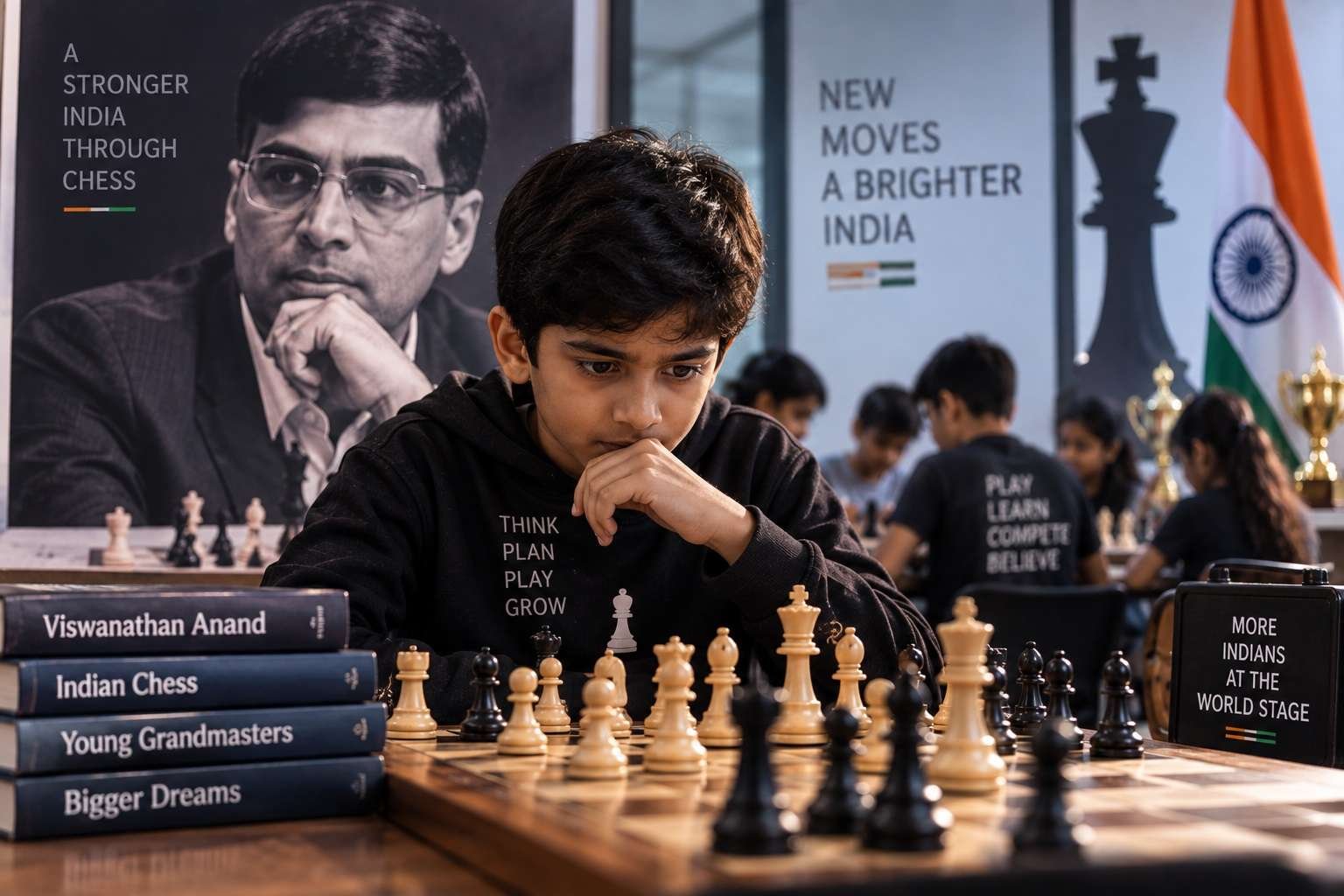
Any serious discussion of India’s modern chess transformation must begin with Viswanathan Anand.
Anand became India’s first Grandmaster in 1988 and subsequently established himself among the world’s elite, eventually becoming world champion. His success fundamentally altered the perception of chess in India.
For a generation of Indian parents, Anand demonstrated something important: chess could be more than an intellectual hobby. It could become a serious international sporting career.
The significance of Anand’s contribution is therefore difficult to measure simply through trophies.
He made chess aspirational.
The generation now challenging for the highest honours grew up in an India where a young Indian chess player could realistically imagine competing with the best in the world.
That psychological shift matters.
Then came the youngsters
The transformation became impossible to ignore in 2024.
Gukesh, then just 18, defeated Ding Liren in Singapore to become the youngest undisputed World Chess Champion in history. He won the 14-game match 7.5–6.5.
But Gukesh’s world title was not an isolated miracle.
At the 2024 Chess Olympiad in Budapest, India won both the Open and Women’s team gold medals. The men’s team featured Gukesh, Praggnanandhaa, Arjun Erigaisi, Vidit Gujrathi and Pentala Harikrishna. Gukesh and Arjun also won individual gold medals on their respective boards.
That is a much more significant indicator of India’s rise than one world championship.
One champion can be an extraordinary individual.
A gold-medal-winning team containing several world-class players suggests something much deeper.
India is producing depth, not just stars
Look at the current generation.
In the July 2026 FIDE rankings, Arjun Erigaisi was ninth in the world and Praggnanandhaa 11th, while Viswanathan Anand remained 14th.
Praggnanandhaa’s recent trajectory is particularly striking.
In August 2026, he won the Grand Chess Tour, defeating Fabiano Caruana 15–13 in the final.
He had already won the 2025 FIDE Circuit, earning qualification for the 2026 Candidates Tournament. His 2025 season included victories at Tata Steel Masters, Superbet Chess Classic Romania and the UzChess Cup Masters.
Meanwhile, Arjun has repeatedly occupied the world’s elite group. FIDE’s June 2026 ranking report noted that he had returned to the top ten after finishing runner-up at the TePe Sigeman tournament.
And the women’s game is producing its own breakthrough stories.
Divya Deshmukh won the 2025 FIDE Women’s World Cup at just 19, becoming the youngest winner in the event’s history and earning the Grandmaster title.
So India’s chess story cannot honestly be reduced to “Gukesh is the new Anand.”
It is bigger than that.
The secret weapon may be the classroom
One of the most interesting developments is happening far away from international tournament halls.
It is happening in schools.
Tamil Nadu, particularly Chennai, has developed an unusually strong chess culture. FIDE reported in January 2026 that a Chess in Education teacher-training programme at Madras Christian College was designed to help bring chess into classrooms and reach nearly 27,000 tribal children across Tamil Nadu.
This is important because elite sporting systems are rarely built at the elite level.
They are built underneath it.
A child has to discover the game before becoming a tournament player. A tournament player needs coaching before becoming a serious competitor. And a serious competitor needs competition, funding, mentorship and international exposure before becoming a potential grandmaster.
The pipeline matters.
India increasingly has one.
The smartphone quietly changed the chessboard
There is another revolution taking place simultaneously: digital access.
A child no longer needs to live next door to a famous chess academy to encounter strong competition.
Online platforms allow players to practise against opponents around the world, analyse games with powerful engines, study openings, watch grandmasters and consume instructional content.
This has dramatically reduced the importance of geography.
And artificial intelligence has changed preparation even further.
Modern chess engines can analyse positions at extraordinary depth. For elite players, engine preparation is now an integral part of serious competition.
But there is an important distinction.
Technology has democratised access to information; it has not democratised excellence.
Having an engine does not make somebody a grandmaster.
The difficult part remains human: discipline, pattern recognition, psychological resilience, preparation and thousands of hours of serious practice.
The computer can tell you that your move was bad.
It cannot do the growing up for you.
The less glamorous side of India’s chess boom
There is also a danger in turning India’s chess success into a fairy tale.
Not every child who learns chess will become a grandmaster.
Not every chess academy is equally good.
And chess should not be sold to parents as a guaranteed shortcut to academic brilliance.
The Times of India article is right to emphasise the game’s potential educational benefits, but those benefits should be described carefully. Chess encourages strategic thinking, calculation, patience and decision-making; that does not mean playing chess automatically produces higher academic achievement.
There is another issue: access.
A chessboard itself is inexpensive compared with many sports. But serious competitive chess can become expensive once coaching, tournament fees, travel, equipment and international competition enter the picture.
If India wants its chess revolution to become genuinely national rather than concentrated around established centres and financially capable families, grassroots programmes will have to remain a priority.
That is where initiatives reaching government and tribal schools become especially significant.
Chennai’s lesson for India
Perhaps the most fascinating part of India’s chess story is that Chennai keeps appearing in it.
Gukesh learned chess at school at the age of seven. He became an International Master at 11 and a Grandmaster at 12 years, seven months and 17 days.
Chennai also produced Viswanathan Anand.
But the larger lesson is not simply that Chennai produces chess champions.
It is that a local sporting culture can eventually create national competitive strength.
Schools, clubs, coaches, tournaments, families, state associations, media, sponsors and online communities reinforce one another.
Once enough pieces are on the board, the system begins producing its own momentum.
DOONITED Editorial Perspective
India’s chess story is sometimes presented as a triumph of extraordinary children.
That is only half the story.
The more important transformation is institutional and cultural.
Anand opened the door.
The internet widened it.
Schools and academies created pathways.
Families invested.
Coaches professionalised preparation.
And a generation of young Indians walked through that door believing that the world’s best players were not mythical figures living somewhere overseas.
They were opponents sitting across the board.
That is perhaps India’s biggest sporting change.
Cricket taught India to dream of winning the world.
Chess is teaching another generation that intellectual excellence can itself be a global sporting identity.
And there is a delicious irony here.
India once exported a game that travelled the world.
Today, the world is increasingly watching India play it.
The bigger insight
India’s chess revolution offers a lesson that extends far beyond chess.
World-class talent is rarely created by one superstar. It emerges when talent discovery, affordable access, education, technology, coaching and competitive opportunity begin reinforcing one another.
That is the real Indian chess story.
Gukesh may be the champion holding the crown.
But behind him stands a much larger board.
And there are already thousands of young players waiting to make their move.

World Beyond the News
Bees Communicate Where Food Is
Honeybees use movement patterns known as waggle dances to communicate information about food locations.
Street Food Reflects Local History
Many famous street foods developed from migration, trade, local ingredients and the everyday needs of working communities.
A Day on Venus Is Extremely Long
Venus rotates so slowly that one rotation relative to distant stars takes longer than its trip around the Sun.
Human Achievement Continues to Push Limits
Athletes, engineers, scientists and explorers regularly establish new benchmarks in speed, endurance, scale and precision.