
Reusable Boosters and the NGLV Race
For decades, India’s space story was built around one remarkably simple principle: build a reliable rocket, launch the satellite, and move on to the next mission.
That formula worked.
But the economics of space are changing.
Today, the world’s leading space programmes are increasingly interested in three things: more payload, lower launch costs and greater reusability.
India is now pushing into all three.
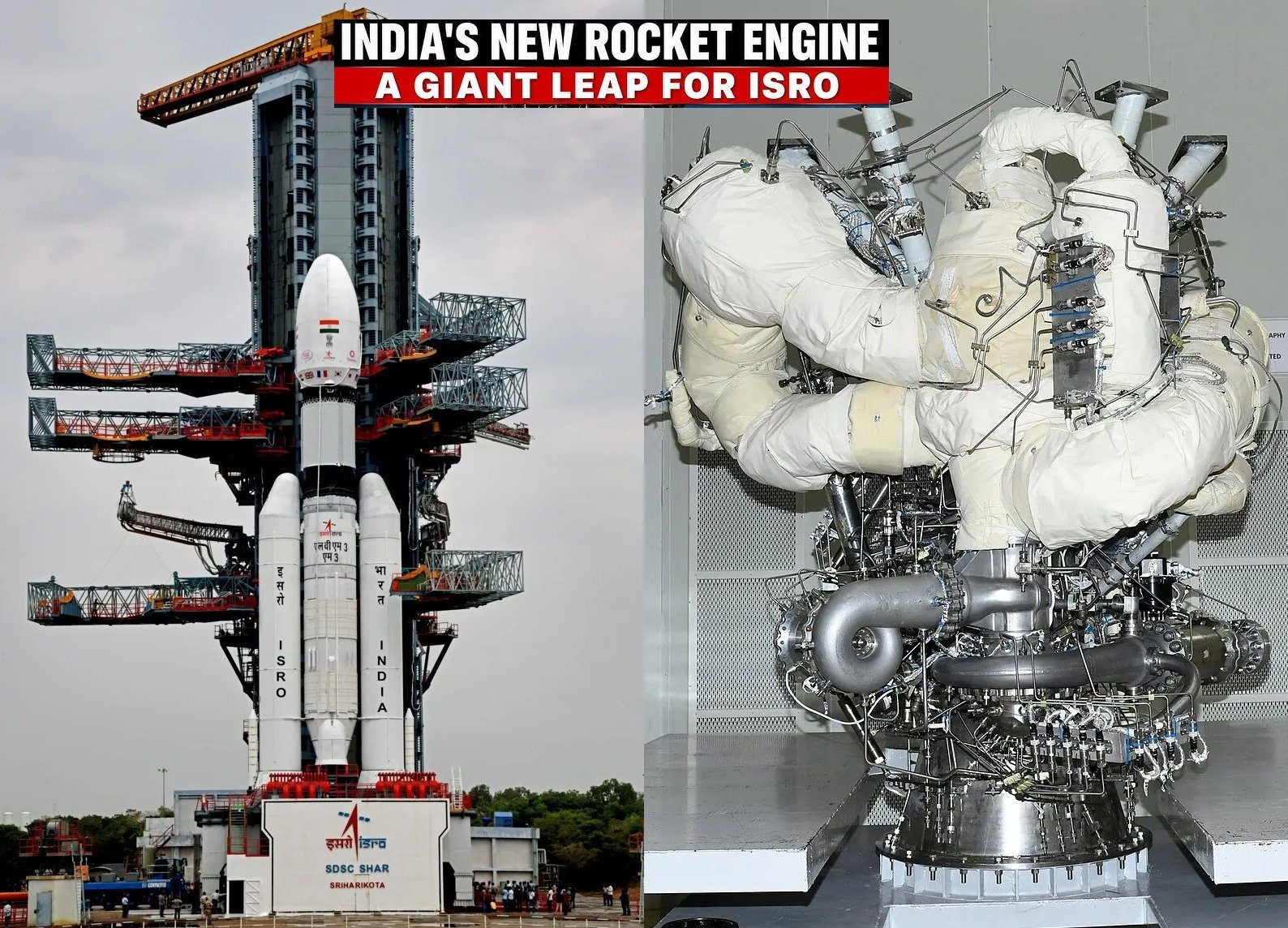
The Indian Space Research Organisation is developing a 200-tonne-thrust semi-cryogenic engine, testing technologies for recovering rocket boosters through Vertical Take-off and Vertical Landing (VTVL), and working on a partially reusable Next Generation Launch Vehicle (NGLV) powered by liquid oxygen and methane.
And in September 2026, one of those programmes crossed an important testing milestone.
ISRO successfully conducted a hot test of its semi-cryogenic engine power-head test article at the full 200-tonne thrust level at the ISRO Propulsion Research Complex in Mahendragiri, Tamil Nadu.
This is not yet a reusable rocket.
It is something more fundamental:
the machinery needed to build India’s next generation of rockets.
The 200-tonne engine: the heavy lifter’s new heart
The semi-cryogenic programme is centred on the SE2000, a 2,000-kilonewton-class engine.
ISRO is developing a semi-cryogenic propulsion stage known as SC120 to replace the current L110 core stage of the LVM3.
The objective is straightforward: increase the launch vehicle’s payload capability while improving propulsion efficiency.
The engine uses liquid oxygen (LOX) and refined kerosene, rather than the hypergolic propellants used in some older rocket stages. ISRO describes the semi-cryogenic system as a cleaner propulsion approach and intends to combine it with an uprated cryogenic upper stage.
The latest test is therefore significant.
On September 5, ISRO tested the Power Head Test Article at 100% of its 200-tonne thrust level for the first time. The test lasted 35 seconds, including five seconds at full thrust, and validated the transition of propellant supply between start and run tanks.
That may sound like engineering paperwork with a very large number attached.
It isn’t.
Engine testing is where ambitious rocket designs meet the rather unforgiving laws of physics.
And physics does not accept PowerPoint presentations.
Why more thrust matters
A more capable core stage means a launcher can potentially carry heavier payloads.
India’s existing LVM3 has already become an important heavy-lift vehicle. The semi-cryogenic upgrade is intended to increase its capability further.
Government documents say the upgraded propulsion system is expected to enhance LVM3’s payload capacity, while the SC120 stage is being developed specifically to replace the present L110 core stage.
That matters because India’s space ambitions are growing.
The country wants to support larger satellites, more demanding scientific missions, human-spaceflight objectives and eventually much more ambitious lunar activity.
You cannot keep asking an older rocket to carry increasingly ambitious dreams simply by giving it a motivational speech.
At some point, the engine has to improve.
The next challenge: bring the rocket back
Building a powerful rocket is only half the modern space-economy equation.
The other question is:
Can some of it be used again?
ISRO is therefore demonstrating VTVL—Vertical Take-off and Vertical Landing technology for recovering booster stages.
The concept will be familiar to anyone who has watched modern reusable rockets land vertically.
The booster launches upward.
After separation, instead of becoming an extremely expensive piece of falling hardware, it performs a controlled descent and lands vertically.
If the technology becomes operationally reliable, recovered stages could potentially be refurbished and flown again.
The Government of India describes VTVL booster recovery as an enabling technology for reusability and future reduction in launch costs.
But there is an important distinction.
India is demonstrating the technology; that does not mean routine reusable launches have already arrived.
Rocket reusability is not merely about making something land upright.
The difficult part is making the entire process repeatable, safe, economically worthwhile and operationally efficient.
Pushpak is another piece of the puzzle
ISRO’s reusable-launch programme also includes the winged RLV-TD, popularly associated with the Pushpak technology demonstrator.
The vehicle has already demonstrated autonomous runway landing during multiple landing experiments.
ISRO says the programme is aimed at developing technologies needed for a fully reusable launch vehicle and that the winged vehicle is configured as a test bed for technologies including hypersonic flight and autonomous landing.
The next-generation architecture is therefore not being built around one magical piece of technology.
It is more like assembling a complicated technological jigsaw puzzle.
Propulsion.
Guidance.
Aerodynamics.
Thermal protection.
Landing systems.
Structures.
Avionics.
Ground infrastructure.
And, perhaps most importantly, the ability to manufacture all of it repeatedly and reliably.
Enter the NGLV
The bigger ambition is the Next Generation Launch Vehicle.
The Government of India has approved development of an NGLV capable of carrying up to 30 tonnes to Low Earth Orbit in its planned configuration.
A partially reusable variant is envisaged with approximately 14 tonnes of payload capacity to LEO.
ISRO is also developing the technologies for a high-thrust LOX-methane propulsion system for the NGLV.
A 2026 ISRO tender confirms that the organisation is establishing infrastructure for testing LOX-methane engines, while ISRO’s 2025–26 annual report records development of key technologies for the future LME1100 engine.
Why methane?
Because methane-based propulsion is being actively explored for future reusable launch systems and can offer a useful combination of performance and operational characteristics.
But once again, India is still developing the technology.
The engine is not yet a routine flight-proven NGLV powerplant.
Why reusability changes the economics
The attraction of reusability is not simply technological glamour.
It is economics.
A traditional expendable rocket effectively throws away major hardware after every launch.
A reusable system attempts to recover and reuse expensive components.
That potentially changes the cost structure of space access.
But “reusable” does not automatically mean “cheap”.
A recovered stage needs inspection.
Components may require replacement.
Thermal and structural stresses have to be managed.
Landing systems add complexity.
Turnaround time matters.
If refurbishment becomes too expensive or slow, the economic advantage can shrink.
This is why India’s VTVL experiments are important even before they become commercial operations.
They are attempts to answer the question:
Can India make rocket reuse practical for its own launch ecosystem?
This is also about India’s private space economy
There is another dimension to the NGLV story.
India is no longer treating space as an exclusively government-operated ecosystem.
IN-SPACe has been developing policies and incentives intended to encourage private companies, startups and manufacturing capability across the space sector. The government has identified expansion of India’s space economy as a strategic objective, with a target of approximately $44 billion by 2033.
That means future launch capability will increasingly depend not only on ISRO laboratories but also on India’s industrial base.
A rocket can be brilliantly designed.
But if producing it takes too long, costs too much or depends on a small number of suppliers, the system cannot scale efficiently.
The next space race is therefore partly a manufacturing race.
India’s real challenge
India has demonstrated impressive capabilities in launch vehicles, propulsion and reusable-technology experiments.
But it would be premature to declare victory.
The NGLV still has to move from design and technology development to integrated testing, flight demonstration and eventual operational reliability.
Reusable launch technology is particularly demanding.
A successful landing is a milestone.
Repeated successful landings followed by rapid and economical turnaround are a business model.
Those are very different achievements.
DOONITED Editorial Perspective
India’s space ambitions are becoming more interesting because the question is changing.
It is no longer simply:
“Can India launch a satellite?”
India has already answered that.
The next questions are much harder:
Can India launch heavier payloads?
Can it recover expensive rocket stages?
Can it fly them again?
Can it reduce the cost of access to space?
And can Indian industry manufacture the resulting systems at scale?
The 200-tonne semi-cryogenic engine, VTVL experiments and LOX-methane NGLV are pieces of that larger puzzle.
The September 2026 200-tonne hot test is particularly encouraging because propulsion is one of the most difficult areas of launch-vehicle development. But a successful test is not the same thing as an operational engine, just as a prototype car is not yet a taxi fleet.
That distinction matters.
India does not need another headline declaring that it has “beaten” every other space power.
It needs something more valuable:
a reliable, reusable and economically competitive launch ecosystem that can keep improving generation after generation.
The real revolution will begin when recovering a rocket is no longer news.
When landing it becomes routine.
When flying it again becomes normal.
And when launching a satellite from India becomes so dependable and competitive that customers around the world stop asking whether India can do it—and start asking when their launch slot is available.
That is the destination.
The 200-tonne engine is one step toward it.

World Beyond the News
Dolphins Use Individual Signature Whistles
Bottlenose dolphins develop distinctive whistles that function somewhat like individual acoustic identifiers.
The Pacific Is Earth’s Largest Ocean
The Pacific Ocean covers more area than any other ocean basin and stretches between Asia, Australia and the Americas.
Artificial Intelligence Learns Statistical Patterns
Modern machine-learning systems identify patterns in large datasets and use those patterns to generate predictions or outputs.
Why Some Stories Spread So Quickly
Emotion, novelty, visual appeal and easy sharing can make a story travel rapidly across social platforms.